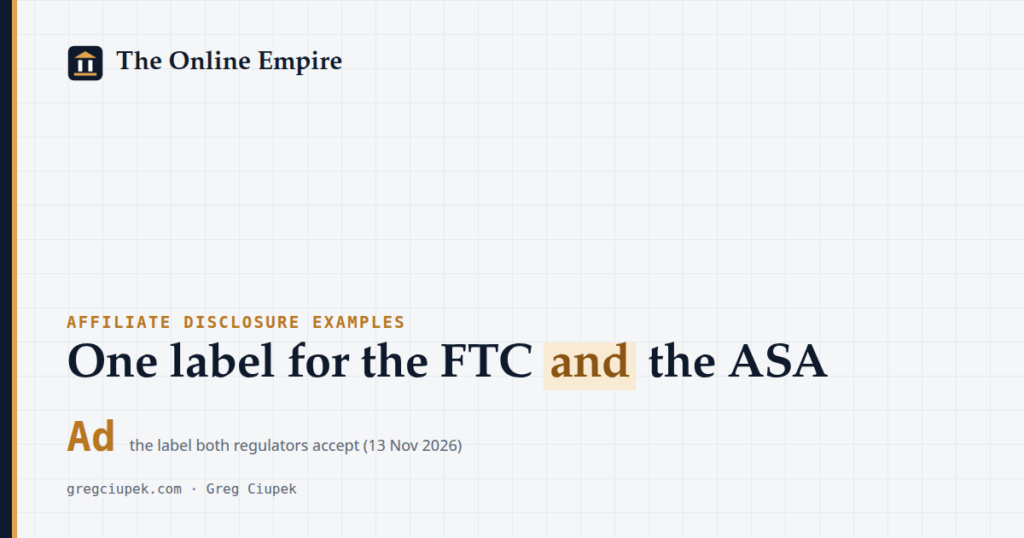
- One label works in both countries: "Ad" placed before the link or at the start of the post. The FTC accepts "ad" and "advertisement"; the UK ASA says "Ad" is usually the most appropriate label (FTC and ASA guidance, checked 13 Nov 2026).
- Say what happens, not what might: "I get paid a share of the sale." The ASA found "may earn an affiliate commission" ambiguous in a ruling of 21 Dec 2022.
- Words that fail in the UK: "Sponsored", "affiliate", "#collab", "sp", "spon", an @mention or a discount code on its own (ASA advice of 22 Mar 2023 and 6 Aug 2026).
- Placement beats wording: a footer note, a separate disclosure page, a video description alone or a caption behind "more" is not enough under 16 CFR 255.0(f) (2023 revision) or CAP Code rule 2.1.
- Cost: $0. The work is a one-time set of templates plus a check on every new post.
Contents · 6 sections
- 01Affiliate disclosure example: which wording works in the US and the UK?
- 02Affiliate disclosure example words to avoid: where the FTC and the ASA disagree
- 03How to add an affiliate disclosure, step by step
- 04Affiliate disclosure examples on this site: what gregciupek.com shows
- 05Frequently asked questions
- 06Sources
This guide is for you if you put affiliate links on a blog, a channel, a social account or a newsletter and want wording you can paste today. I read the US Endorsement Guides (16 CFR Part 255), the FTC's two plain-language guides, the UK CAP Code section 2 and two ASA advice notes on 13 Nov 2026, and mapped each example to the exact rule behind it.
It is not legal advice. The rules below are the regulators' own, linked in the sources, and when your case is unusual, ask a lawyer or read the official text. If you are new to the model, start with What is affiliate marketing.
Affiliate disclosure example: which wording works in the US and the UK?
An affiliate disclosure example that meets both FTC and ASA rules puts the word "Ad" before the reader meets the link and says plainly that you are paid a share of sales. As of 13 Nov 2026 that one pattern satisfies 16 CFR 255.5 (US, 2023 revision) and CAP Code rules 2.1 and 2.3 (UK) in every format below.
Each row is a template to copy, with the US clause and UK rule it answers. Replace the brand and product names and keep only sentences that are true for you.
| Where | Copy this | Where it goes | US rule (FTC) | UK rule (ASA/CAP) |
|---|---|---|---|---|
| Blog post, top (some links are affiliate) | "Ad: links marked (Ad) are affiliate links. If you buy through them, I get paid a share of the sale." | Above the first paragraph, before any link | § 255.5(a); § 255.5(b) Example 11 (affiliate blog); § 255.0(f) "difficult to miss" | Rules 2.1, 2.3; ASA affiliate advice (22 Mar 2023): a note at the bottom is "unlikely to be sufficient" |
| Blog post that is entirely affiliate (a roundup) | Title: "Ad | Best PRODUCT for USE". First line: "This whole article is an ad: I am paid a share of sales through every product link." | In the title, so it shows before the click, and again at the top | § 255.5(a); § 255.0(f) | Rule 2.1; affiliate advice: commercial nature "clear prior to consumer engagement", e.g. "Ad" in the title |
| Inline link | "PRODUCT at BRAND (Ad, paid link)" | Next to the link | FTC FAQ: "Paid link" next to the link "should be an adequate disclosure" | Affiliate advice: "(Ad)" before affiliate content "is likely to be acceptable" |
| Comparison table | Line above the table: "Ad: I get paid a share of sales through the buttons in this table. Brands cannot pay for a higher place." Button text: "See price at BRAND (Ad)" | Above the table, on every button | § 255.5(a); § 255.4(b) Example 3: paid rankings are deceptive even with a disclosure | Rules 2.1, 2.3: the links themselves must be identifiable as ads |
| YouTube video | Title or thumbnail: "Ad". Said and shown on screen at the start: "This video is an ad. I get paid when you buy through the links below." Description, first line: "Ad: the links below are affiliate links." | Title or thumbnail, first seconds, top of description | § 255.0(f): visual and audible; FTC FAQ: in the video itself, the description alone is "not enough on its own" | Rule 2.1; social media advice (6 Aug 2026): "Ad" in the title and/or thumbnail before the click |
| Instagram, TikTok, Facebook | Caption starts: "Ad · I get paid if you buy with my link or code." Video: "Ad" on screen from the first frame. Plus the platform's paid-partnership tool. | First words of the caption, before "more", not among hashtags | FTC Disclosures 101 (Nov 2019): not behind MORE, not in a group of hashtags, platform tool not enough alone | Rule 2.1; ASA social advice (6 Aug 2026): label upfront; a code or @mention alone fails |
| Email or newsletter | Subject (if the email is mainly a promotion): "Ad: OFFER". Body: "(Ad)" next to each affiliate link, and at the top: "Links marked (Ad) pay me a share of the sale." | Subject line and next to every affiliate link | § 255.5(a) and § 255.0(f) apply to every medium; the FAQ has no email-specific answer | Rule 2.2: unsolicited marketing email must be identifiable "without the need to open" it; rule 2.1 |
| Amazon links (both countries) | "Ad: as an Amazon Associate I earn from qualifying purchases." | On your site, near the Amazon links | Amazon Operating Agreement section 5 requires the sentence (updated 15 Oct 2025); § 255.5(a) still requires clear placement | The Amazon sentence alone has no "Ad" label; add it for UK readers (rule 2.1) |
16 CFR 255 are guides interpreting section 5 of the FTC Act (2023 revision, 88 FR 48102, 26 Jul 2023). CAP Code rules 2.3 and 2.4 also reflect practices banned by the UK's DMCC Act, enforced by the CMA (checked 13 Nov 2026).
Affiliate disclosure example words to avoid: where the FTC and the ASA disagree
Affiliate disclosure examples that pass in the US can fail in the UK, and the clearest case is "Sponsored". The FTC lists it as acceptable, while the ASA advises against it because it is "open to varied interpretation" (FTC Disclosures 101, Nov 2019; ASA social media advice, 6 Aug 2026). If your readers are in both countries, use the stricter word.
| Label | FTC (US) | ASA (UK) | Use it? |
|---|---|---|---|
| "Ad", "#ad", "Advertisement" | Acceptable; "#ad", "Ad:" and "ad" at the start are "probably all equal" | Preferred; "usually be considered the most appropriate label" | Yes, in both |
| "Sponsored", "#sponsored" | Acceptable | Advised against (Britvic ruling, 18 Nov 2015) | US only |
| "Affiliate link", "*affiliate", "aff" | People "might not understand" that it means you are paid | Insufficient (Asos ruling, 22 Apr 2020) | Only as extra words after "Ad" |
| "I may earn a commission" | Not addressed directly; must communicate the nature of the connection (§ 255.5(a)) | "Ambiguous and confusing" (MailOnline ruling, 21 Dec 2022) | No: say "I get paid" |
| "Thanks to BRAND", "#ambassador", "#collab", "sp", "spon" | "Thanks to Acme brand for the free product" is an FTC example; standalone "thanks", "ambassador", "sp", "spon", "collab" are not | Insufficient | No |
| Discount code or @mention only | Not a disclosure of payment | Insufficient (several rulings, e.g. Coco Shine, 27 Jun 2018) | No |
A disclosure page or footer does not replace the label next to the link: the FTC FAQ says one disclosure on the home page "won't be sufficient" (checked 13 Nov 2026).
How to add an affiliate disclosure, step by step
Adding an affiliate disclosure costs $0: you need a short set of templates, a place for them in your theme or editor, and a check before each post goes out. The steps follow the order in which a reader meets your content, from the title to the link, which is how both regulators frame it (checked 13 Nov 2026).
- List every paid relationship. Affiliate programs, free products, your own companies. § 255.5(a) also covers family ties and "the possibility of being paid".
- Decide the post type. An all-affiliate roundup gets "Ad" in the title; mixed content gets a top line and "(Ad)" on each affiliate link (ASA, 22 Mar 2023).
- Label the links themselves. Same size and contrast as the text around them; an ASA ruling of 18 Aug 2021 rejected a poorly contrasting label.
- Check the first screen on a phone. The label must show without tapping "more" or opening the description.
- Add the program's own sentence. Amazon requires "As an Amazon Associate I earn from qualifying purchases" (section 5, updated 15 Oct 2025); see my Amazon Associates commission rates guide.
- Add rel="sponsored" for search engines. Readers never see it, so it is never the disclosure itself. How I build and count such links is in how to create an affiliate link.
Affiliate disclosure examples on this site: what gregciupek.com shows
Affiliate disclosure examples on gregciupek.com come in three layers, as I found them with curl on 13 Nov 2026: a "Partner links" box above the article, a "Disclosure: related company" box where I own the company, and "(partner link)" next to paid links, with one exception below. The site had 39 published posts that day (WordPress REST API).
- "Partner links" box above the short-answer box, before any link: "If you use them, we may earn a commission at no extra cost to you."
- "Disclosure: related company" box from the
oe_relatedshortcode, one per company I run, linking to How we make money (updated 28 Oct 2026). - /go/ links with
rel="sponsored nofollow noopener"; 3 of 3 that I requested returned a 302 redirect to the partner with our referral code. On the newsletter-pricing article each is followed by "(partner link)"; on the AI phone assistant article the two /go/ links have no label next to them.
Two gaps against my own table on 13 Nov 2026: the partner box and How we make money say "we may earn a commission", the phrase the ASA called ambiguous in December 2022, and one article has two partner links with no label next to them. By the table, the box should say "we get paid a share of sales" and every link should carry "(Ad, partner link)".
For example, the newsletter tool I write about is one of my companies. Its link here today: NetSendo pricing (partner link). If you send a few emails a year, you may not need a paid tool at all.
Frequently asked questions
Is "#ad" at the end of a caption enough?
Usually not. The FTC warns against burying it in a group of hashtags, and the ASA expects the label upfront; only a very short post may carry it at the end (ASA advice, 6 Aug 2026).
Is a disclosure page or footer enough for an affiliate blog?
No. The FTC FAQ says a single disclosure on the home page "won't be sufficient", and the ASA says a disclaimer at the bottom of a post is unlikely to be sufficient. Keep the page, but put a label before the first link and next to each affiliate link.
Does rel="sponsored" count as a disclosure?
No. It tells search engines a link is paid, but readers never see it, and 16 CFR 255.0(f) requires a disclosure ordinary consumers easily notice.
Do I need a disclosure if the product was free and I earn no commission?
In the US, yes, if a significant minority of your audience would not expect it: § 255.5(a) names free or discounted products as a material connection. In the UK, the ASA advice of 6 Aug 2026 says any payment or other incentive makes the content an ad that must be identifiable.
Next: Affiliate marketing for beginners and the affiliate topic.
Sources
- Federal Trade Commission, Guides Concerning the Use of Endorsements and Testimonials in Advertising, 16 CFR Part 255 (88 FR 48102, 26 Jul 2023; checked 13 Nov 2026): ecfr.gov
- Federal Trade Commission, Disclosures 101 for Social Media Influencers (Nov 2019; checked 13 Nov 2026): ftc.gov
- Federal Trade Commission, FTC's Endorsement Guides: What People Are Asking (no date on page; checked 13 Nov 2026): ftc.gov
- CAP, UK Code of Non-broadcast Advertising, section 02 Recognition of marketing communications, rules 2.1–2.4 (checked 13 Nov 2026): asa.org.uk
- ASA / CAP, Online Affiliate Marketing, AdviceOnline (22 Mar 2023; checked 13 Nov 2026): asa.org.uk
- ASA / CAP, Recognising ads: Social media and influencer marketing, AdviceOnline (6 Aug 2026; checked 13 Nov 2026): asa.org.uk
- Amazon Associates, Associates Program Operating Agreement, section 5 (updated 15 Oct 2025; checked 13 Nov 2026): affiliate-program.amazon.com
- gregciupek.com, How we make money (updated 28 Oct 2026; checked 13 Nov 2026): gregciupek.com
As of 13 Nov 2026. That day I read 16 CFR Part 255 on eCFR, the FTC's Disclosures 101 and FAQ pages, CAP Code section 2, the ASA's affiliate and social media advice and section 5 of Amazon's Operating Agreement. Rulings are quoted with the dates the ASA gives for them. I checked gregciupek.com read only with curl the same day: the partner and related-company boxes, the rel attributes and redirects of three /go/ links, the How we make money page and the post count from the WordPress REST API. The gaps described in "Our numbers" were still live at the time of writing. This article is not legal advice.