- How to become a sole trader in the UK: you start trading, then register for Self Assessment with HMRC. You must register once gross trading income goes over £1,000 (about $1,338) in a tax year (6 April to 5 April).
- Deadline: tell HMRC by 5 October after the tax year you started. HMRC's registration pages list no fee (checked 8 Nov 2026), and your Unique Taxpayer Reference arrives by post in about 15 days.
- Tax year 2026/27 rates from GOV.UK: Personal Allowance £12,570, Income Tax 20% up to £50,270, Class 4 National Insurance 6% on profits from £12,570 to £50,270.
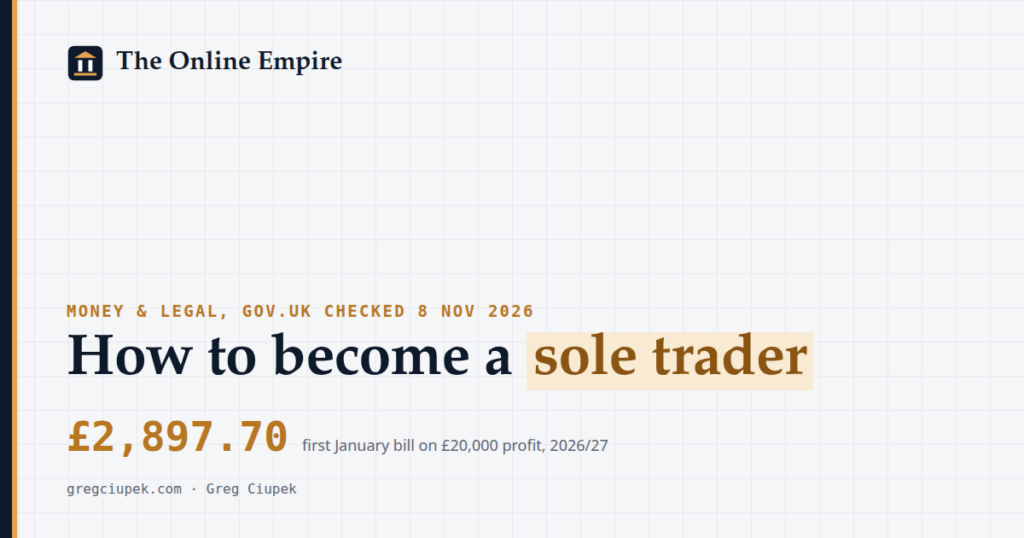
- My worked example: £20,000 profit means £1,931.80 (about $2,586) of tax and NI, but the first January bill is £2,897.70 (about $3,879) because of payments on account.
Contents · 8 sections
- 01How to become a sole trader: what does it mean in the UK?
- 02How to become a sole trader: deadlines, costs and thresholds for 2026/27
- 03How to become a sole trader step by step with HMRC
- 04How much tax does a sole trader pay? A worked example for 2026/27
- 05How to become a sole trader without a first-year cash shock
- 06How to become a sole trader and stay compliant: VAT and Making Tax Digital
- 07Frequently asked questions
- 08Sources
This guide is for you if you live in the UK, have started selling something (a service, a store, a blog with affiliate income) and want to know exactly what HMRC expects, by when and for how much. It is also for people who keep a job and run a side business in the evenings, which GOV.UK explicitly allows.
I am not a UK sole trader myself: my companies are registered in Poland, and I run UK-facing sites from there. So I did what I do with every money topic here: I read the HMRC and GOV.UK pages directly on 8 Nov 2026, built a dated table of deadlines and thresholds, and worked out the tax on three example profits line by line. This is not tax advice; GOV.UK and HMRC are the final word, and a tax adviser can check your own case.
How to become a sole trader: what does it mean in the UK?
To become a sole trader in the UK you simply start working for yourself and then register for Self Assessment with HMRC; there is no separate company to form. GOV.UK (checked 8 Nov 2026) says you must register once you earn more than £1,000 in a tax year, and that you can start trading straight away without registering first.
A sole trader is a self-employed person who owns the business personally. You keep all the profit after tax, and you carry "unlimited liability": GOV.UK says owners are personally responsible for all of the business's debts. That is the main difference from a limited company, which costs £100 to incorporate online at Companies House and is a separate legal person. I compared both forms in how to start an online business. Which of the two pays less tax at your profit level is worked out line by line in sole trader vs limited company.
GOV.UK's own test for whether you are trading is practical: you sell regularly to make a profit, make items to sell, sell regularly online or at car boot sales, or get paid for a service. If you only sell the odd unwanted item, HMRC has a separate check for occasional income.
How to become a sole trader: deadlines, costs and thresholds for 2026/27
Becoming a sole trader for the 2026/27 tax year (6 April 2026 to 5 April 2027) comes down to eight dated numbers on GOV.UK: a £1,000 registration trigger, a 5 October 2027 registration deadline, 31 January 2028 for the online return and payment, a £90,000 VAT threshold and a £20,000 Making Tax Digital threshold.
GOV.UK publishes these rules on separate pages, mostly with the dates for the 2025/26 year still being filed. I put them in one table and applied the same rules to a business that starts in 2026/27. Where a date in the right-hand column is my application of a GOV.UK rule rather than a date printed on the page, the table says so.
| Item | Rule on GOV.UK | If you start trading in 2026/27 |
|---|---|---|
| Registration trigger | Gross trading income over £1,000 in a tax year (the trading allowance) | £1,000 (about $1,338) |
| Registration cost | No fee listed on HMRC's registration pages | £0 |
| Register for Self Assessment | By 5 October after the end of the tax year | 5 Oct 2027 (rule applied) |
| UTR by post | "Around 15 days" after you register, longer from overseas | about 15 days |
| Paper tax return | 31 October after the tax year (31 Oct 2026 for 2025/26) | 31 Oct 2027 (rule applied) |
| Online tax return | 31 January after the tax year (31 Jan 2027 for 2025/26) | 31 Jan 2028 (rule applied) |
| Pay the bill | 31 January, plus 31 July for the second payment on account | 31 Jan 2028 and 31 Jul 2028 |
| National Insurance | Class 4: 6% on profits £12,570–£50,270, 2% above; no Class 2 to pay at £7,105 or more | rates for 2026/27 |
| Making Tax Digital for Income Tax | Qualifying income over £20,000 in 2026/27 means MTD from 6 April 2028 | £20,000 (about $26,770) |
| VAT registration | Taxable turnover over £90,000 in the last 12 months, or expected in the next 30 days | £90,000 (about $120,464) |
| Late filing penalty | £100 at once; after 3 months £10 a day up to £900; more after 6 and 12 months | £100 (about $134) |
If you register after 5 October, GOV.UK says HMRC gives you a filing deadline 3 months from its letter, but the tax is still due by 31 January. If you then do not pay it all by 31 January, you may get a "failure to notify" penalty based on what is still unpaid.
How to become a sole trader step by step with HMRC
Becoming a sole trader with HMRC takes six steps: check you are trading, pick a name, keep records from day one, register for Self Assessment by 5 October after your first tax year, wait about 15 days for your UTR, then file and pay by 31 January. Each step below follows GOV.UK guidance read on 8 Nov 2026.
- Check you are trading. Use GOV.UK's tests above. Gross trading income of £1,000 or less in a tax year is covered by the trading allowance, and you may not need to tell HMRC at all, though you must still keep records of it. How the allowance works against actual expenses, with three worked examples and the announced rise to £3,000 from April 2027, is in my trading allowance explainer.
- Choose a business name. You can trade under your own name or a trading name. It must not include "limited", "Ltd", "LLP" or "plc", must not be offensive and should not be too close to someone's trademark. Your own name and the business name must appear on invoices and letters.
- Keep records from the first sale. GOV.UK says you must keep records when you start trading. A separate bank account is not required by the guidance I read, but it makes the records far easier.
- Get a National Insurance number ready and register. You need one to register for Self Assessment as a sole trader. If you already have a Self Assessment record for another reason, GOV.UK says you must register again as a sole trader so you are set up for Class 2 National Insurance.
- Wait for your UTR. The 10-digit Unique Taxpayer Reference comes by post around 15 days after registration and also appears in your Personal Tax Account and the HMRC app.
- File and pay. After 5 April, send the return online by 31 January and pay by the same date. You can file any time after 5 April, which tells you the bill months early.
The £1,000 trading allowance is measured on gross income, before expenses. A side business with £1,400 of sales and £900 of costs has made only £500 of profit, but it is still over the line and must register.
How much tax does a sole trader pay? A worked example for 2026/27
A sole trader in England, Wales or Northern Ireland with £20,000 profit and no other income pays £1,486 Income Tax and £445.80 Class 4 National Insurance for 2026/27, £1,931.80 in total (9.7% of profit), using GOV.UK rates checked 8 Nov 2026. At £40,000 profit the total is £7,131.80 (17.8%).
Calculated step by step for £20,000 profit (profit = income minus allowable expenses):
- Taxable income. £20,000 − £12,570 Personal Allowance = £7,430.
- Income Tax. £7,430 × 20% basic rate = £1,486.00.
- Class 4 National Insurance. Profits over £12,570: £7,430 × 6% = £445.80.
- Class 2. Profit is above £7,105, so Class 2 is treated as paid and costs nothing.
- Total for the year. £1,486.00 + £445.80 = £1,931.80 (about $2,586).
| Profit | Income Tax | Class 4 NI | Total | Share of profit | First 31 January payment | 31 July payment |
|---|---|---|---|---|---|---|
| £5,000 | £0 | £0 | £0 | 0% | £0 | £0 |
| £20,000 | £1,486.00 | £445.80 | £1,931.80 (about $2,586) | 9.7% | £2,897.70 (about $3,879) | £965.90 |
| £40,000 | £5,486.00 | £1,645.80 | £7,131.80 (about $9,546) | 17.8% | £10,697.70 (about $14,319) | £3,565.90 |
At £5,000 the profit is under £7,105, so nothing is due, but no National Insurance year is credited either. GOV.UK lets you pay voluntary Class 2 at £3.65 a week for 2026/27, which is £189.80 for a full year, to protect your State Pension record.
If you live in Scotland, Income Tax uses Scottish bands (19% to 48% for 2026/27 on GOV.UK); National Insurance is the same across the UK.
How to become a sole trader without a first-year cash shock
A new sole trader's first January bill is usually 150% of the year's tax, because HMRC adds the first "payment on account" for the next year. GOV.UK (checked 8 Nov 2026) says each payment on account is half of last year's tax including Class 4, due 31 January and 31 July, unless that tax was under £1,000.
In my £20,000 example, the first bill on 31 January 2028 is the full £1,931.80 plus a first payment on account of £965.90: £2,897.70. Another £965.90 follows on 31 July 2028. If your profit then grows, the difference comes as a "balancing payment" the next January. At £40,000 profit the first January payment is £10,697.70, which is why I would set aside money from every invoice rather than wait for the statement.
The share of profit above (9.7% at £20,000, 17.8% at £40,000) is what I would reserve from day one, plus half again for the first January. These are calculations on GOV.UK rates, not measurements from my own businesses, which are taxed in Poland.
Payments on account are not needed if more than 80% of last year's tax was already collected outside Self Assessment, for example through a PAYE tax code from a job.
How to become a sole trader and stay compliant: VAT and Making Tax Digital
After registering, two thresholds change how a sole trader reports: VAT registration once taxable turnover passes £90,000 in a rolling 12 months, and Making Tax Digital for Income Tax from 6 April 2028 if qualifying income in 2026/27 is over £20,000. Both figures come from GOV.UK pages checked 8 Nov 2026.
The VAT test is rolling, not per tax year. GOV.UK's example: turnover passes £90,000 on 15 July, you register by 30 August and are VAT-registered from 1 September. You can also register voluntarily below the threshold to reclaim VAT on costs.
Making Tax Digital means keeping records in compatible software and sending updates to HMRC during the year. It started on 6 April 2026 for qualifying income over £50,000 (2024/25), moves to over £30,000 from 6 April 2027 and over £20,000 from 6 April 2028. Qualifying income is self-employment and property income before expenses, so a business with £20,000 profit is likely above the line. You still file a normal Self Assessment return for the year before you start.
If you sell online, GOV.UK also points to separate rules on selling goods online, importing, licences and storing personal data. For a store, my guide on how to start an online store covers the setup side.
In the US, a sole proprietor is someone who owns an unincorporated business alone (IRS, checked 8 Nov 2026). Profit goes on Schedule C with Form 1040; self-employment tax is 15.3% (12.4% Social Security, 2.9% Medicare) via Schedule SE once net earnings reach $400, with Social Security applying to the first $184,500 for 2026. If you expect to owe $1,000 or more, the IRS expects quarterly estimated payments with Form 1040-ES. A single-member LLC is often taxed the same way: see LLC for an online business.
Frequently asked questions
How long does it take to become a sole trader in the UK?
You can start trading the same day; GOV.UK says no registration is needed before you begin. Registering for Self Assessment online is a one-off form, and your Unique Taxpayer Reference arrives by post around 15 days later (GOV.UK, checked 8 Nov 2026), longer if you live overseas.
How much does it cost to register as a sole trader?
HMRC's registration pages list no fee (checked 8 Nov 2026). The costs come later: your tax and National Insurance, possibly bookkeeping software once Making Tax Digital applies, insurance and any licences your trade needs. A limited company, by comparison, costs £100 to incorporate online at Companies House.
Can I be employed and a sole trader at the same time?
Yes. GOV.UK says you can be employed and self-employed at once. Your salary uses up the Personal Allowance first, so business profit is taxed from the first pound, and you still register for Self Assessment once trading income goes over £1,000 a year.
Do I need to register if I earn less than £1,000?
Usually not: gross trading income of £1,000 or less in a tax year is covered by the trading allowance. You may still choose to register, for example to prove you are self-employed for Tax-Free Childcare or to pay voluntary Class 2 National Insurance. Keep records either way.
What happens if I miss the 5 October deadline?
GOV.UK says HMRC will give you a filing deadline 3 months from its letter, but the tax is still due on 31 January. If you do not pay it all by then, you may get a failure-to-notify penalty based on the unpaid amount. Register as soon as you can.
More on legal forms and taxes in the Money and legal topic.
Sources
- GOV.UK, Become a sole trader (updated 5 Oct 2026, checked 8 Nov 2026): gov.uk
- GOV.UK, Working for yourself (updated 5 Oct 2026, checked 8 Nov 2026): gov.uk
- GOV.UK, Check how to register for Self Assessment (updated 8 Oct 2026, checked 8 Nov 2026): gov.uk
- GOV.UK, Self Assessment tax returns: deadlines and penalties (updated 30 Sep 2026, checked 8 Nov 2026): gov.uk
- GOV.UK, Find your UTR number (updated 30 Sep 2026, checked 8 Nov 2026): gov.uk
- HMRC, Tax-free allowances on property and trading income (updated 30 Sep 2026, checked 8 Nov 2026): gov.uk
- GOV.UK, Income Tax rates and Personal Allowances (updated 1 Oct 2026, checked 8 Nov 2026): gov.uk
- GOV.UK, Income Tax in Scotland (updated 30 Sep 2026, checked 8 Nov 2026): gov.uk
- GOV.UK, Self-employed National Insurance rates (updated 27 Oct 2026, checked 8 Nov 2026): gov.uk
- GOV.UK, Understand your Self Assessment tax bill: payments on account (updated 21 Oct 2026, checked 8 Nov 2026): gov.uk
- GOV.UK, Pay your Self Assessment tax bill (updated 28 Oct 2026, checked 8 Nov 2026): gov.uk
- GOV.UK, Register for VAT (updated 6 Nov 2026, checked 8 Nov 2026): gov.uk
- HMRC, Find out if and when you need to use Making Tax Digital for Income Tax (updated 13 Oct 2026, checked 8 Nov 2026): gov.uk
- HMRC, Work out your qualifying income for Making Tax Digital for Income Tax (updated 13 Oct 2026, checked 8 Nov 2026): gov.uk
- GOV.UK, Set up a private limited company: register your company (updated 14 Oct 2026, checked 8 Nov 2026): gov.uk
- IRS, Sole proprietorships (checked 8 Nov 2026): irs.gov
- IRS, Self-employment tax (Social Security and Medicare taxes) (reviewed 30 Oct 2026, checked 8 Nov 2026): irs.gov
- IRS, Estimated taxes (reviewed 25 Sep 2026, checked 8 Nov 2026): irs.gov
- European Central Bank, Euro foreign exchange reference rates (6 Nov 2026): ecb.europa.eu
As of 8 Nov 2026. I read every GOV.UK and HMRC page above through the GOV.UK content API on 8 Nov 2026 (rates and thresholds for the 2026/27 tax year) and the IRS pages the same day. The 2026/27 filing and payment dates are GOV.UK's rules applied to a business started in 2026/27; GOV.UK's pages print the 2025/26 dates. The £5,000, £20,000 and £40,000 profits are examples, assuming the standard Personal Allowance, no other income and residence outside Scotland. Pounds converted at ECB reference rates of 6 Nov 2026 (about $1.34 to the pound). Not tax or legal advice: check your own case with HMRC or a tax adviser.