- On 2026/27 GOV.UK rates, a one-person limited company that pays out all its profit costs more tax than being a sole trader at every profit I tested from £20,000 to £150,000 (about $26,770 to $200,773), apart from a £400 window around £60,000 where the gap is under £5.
- At £40,000 profit: sole trader £7,131.80 (about $9,546) of Income Tax and NI, limited company £8,367.30 (about $11,200) of employer NI, Corporation Tax and dividend tax.
- The reasons are dated: dividend tax rose to 10.75% and 35.75% from 6 April 2026, employer NI is 15% above £5,000, and a sole-director company cannot claim the £10,500 Employment Allowance.
- A company still wins on tax you pay now if you leave profit inside it: at £60,000 profit, £9,931.45 instead of £13,888.60, a deferral of about $5,298, not a saving.
- Not tax or legal advice. The US has no "limited company"; there you compare a sole proprietorship, an LLC and an S or C corporation.
Contents · 8 sections
- 01Sole trader vs limited company: which pays less tax in 2026/27?
- 02Sole trader vs limited company: how the company side is calculated
- 03Sole trader vs limited company: costs, deadlines and paperwork side by side
- 04Sole trader vs limited company: what the Companies House feed shows in one week
- 05Sole trader vs limited company: when does a company still make sense?
- 06Sole trader vs limited company in the US: what is the equivalent?
- 07Frequently asked questions
- 08Sources
This comparison is for you if you make money from a store, a blog or a service in the UK and keep hearing that "going limited" saves tax. I read the GOV.UK and HMRC pages on 9 Nov 2026, calculated both forms line by line at four profit levels, then scanned every £50 up to £200,000.
I run my businesses through companies in Poland (JG INVEST P.S.A. publishes this site), so none of this is my own UK tax bill. What I do have is a live feed of Companies House filings behind our UK register project, Companies Daily, which shows how many companies open and close in a week. GOV.UK, HMRC and a tax adviser are the final word on your case.
Sole trader vs limited company: which pays less tax in 2026/27?
Sole trader vs limited company in 2026/27: on GOV.UK rates checked 9 Nov 2026, a sole trader pays less total tax than a one-person company that pays out all its profit at £20,000, £40,000 and £100,000 of profit, and about the same at £60,000. The company only pays less now if you leave profit inside it.
I compared the two forms on the same pre-tax business profit, before the owner takes any pay. The company pays its director a £12,570 salary (it uses the Personal Allowance and costs no employee NI), pays Corporation Tax on what is left, and pays the rest out as dividends. The last column shows the tax if you take only the salary and keep the rest in the company.
| Business profit | Sole trader: Income Tax + Class 4 NI | Limited company, all profit paid out | Company costs more by | Limited company, profit left inside |
|---|---|---|---|---|
| £20,000 (about $26,770) | £1,931.80 (9.7%) | £2,825.80 (14.1%) | £894.00 (about $1,197) | £2,331.45 (11.7%) |
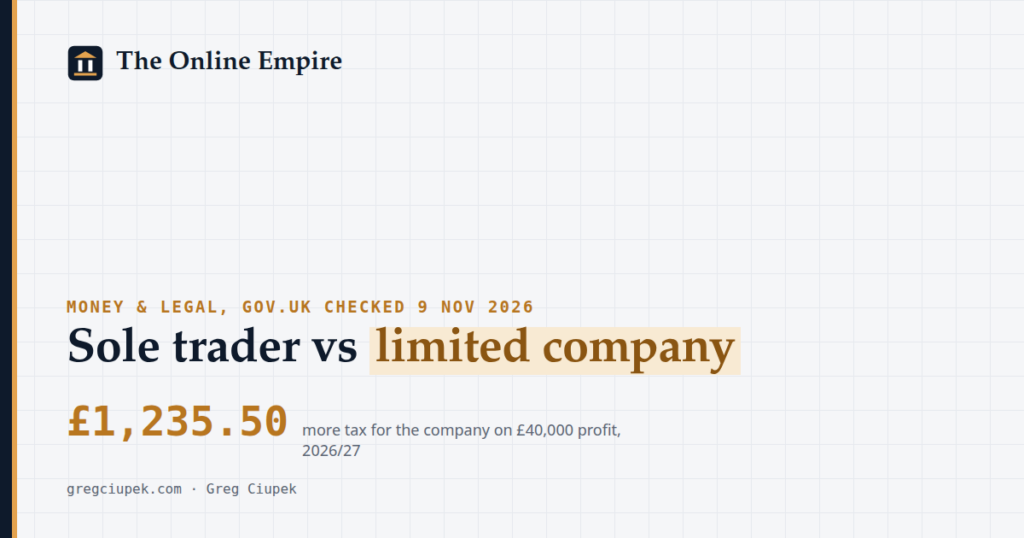
| £40,000 (about $53,540) | £7,131.80 (17.8%) | £8,367.30 (20.9%) | £1,235.50 (about $1,654) | £6,131.45 (15.3%) |
| £60,000 (about $80,309) | £13,888.60 (23.1%) | £13,908.80 (23.2%) | £20.20 (about $27) | £9,931.45 (16.6%) |
| £100,000 (about $133,849) | £30,688.60 (30.7%) | £34,790.38 (34.8%) | £4,101.78 (about $5,490) | £20,253.54 (20.3%) |
To check the corners, I ran the same model at every £50 of profit from £15,000 to £200,000. The company came out cheaper only between about £60,150 and £60,550, by at most a few pounds, which a single accountant's invoice wipes out. At £125,140, where the sole trader has lost the whole Personal Allowance, the company still cost £1,782.93 more. I also tried a £5,000 salary instead of £12,570: it made the company £462.80 dearer at £40,000 and £797.49 dearer at £60,000.
Articles that show big savings from "going limited" often use earlier years' dividend or employer NI rates, or assume the Employment Allowance. GOV.UK lists 10.75% and 35.75% from 6 April 2026, employer NI is 15% for 2026/27, and the allowance is not available when a company's only director is its only employee paying secondary NI.
Sole trader vs limited company: how the company side is calculated
A sole trader vs limited company calculation for the company side has four taxes stacked on each other: employer National Insurance on the salary, Corporation Tax at 19% on profits up to £50,000, then dividend tax at 10.75% in the basic band after a £500 allowance. Here is £40,000 of profit, using 2026/27 rates checked 9 Nov 2026.
- Director's salary. £12,570. It equals the Personal Allowance and the employee primary threshold, so the director pays no Income Tax and no employee NI on it.
- Employer NI. 15% on salary above the £5,000 secondary threshold: (£12,570 − £5,000) × 15% = £1,135.50. No Employment Allowance, because the sole director is the only employee.
- Company profit. £40,000 − £12,570 − £1,135.50 = £26,294.50, since both salary and employer NI are deductible costs.
- Corporation Tax. Profit is under £50,000, so the 19% small profits rate applies: £4,995.95. That leaves £21,298.54 to pay out as dividends.
- Dividend tax. The first £500 is covered by the dividend allowance; the rest sits in the basic band: £20,798.54 × 10.75% = £2,235.84.
- Total. £1,135.50 + £4,995.95 + £2,235.84 = £8,367.30 (about $11,200), against £7,131.80 for a sole trader on the same £40,000.
Above £50,000 of company profit, HMRC's marginal relief applies: tax at 25%, minus 3/200 of the gap to £250,000. HMRC's manual (CTM03910) lists that fraction up to the year starting 1 April 2025; I used the same fraction for 2026 because GOV.UK still shows the same 19% and 25% rates and the same £50,000 and £250,000 limits, which is what the fraction is derived from in CTM03925. At £100,000 of business profit that gives £19,118.04 of Corporation Tax.
Sole trader vs limited company: costs, deadlines and paperwork side by side
Sole trader vs limited company on paperwork: a sole trader registers for Self Assessment free and files one return a year, while a limited company costs £100 to incorporate, £50 a year for the confirmation statement, and files accounts, a Company Tax Return and payroll, each with its own penalty (Companies House and GOV.UK fee pages, checked 9 Nov 2026).
| Item | Sole trader | Private limited company |
|---|---|---|
| Setting up | Start trading, register for Self Assessment once trading income passes £1,000 a year; no fee listed | £100 online (about $134), usually registered within 24 hours |
| Yearly Companies House fee | None | £50 confirmation statement (about $67) |
| Liability | Unlimited: you are personally responsible for all business debts | Limited to the owners' investment |
| Tax on profit | Income Tax 20/40/45% and Class 4 NI 6%/2% | Corporation Tax 19% to £50,000, 25% above £250,000, marginal relief between |
| Paying yourself | Profit is your income | PAYE salary (company must register as employer) and dividends with a voucher and minutes for each |
| First accounts | Self Assessment return by 31 January after the tax year | Accounts to Companies House 21 months after registration; Corporation Tax due 9 months and 1 day after the period |
| Late filing penalty | £100 for a late Self Assessment return | £150 to £1,500 for late accounts (doubled if late two years running), plus £200 for a late Company Tax Return |
| Closing down | Stop trading and tell HMRC | £13 online voluntary strike-off (about $17) if solvent |
The fees are small next to the time: a company adds payroll, annual accounts and a separate tax return, and GOV.UK says directors stay legally responsible even if an accountant does the work. I did not price accountants; I found no primary source for typical fees.
Companies House's late filing guidance (updated 16 Jan 2026) says not filing accounts or confirmation statements is a criminal offence and directors can be personally fined. The automatic penalty starts at £150 the day after the deadline.
Sole trader vs limited company: what the Companies House feed shows in one week
Sole trader vs limited company is a choice thousands of people get wrong in both directions: in the working week of 2 to 6 Nov 2026, our Companies Daily feed of Companies House filings recorded 14,778 new incorporations and 20,737 dissolutions, 13,669 of them through the registrar's compulsory route rather than by the owners.
Companies House says it starts compulsory strike-off when it has reasonable cause to believe a company is no longer operating, for example when documents are outstanding and its letters go unanswered. So a large share of companies do not close because the owner decided to; they fade out after missing filings. In the same week owners sent 6,196 voluntary strike-off applications (form DS01).
Read from our Companies Daily database on 9 Nov 2026 at 14:40 Warsaw time (read-only query): Companies House filings dated 2–6 Nov 2026, counted by form type. One-week sample; the 4 Nov figures include a large weekly batch of Gazette dissolutions. Of 146,341 active companies in the database that filed anything since 1 Nov 2026, 4,351 (3.0%) were marked as having overdue accounts. That is a sample of companies with recent filings, not the whole register.
Sole trader vs limited company: when does a company still make sense?
A limited company can still beat a sole trader in 2026/27 when you do not need all the profit personally, when liability is a real risk, or when clients or investors require a company. On GOV.UK rates checked 9 Nov 2026, the tax advantage comes from leaving profit in the company, and it is a deferral until you pay dividends.
- You reinvest. If a store needs stock or a site needs paid work, profit kept in the company is taxed at 19% instead of up to 40% plus 2% NI. At £60,000 that is £9,931.45 now against £13,888.60 as a sole trader. The dividend tax arrives when you take the money out.
- You carry real liability. Physical products, staff, leases or big contracts are where "unlimited liability" bites. GOV.UK suggests insurance as another way to get protection, which may be enough for a blog or a small service.
- You stay a sole trader. If you need most of the profit to live on and your risk is low, the table above says the sole trader route pays less tax and costs less to run. You can incorporate later.
Things I did not model and which can change the answer: pension contributions, a second shareholder such as a spouse, other income, Scottish Income Tax, student loans and VAT. I set out how to register as a sole trader, with the 2026/27 deadlines, in how to become a sole trader, and the wider first steps in how to start an online business.
Sole trader vs limited company in the US: what is the equivalent?
The US equivalent of sole trader vs limited company is a sole proprietorship versus an LLC or a corporation. A sole proprietor pays 15.3% self-employment tax for 2026 (IRS, reviewed 30 Oct 2026), a C corporation pays a flat 21% (Form 1120 instructions), and a single-member LLC is taxed like a sole proprietor unless it elects otherwise.
The US version of "salary plus dividends" is the S corporation. The IRS says an S corporation must pay a shareholder-employee reasonable compensation before making non-wage distributions, and that it can reclassify distributions as wages, which are subject to employment taxes. In other words, the same trap as in the UK: the saving depends on how much you can fairly leave out of payroll. The Social Security part of the 15.3% applies to the first $184,500 of combined earnings in 2026. I compared state LLC costs in LLC for an online business.
Frequently asked questions
Is it cheaper to be a sole trader or a limited company in 2026/27?
For one person who takes all the profit out, my calculation on GOV.UK rates (checked 9 Nov 2026) found the sole trader cheaper at every profit from £20,000 to £150,000, except a narrow window around £60,000 where the two are within a few pounds. The company is cheaper only on tax paid now if profit stays inside it.
At what profit should I switch from sole trader to limited company?
On 2026/27 rates there is no clear tax switch-over point for full extraction: the company does not pull ahead even at £125,140. Switch for other reasons, such as reinvesting profit, liability or clients who require a company. Ask an accountant to run your own figures, including pension contributions.
What salary should a sole director take in 2026/27?
In my model, £12,570 beat £5,000 at every profit level tested: it costs £1,135.50 of employer NI but uses the full Personal Allowance with no employee NI. The £10,500 Employment Allowance is not available if the sole director is the only employee paying secondary NI (GOV.UK, checked 9 Nov 2026).
How much does it cost to run a limited company in the UK?
Companies House charges £100 to incorporate online and £50 a year for the confirmation statement (fees page updated 14 Oct 2026). Late accounts cost £150 to £1,500, and a late Company Tax Return £200. Accountant fees come on top; I did not price them.
Can I change from sole trader to limited company later?
Yes. You register the company at Companies House, which usually sets it up for Corporation Tax at the same time (GOV.UK, checked 9 Nov 2026). Moving contracts, assets and the sole trader registration across is where an adviser earns their fee.
More on legal forms and taxes in the Money and legal topic.
Sources
- GOV.UK, Income Tax rates and Personal Allowances (updated 1 Oct 2026, checked 9 Nov 2026): gov.uk
- GOV.UK, Self-employed National Insurance rates (updated 27 Oct 2026, checked 9 Nov 2026): gov.uk
- GOV.UK, Tax on dividends (updated 30 Sep 2026, checked 9 Nov 2026): gov.uk
- GOV.UK, Corporation Tax rates, expenses and reliefs (updated 23 Oct 2026, checked 9 Nov 2026): gov.uk
- HMRC, Marginal Relief for Corporation Tax (updated 30 Sep 2026, checked 9 Nov 2026): gov.uk
- HMRC, Company Taxation Manual CTM03910 and CTM03925, small profits rate and marginal relief (updated 30 Sep 2026, checked 9 Nov 2026): gov.uk
- HMRC, Rates and thresholds for employers 2026 to 2027 (updated 30 Sep 2026, checked 9 Nov 2026): gov.uk
- GOV.UK, Employment Allowance: eligibility (updated 21 Oct 2026, checked 9 Nov 2026): gov.uk
- GOV.UK, Self Assessment tax returns: deadlines and penalties (updated 30 Sep 2026, checked 9 Nov 2026): gov.uk
- GOV.UK, Become a sole trader (updated 5 Oct 2026, checked 9 Nov 2026): gov.uk
- GOV.UK, Set up a private limited company: register your company (updated 14 Oct 2026, checked 9 Nov 2026): gov.uk
- GOV.UK, Running a limited company: taking money out (updated 23 Oct 2026, checked 9 Nov 2026): gov.uk
- GOV.UK, Accounts and tax returns for private limited companies, including Company Tax Return penalties (updated 23 Oct 2026, checked 9 Nov 2026): gov.uk
- Companies House, Companies House fees (updated 14 Oct 2026, checked 9 Nov 2026): gov.uk
- Companies House, Late filing penalties (updated 16 Jan 2026, checked 9 Nov 2026): gov.uk
- Companies House, Companies House to resume compulsory strike off process (9 Oct 2020, checked 9 Nov 2026): gov.uk
- IRS, Self-employment tax (Social Security and Medicare taxes) (reviewed 30 Oct 2026, checked 9 Nov 2026): irs.gov
- IRS, S corporation compensation and medical insurance issues (reviewed 3 Mar 2026, checked 9 Nov 2026): irs.gov
- IRS, Limited liability company (LLC) (reviewed 10 Oct 2026, checked 9 Nov 2026): irs.gov
- IRS, Instructions for Form 1120 (2025), Schedule J line 1a (reviewed 30 Apr 2026, checked 9 Nov 2026): irs.gov
- European Central Bank, Euro foreign exchange reference rates (6 Nov 2026): ecb.europa.eu
- Companies Daily database of Companies House filings, read-only query (9 Nov 2026): our own data, not yet public.
As of 9 Nov 2026. I read every GOV.UK, HMRC and Companies House page above through the GOV.UK content API on 9 Nov 2026, and the IRS pages the same day. The tax figures are my calculation for the 2026/27 tax year: one owner, standard Personal Allowance, no other income, outside Scotland, a 12-month company accounting period inside the financial year from 1 April 2026, no associated companies, no pension contributions, salary £12,570 and the rest paid as dividends in the same tax year. The 3/200 marginal relief fraction for the 2026 financial year is my application of HMRC's method. Pounds converted at ECB reference rates of 6 Nov 2026 (about $1.34 to the pound). Companies House counts come from our own database, queried on 9 Nov 2026. Not tax or legal advice: check your case with HMRC, the IRS or a qualified adviser.