- AI API costs are billed per million tokens, separately for input and output. On the Anthropic, OpenAI and Google price pages I read on 14 Nov 2026, standard prices ran from $0.10 to $10 per million input tokens and $0.50 to $50 per million output tokens across ten current models.
- A 1,500-word article (3,000 input and 2,250 output tokens, my assumption) costs about $0.0014 on Claude Haiku 5.5 or gpt-6-luna prices, $0.0285 on Claude Sonnet 5.5 or gpt-6.1-sol and $0.14 on gpt-6-astra. Writing is never the expensive part.
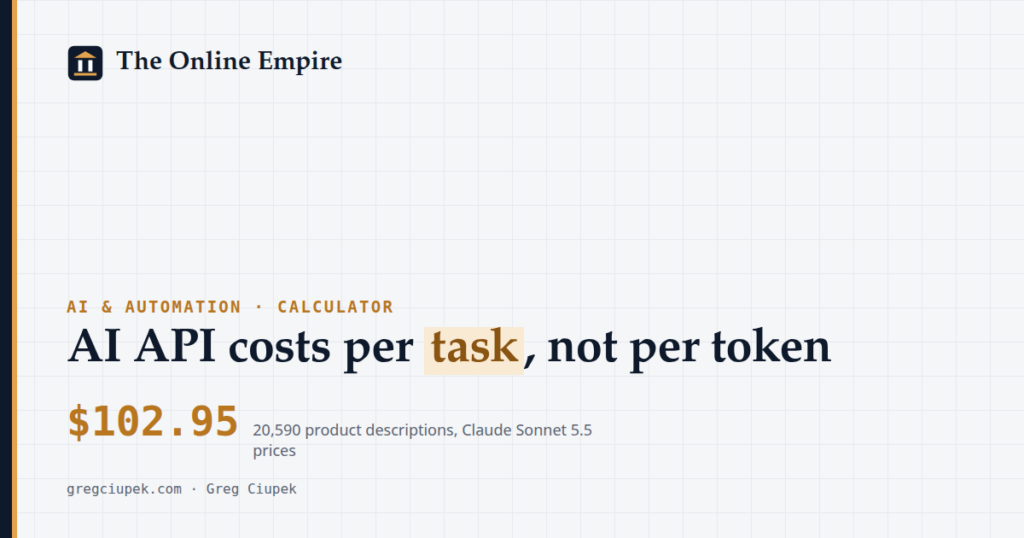
- Descriptions for a 20,590-product catalog (the size of one of my stores on 12 Nov 2026) cost about $5.15 on the cheapest models and $102.95 on Claude Sonnet 5.5, before the 50% batch discount all three providers list.
- Hidden "thinking" tokens are billed as output. If a model thinks 2,000 tokens per description, the same Sonnet 5.5 catalog goes from $102.95 to $514.75.
Contents · 8 sections
- 01What are AI API costs per million tokens in November 2026?
- 02How do AI API costs turn into a cost per task?
- 03What do AI API costs come to for an article, a catalog and customer replies?
- 04What makes AI API costs higher than the price table?
- 05How can I lower AI API costs on repeated tasks?
- 06AI API costs on your own numbers: the calculator
- 07Frequently asked questions
- 08Sources
This is for you if you run a store or a small company and want to know what "per million tokens" means for one job: an article, a product description, a reply to a customer. Below are the prices from the providers' own pages, three tasks worked out with every assumption stated, and a calculator for your own numbers. My reason for doing the sum: three of my stores had catalogs of over 20,000 products each on 12 Nov 2026, and rewriting a catalog that size is a real decision.
What are AI API costs per million tokens in November 2026?
AI API costs on 14 Nov 2026 ranged from $0.10 input and $0.50 output per million tokens (Claude Haiku 5.5, gpt-6-luna) to $10 input and $50 output (gpt-6-astra), according to the Anthropic, OpenAI and Google pricing pages I read that day; mid-range models such as Claude Sonnet 5.5 and gpt-6.1-sol were both $2 and $10.
A token is a piece of a word. Input is what you send; output is what the model writes, and it costs five times more on every model below except Gemini 3.5 Flash-Lite (about eight).
| Provider | Model (as named on the page) | Input | Cached input | Output | Batch in / out |
|---|---|---|---|---|---|
| Anthropic | Claude Haiku 5.5 (prompts up to 100,000 tokens) | $0.10 | $0.01 | $0.50 | $0.05 / $0.25 |
| Anthropic | Claude Sonnet 5.5 | $2 | $0.10 | $10 | $1 / $5 |
| Anthropic | Claude Opus 5.5 | $4 | $0.20 | $20 | $2 / $10 |
| OpenAI | gpt-6-luna | $0.10 | $0.01 | $0.50 | $0.05 / $0.25 |
| OpenAI | gpt-6.1-terra | $1 | $0.05 | $5 | $0.50 / $2.50 |
| OpenAI | gpt-6.1-sol | $2 | $0.10 | $10 | $1 / $5 |
| OpenAI | gpt-6-astra | $10 | $1 | $50 | $5 / $25 |
| Gemini 3.5 Flash-Lite | $0.30 | $0.03 | $2.50 | $0.15 / $1.25 | |
| Gemini 4 Hydrogen | $1.50 | $0.075 | $7.50 | $0.75 / $3.75 | |
| Gemini 4 Argon (from 1 Dec 2026; $2 / $10 until 30 Nov 2026) | $4 | $0.20 | $20 | $2 / $10 |
OpenAI's prices are for short context. Gemini 4 Argon doubles in price on 1 Dec 2026, so I calculate it at the December price.
How do AI API costs turn into a cost per task?
To turn AI API costs into a cost per task, multiply the input tokens of one task by the input price, add the output tokens times the output price, and divide by one million; a task with 1,000 input and 300 output tokens on $2/$10 prices costs (1,000 × $2 + 300 × $10) ÷ 1,000,000 = $0.005.
The hard part is the token counts. Mine are assumptions, not measurements:
A1: 1 English word is about 1.5 tokens; Anthropic's page says counts depend on the tokenizer, language and content. A2: no hidden reasoning ("thinking") tokens. A3: one attempt per task, no retries. A4: standard global processing, no regional or US-only endpoint. A5: no prompt caching unless I say so.
| Task | What goes in | Input tokens | What comes out | Output tokens |
|---|---|---|---|---|
| 1,500-word article | brief, outline, style rules, notes (about 2,000 words) | 3,000 | 1,500 words | 2,250 |
| Product description | instructions plus supplier title and attributes (about 650 words) | 1,000 | 200 words | 300 |
| Customer-service reply | instructions, store policies, order data, the email thread (about 2,650 words) | 4,000 | 200 words | 300 |
What do AI API costs come to for an article, a catalog and customer replies?
On prices read on 14 Nov 2026 and the token assumptions above, a 1,500-word article costs between $0.0014 and $0.14, descriptions for a 20,590-product catalog between $5.15 and $514.75, and 1,000 customer-service replies between $0.55 and $55, depending only on which of ten models you pick.
| Model | One 1,500-word article | 20,590 product descriptions | Same, batch | 1,000 customer replies |
|---|---|---|---|---|
| Claude Haiku 5.5 | $0.0014 | $5.15 | $2.57 | $0.55 |
| gpt-6-luna | $0.0014 | $5.15 | $2.57 | $0.55 |
| Gemini 3.5 Flash-Lite | $0.0065 | $21.62 | $10.81 | $1.95 |
| gpt-6.1-terra | $0.0143 | $51.48 | $25.74 | $5.50 |
| Gemini 4 Hydrogen | $0.0214 | $77.21 | $38.61 | $8.25 |
| Claude Sonnet 5.5 | $0.0285 | $102.95 | $51.48 | $11.00 |
| gpt-6.1-sol | $0.0285 | $102.95 | $51.48 | $11.00 |
| Claude Opus 5.5 | $0.0570 | $205.90 | $102.95 | $22.00 |
| Gemini 4 Argon (December price) | $0.0570 | $205.90 | $102.95 | $22.00 |
| gpt-6-astra | $0.1425 | $514.75 | $257.38 | $55.00 |
The catalog on Claude Sonnet 5.5: (1,000 × $2 + 300 × $10) ÷ 1,000,000 = $0.005 per product, × 20,590 products = $102.95, or $51.48 through the batch API. A customer reply on the same prices: (4,000 × $2 + 300 × $10) ÷ 1,000,000 = $0.011, so $11 per 1,000 replies.
At three cents a draft, the real cost of an AI-written article is your time to brief it and check the facts. The catalog is where model choice moves money: the gap between the cheapest and dearest model is 100× on every task, multiplied by tens of thousands of items.
My eight stores in Poland listed 98,659 products in their public APIs on 12 Nov 2026, the largest being agdkomp.pl (20,590), magiawibracji.pl (20,510) and rozkoszownia.pl (20,464). On my assumptions, one description for each of them would cost about $12.33 on Claude Haiku 5.5 batch prices or about $246.65 on Claude Sonnet 5.5 batch prices. Arithmetic on list prices, not an invoice: I have not run that rewrite, and these stores are in Polish, where token counts per word differ (Anthropic says counts depend on language).
What makes AI API costs higher than the price table?
AI API costs climb above the simple formula mainly through hidden reasoning tokens, which Google's price page says are billed at the output price; through retries and longer prompts than planned; and through a 10% uplift that both Anthropic and OpenAI list for regional or US-only processing on recent models (pages read 14 Nov 2026).
- Thinking tokens. Google's table says outright that the output price includes thinking tokens. With 2,000 thinking tokens per description, the Sonnet 5.5 catalog becomes (1,000 × $2 + 2,300 × $10) ÷ 1,000,000 × 20,590 = $514.75, five times my base case. For short, repetitive writing, set reasoning to the lowest level.
- Tokenizers. Anthropic's newer tokenizer produces about 30% more tokens for the same text, so equal list prices do not mean equal bills.
- Retries. Regenerate one description in five and the bill grows 20%.
- Data residency. Anthropic charges 1.1× for US-only inference; OpenAI adds 10% on regional endpoints for models released from 5 Mar 2026.
- Promotions. Gemini 4 Argon and Carbon are at half price until 30 Nov 2026, Gemini 3.8 Flash until 31 Dec 2026.
A wrong instruction on a 20,000-product job repeats 20,000 times, and fixing published pages costs more than the API bill. Run 50 products first, read every one, then batch the rest.
How can I lower AI API costs on repeated tasks?
The two levers listed on all three price pages I read on 14 Nov 2026 are the batch discount, which halves input and output prices for jobs that can wait, and prompt caching, which charges as little as 5% of the input price on Claude Sonnet 5.5 for instructions reused across many requests.
- Send bulk jobs as a batch. Catalog rewrites and translations do not need an answer in seconds, and batch prices are half the standard ones.
- Put the fixed part of the prompt first. Cached instructions are billed at $0.10 instead of $2 per million on Claude Sonnet 5.5 and gpt-6.1-sol. Anthropic also charges $2.50 per million to write a 5-minute cache on Sonnet 5.5, so it pays only when the prefix is reused.
- Match the model to the task. A description from structured data is a small-model job; a reply to an angry customer may deserve a larger one.
- Measure ten real tasks. Every API response returns its token counts. Average ten and put them in the calculator below.
AI API costs on your own numbers: the calculator
To calculate AI API costs on your own numbers, pick a task and a model, then replace my token assumptions with the counts your API responses return; the calculator below uses prices read on 14 Nov 2026 and applies the 50% batch discount when you choose it.
- Cost per task
- $0.0050
- Input share of the cost
- 40%
- Cost per 1,000 tasks
- $5.00
- Total for all tasks
- $102.95
Preloaded with the catalog case and my assumptions A1–A5. Thinking tokens are billed at the output price. API usage only, no staff time.
For a phone agent, tokens are the smaller line: see my worked example on 305 real calls in How much does an AI agent cost?. For where AI fits in a store build overall, see Build an online store with AI, and for the jobs worth handing over first, AI for business owners. Everything else on the topic is in AI & automation.
Frequently asked questions
How much does the OpenAI or Claude API cost per request?
It depends on the tokens in and out of that request. On prices read on 14 Nov 2026, a request with 1,000 input and 300 output tokens cost $0.00025 on Claude Haiku 5.5 or gpt-6-luna and $0.005 on Claude Sonnet 5.5 or gpt-6.1-sol. Multiply by your monthly request count for a budget.
How much does an AI customer-service reply cost?
On my assumption of 4,000 input and 300 output tokens per reply, $0.00055 on Claude Haiku 5.5 or gpt-6-luna and $0.011 on Claude Sonnet 5.5 or gpt-6.1-sol, at prices read on 14 Nov 2026. Most of the input is your policies and order data, so caching them cuts the bill.
Is Claude, OpenAI or Gemini cheapest?
At the bottom tier, Claude Haiku 5.5 and gpt-6-luna had identical list prices on 14 Nov 2026 ($0.10 / $0.50 per million tokens), with Gemini 3.5 Flash-Lite at $0.30 / $2.50. The same text produces different token counts on each tokenizer, so run ten of your own tasks on each before deciding.
How many tokens is 1,000 words?
I assume about 1,500 tokens for 1,000 English words, but that is an assumption. Anthropic says its newer models produce about 30% more tokens for the same text than older ones, and that counts vary by language and content. Both APIs report exact token counts in every response, so measure on your own text.
Sources
- Anthropic, Pricing: model pricing, batch processing, prompt caching, data residency (read 14 Nov 2026): platform.claude.com
- OpenAI, API pricing: flagship models, Flex/Batch, regional processing uplift (read 14 Nov 2026): developers.openai.com
- Google, Gemini Developer API pricing: Gemini 4 Argon, Gemini 4 Hydrogen, Gemini 3.5 Flash-Lite, Gemini 3.8 Flash (read 14 Nov 2026): ai.google.dev
- Product counts of my stores from each store's public API (12 Nov 2026), from the site's fact register.
As of 14 Nov 2026. I read the Anthropic, OpenAI and Google pricing pages on 14 Nov 2026 and used standard text prices for short prompts; Gemini 4 Argon is calculated at the price Google lists from 1 Dec 2026. Token counts per task are my assumptions, not measurements, and every dollar figure for my stores' catalogs is arithmetic on list prices, not an invoice. Store product counts are from the stores' public APIs on 12 Nov 2026. I will replace the assumptions with measured token counts when I run a real catalog job.