- The Model Context Protocol (MCP) is an open standard that lets an AI application, such as Claude, ChatGPT or a coding assistant, connect to outside tools and data through one common interface instead of a custom integration for every source.
- Anthropic open-sourced MCP on 25 Nov 2024 and donated it to the Agentic AI Foundation under the Linux Foundation on 9 Dec 2025. The current specification version is 2026-07-28 (checked 13 Nov 2026).
- Three of my sites run a public, read-only MCP server with a server card: gregciupek.com (8 tools), madrydochod.pl (8 tools) and kontowtescie.pl (11 tools), checked 13 Nov 2026.
- Agent-readiness scores on isitagentready: madrydochod.pl 93/100 (15 Oct 2026), kontowtescie.pl 100/100 (25 Oct 2026).
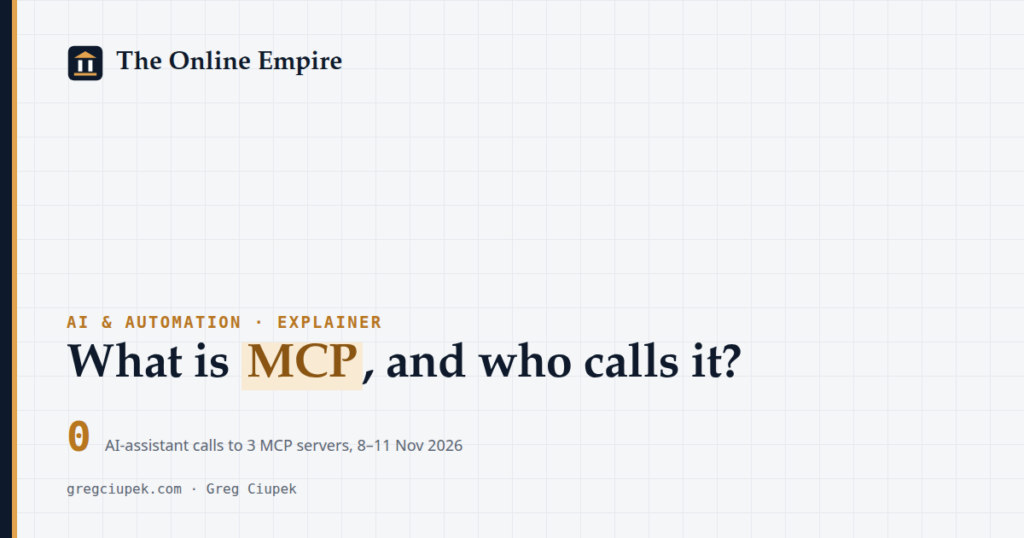
- The weak number: in the server logs for 8–11 Nov 2026, every call to those three MCP servers came from readiness checkers, 0 from an AI assistant serving a real user.
Contents · 8 sections
- 01Model context protocol: what is it in one sentence?
- 02How does the model context protocol work?
- 03Model context protocol on my sites: what I actually run
- 04Does the model context protocol bring traffic or customers?
- 05When does the model context protocol matter for a small business or store?
- 06Model context protocol vs an API, plugins and llms.txt
- 07Frequently asked questions
- 08Sources
This is for you if "MCP" keeps showing up in tool announcements and you want to know what it is, whether your store or site needs one, and what it does in practice. I give you the definition from the specification, then the three MCP servers I run on my own sites, including the log lines that show how little they are used today.
I built these servers because they were cheap to add and I wanted to see what agents do with them. So far: almost nothing, which is worth knowing before you pay anyone to build one.
Model context protocol: what is it in one sentence?
The Model Context Protocol is an open standard, published by Anthropic on 25 Nov 2024, that defines how an AI application asks an outside program for tools, data and prompt templates, so one connector works with every assistant that speaks MCP instead of needing a separate plugin for each one.
The specification describes itself as "an open protocol that enables seamless integration between LLM applications and external data sources and tools." Anthropic's launch post put the problem plainly: every new data source needed its own custom implementation. MCP replaces that with one protocol on both sides.
The comparison the specification itself uses is the Language Server Protocol, the standard that lets one code editor support dozens of programming languages.
Anthropic donated MCP to the Agentic AI Foundation, a fund under the Linux Foundation co-founded by Anthropic, Block and OpenAI, on 9 Dec 2025. In that post Anthropic counted more than 10,000 active public MCP servers and named ChatGPT, Cursor, Gemini, Microsoft Copilot and Visual Studio Code as adopters. Those are Anthropic's figures from Dec 2025, not mine.
How does the model context protocol work?
The model context protocol works as a conversation between three parts, as defined in the 2026-07-28 specification: a host (the AI app), a client inside it, and a server (your connector), exchanging JSON-RPC 2.0 messages either over a local process (stdio) or over the web as HTTP POST requests (Streamable HTTP).
- Host: the application the person uses, for example a desktop chat app or a coding editor.
- Client: the connector inside the host that talks to one server.
- Server: the program that exposes your system. It can offer three kinds of things: tools (functions the model can run, such as "search products"), resources (data to read, such as a document) and prompts (ready-made message templates).
In practice the model sees a list of tools with names, descriptions and input schemas, decides that one fits the user's question, and the host calls it. The server returns structured data, and the model writes its answer from that data instead of guessing or scraping HTML.
The current revision, 2026-07-28, changed the plumbing. According to its changelog, MCP is now stateless: the old initialize handshake and session IDs are gone, every request carries its own protocol version, and servers must answer a new server/discover call. Roots, Sampling and Logging are deprecated. This matters only if you build servers.
Official SDKs exist for TypeScript, Python, C#, Go, Rust and Ruby (Tier 1), Java (Tier 2), and Swift, PHP and Kotlin (Tier 3), per the SDK page checked on 13 Nov 2026.
Model context protocol on my sites: what I actually run
As of 13 Nov 2026 three sites in my fleet publish an MCP server card at /.well-known/mcp/server-card.json and answer MCP requests at /mcp; I listed their tools myself with a tools/list request that day, and every tool open to the public is read-only, while tools that change anything require the reader to sign in.
| Site | What it serves | Tools | Sign-in tools | Protocol version on card | isitagentready |
|---|---|---|---|---|---|
| gregciupek.com | Guides, topics, Empire Counter, book facts | 8 | 3 (newsletter) | 2025-11-25 | no score on record |
| madrydochod.pl | Polish personal-finance offers and guides | 8 | 3 (reminders) | 2025-11-25 | 93/100 (15 Oct 2026) |
| kontowtescie.pl | Reliability index of 12 Polish banks | 11 | 3 (outage alerts) | 2025-11-25 | 100/100 (25 Oct 2026) |
Two honest notes on this table. First, all three servers still declare protocol version 2025-11-25, one revision behind the current 2026-07-28, so they are working but not up to date. Second, the readiness scores are from October and measure whether the files and endpoints exist, not whether anyone uses them.
On gregciupek.com the server card links to a page for agents that explains the tools. The get_fleet_stats tool returns the same numbers as the Empire Counter, and search_articles returns this site's guides with their URL and dates, so an assistant can cite the page rather than paraphrase it.
Does the model context protocol bring traffic or customers?
On my data, not yet: in the access logs for 8–11 Nov 2026, the three MCP servers received 21 POST requests in total, 7 per site, and every one came from a readiness checker, my own daily check or a scanner calling itself agent-ready-check, while none came from ChatGPT, Claude or another assistant answering a real person.
8–11 Nov 2026, three sites, four days of logs: 21 calls to /mcp, 0 from an AI assistant. On 13 Nov 2026 the only calls up to the afternoon were mine (writing this article) and the daily checker. For comparison, madrydochod.pl got 27 of 80 human visitors from ChatGPT between 17 and 25 Oct 2026, through ordinary links in answers, not through MCP.
The reason is simple. Chat assistants mostly use MCP servers that a user or a company has connected on purpose, as a connector or integration. Nobody discovers a small site's MCP server on their own and starts calling it. The traffic I do get from AI comes from web search inside the assistant, which reads normal HTML pages. I covered that side in how to get cited by ChatGPT.
When does the model context protocol matter for a small business or store?
The model context protocol matters when an AI assistant has to work with your live data, such as orders, stock, tickets, bookings or documents, for you or your staff; it matters little as of Nov 2026 for a public blog or a small store that wants more visitors, because assistants rarely call unknown servers on their own.
Cases where I would use it:
- Your own work. Connect your assistant to your store, help desk or analytics so you can ask "which orders shipped late this week" without exporting a spreadsheet. Some tools you already pay for ship an official MCP server; check before building one.
- Your own agent. If you build an agent, MCP is the standard way to give it tools. I explain agents in what is an AI agent and the build steps in how to build an AI agent.
- Partners who ask for it. If a marketplace or a customer's assistant wants to read your catalog or prices, an MCP server is a cleaner answer than a scraper.
If you still want a public, read-only server like mine, this is the order I followed:
- Decide what is public. List the data an assistant may read without signing in. On my sites that is published articles and public statistics, never subscriber or customer data.
- Build read-only tools first. Each tool gets a clear name, a one-line description and an input schema. Mark them read-only. The specification says hosts must get user consent before calling a tool, so a clear description is what the user sees.
- Put anything that writes behind sign-in. On my sites the three tools that change something (subscribe, add a reminder, add an alert) need OAuth and act on that reader's own account only.
- Publish a server card and a docs page. The card at
/.well-known/mcp/server-card.jsontells clients where the endpoint is and which versions it supports. - Test and then watch the logs. Send
tools/listand onetools/call, then count real calls for a few weeks before you spend more on it.
The specification states that tools are arbitrary code execution and that tool descriptions from an untrusted server should be treated as untrusted. As a site owner, never expose purchase prices, customer data or write actions without authentication. As a user, connect only MCP servers from sources you trust, and read what each tool does before you allow it.
Model context protocol vs an API, plugins and llms.txt
The model context protocol is not a replacement for an API: as of Nov 2026, an MCP server usually sits on top of an existing API and repackages it for AI models, with tool descriptions, input schemas and a standard way for any MCP-compatible assistant to find and call it.
- API: made for developers who write code against it. An assistant cannot use it unless someone writes an integration.
- Plugins and custom GPT actions: tied to one vendor. MCP is vendor-neutral and governed under the Linux Foundation since Dec 2025.
- llms.txt: a text file that helps a model read your site. It is passive; MCP lets the model run a function and get structured data back.
My sites run all three side by side, reading the same database. More in the AI & automation topic.
Frequently asked questions
What does MCP stand for in AI?
MCP stands for Model Context Protocol. It is an open standard introduced by Anthropic on 25 Nov 2024 that defines how AI applications connect to outside tools and data. Since 9 Dec 2025 it is governed by the Agentic AI Foundation under the Linux Foundation.
Is the model context protocol only for Claude?
No. Anthropic created it, but in its Dec 2025 post it listed ChatGPT, Cursor, Gemini, Microsoft Copilot and Visual Studio Code among the products that adopted MCP. A server you build once can be used by any client that supports the protocol.
What is the current MCP specification version?
The current version is 2026-07-28, as listed on modelcontextprotocol.io on 13 Nov 2026. Versions are named by the date of the last backward-incompatible change. Earlier versions are 2025-11-25, 2025-06-18, 2025-03-26 and 2024-11-05.
Do I need an MCP server for my online store?
Not for traffic. My three public MCP servers got 0 calls from AI assistants between 8 and 11 Nov 2026. It makes sense when you, your staff or a partner will connect an assistant to your store data, and some platforms and tools already offer an official server you can connect instead of building one.
Is MCP safe to use?
It is as safe as the server you connect. The specification requires hosts to ask for user consent before running a tool and warns that tool descriptions from untrusted servers should not be trusted. Connect only servers from known sources and keep write actions behind sign-in.
Sources
- Model Context Protocol, Specification, version 2026-07-28 (checked 13 Nov 2026): modelcontextprotocol.io
- Model Context Protocol, Key Changes (changelog) for 2026-07-28 (checked 13 Nov 2026): modelcontextprotocol.io
- Model Context Protocol, Versioning (checked 13 Nov 2026): modelcontextprotocol.io
- Model Context Protocol, SDKs and tiers (checked 13 Nov 2026): modelcontextprotocol.io
- Anthropic, Introducing the Model Context Protocol (25 Nov 2024): anthropic.com
- Anthropic, Donating the Model Context Protocol and establishing the Agentic AI Foundation (9 Dec 2025): anthropic.com
- Official SDK repositories, TypeScript and Python (checked 13 Nov 2026): github.com, github.com
- Own data: server cards and tools/list responses of gregciupek.com, madrydochod.pl and kontowtescie.pl (13 Nov 2026); access logs of the three sites, 8–11 Nov 2026; isitagentready scores (15 and 25 Oct 2026).
As of 13 Nov 2026. On 13 Nov 2026 I checked the MCP specification, changelog and SDK list, both Anthropic posts, the three server cards and a tools/list on each server, and counted /mcp calls in the access logs for 8–11 Nov 2026. Readiness scores: 15 Oct 2026 (madrydochod.pl), 25 Oct 2026 (kontowtescie.pl); ChatGPT visitors: server logs, 17–25 Oct 2026.