- An AI phone agent is billed in three lines: language-model tokens, a voice layer per minute and phone carriage. On the price pages I checked on 28 Oct 2026, tokens run from $0.10 to $4 per million input tokens and $0.50 to $20 per million output tokens across six current Anthropic and OpenAI models.
- The voice layer is $0.08 a minute (ElevenLabs Speech Engine) or $0.07 a minute (Twilio ConversationRelay); a US call adds $0.0085 a minute inbound or $0.0140 outbound, plus $1.15 a month for a local number (Twilio).
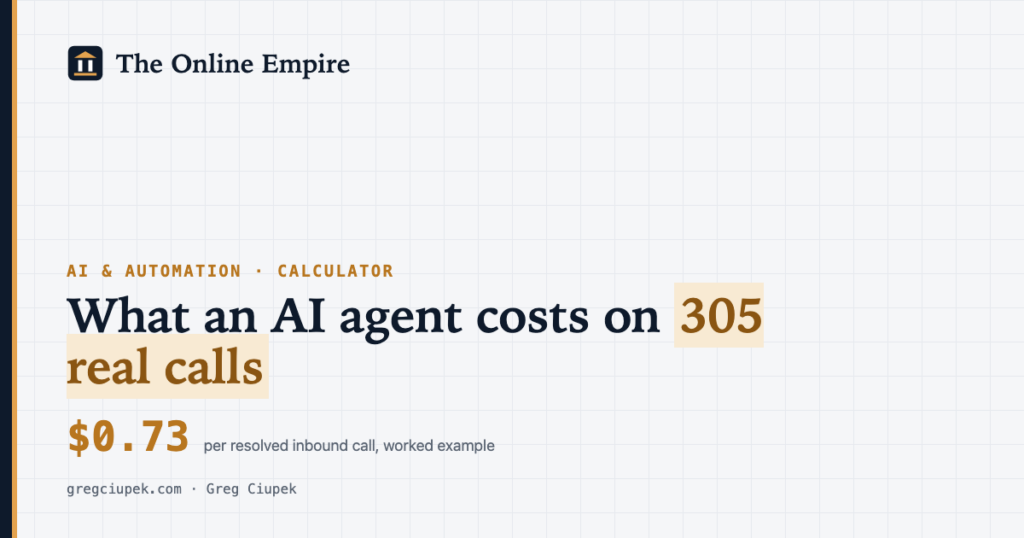
- Applied to the real call log of our AI assistant Emily (305 calls, 9–27 Oct 2026) with my assumed call lengths and token counts, the period comes to about $60, or about $0.73 per resolved inbound call. That is a calculation, not our invoice.
- In that example the voice layer is 69% of the total and tokens about 21%. A cheaper model saves less than most people expect; fewer wasted minutes save more.
Contents · 8 sections
- 01How much does an AI agent cost per call?
- 02How much does an AI agent cost in tokens? The price lists
- 03How much does an AI agent cost on 305 real calls? The worked example
- 04How much does an AI agent cost on your numbers? The calculator
- 05What does an AI agent cost beyond the price lists?
- 06How much does an AI agent cost compared to the alternatives?
- 07Frequently asked questions
- 08Sources
This is for you if you are pricing an AI agent for a store or a small company and every answer you find is an average from someone else's business. Below are the per-token and per-minute prices from the providers' own pages, a worked example on 305 real calls, and a calculator where you replace my numbers with yours.
The calls come from Emily, the AI assistant of GAPLI, built in Telofia. Both are my companies, so read the disclosure and treat my opinion of them with that in mind.
How much does an AI agent cost per call?
On price pages checked on 28 Oct 2026, a 3-minute inbound AI phone call costs about $0.27 to $0.41 in usage, depending on the model: $0.24 of that is the voice layer, about $0.03 is US phone carriage and between $0.004 and $0.14 is language-model tokens, using my assumed 10,000 input and 400 output tokens per minute.
The token line is the one everybody argues about, and it is the smallest of the three in a voice agent. Here is the same 3-minute inbound call on four price points:
All four use the same assumptions (3 minutes, 10,000 input and 400 output tokens per minute, $0.08 voice, $0.0085 carriage), so treat them as arithmetic, not quotes.
How much does an AI agent cost in tokens? The price lists
Language models are priced per million tokens, separately for input (what the agent reads) and output (what it writes). On 28 Oct 2026 Anthropic listed Claude Haiku 5.5 at $0.10/$0.50, Claude Sonnet 5.5 at $2/$10 and Claude Opus 5.5 at $4/$20; OpenAI listed gpt-6-luna at $0.10/$0.50, gpt-6.1-terra at $1/$5 and gpt-6.1-sol at $2/$10.
A token is a piece of a word. In a phone agent input dwarfs output, because on every turn the model rereads its instructions, retrieved knowledge and the conversation so far.
| Provider | Model (as named on the page) | Input | Cached input | Output |
|---|---|---|---|---|
| Anthropic | Claude Haiku 5.5 (prompts up to 100,000 tokens) | $0.10 | $0.01 | $0.50 |
| Anthropic | Claude Sonnet 5.5 | $2 | $0.10 | $10 |
| Anthropic | Claude Opus 5.5 | $4 | $0.20 | $20 |
| OpenAI | gpt-6-luna | $0.10 | $0.01 | $0.50 |
| OpenAI | gpt-6.1-terra | $1 | $0.05 | $5 |
| OpenAI | gpt-6.1-sol | $2 | $0.10 | $10 |
Three details from the same pages change real bills. Anthropic says Claude 4.7 and later models produce about 30% more tokens for the same text, so equal prices do not mean equal cost per call. Both providers add 10% for regional or US-only processing on recent models. OpenAI's gpt-5.6-sol price is promotional (at least through 21 Nov 2026), so I left it out.
| Item | Price | Source |
|---|---|---|
| Voice layer for an agent (Speech Engine), per minute | $0.08 | ElevenLabs API pricing |
| Voice layer (ConversationRelay), per minute | $0.07 | Twilio US voice pricing |
| Receiving a call on a local US number, per minute | $0.0085 | Twilio US voice pricing |
| Placing a call to a US or Canadian number, per minute | $0.0140 | Twilio US voice pricing |
| Local US number, per month | $1.15 | Twilio US voice pricing |
OpenAI also lists a gpt-live-1 voice session at $0.05 a minute, with the backend model charged separately, and audio models priced per million audio tokens. I left them out of the example because I have no measured audio tokens per minute.
How much does an AI agent cost on 305 real calls? The worked example
Applying the prices above to Emily's real call counts for 9–27 Oct 2026 (136 inbound, 30 outbound conversations, 45 voicemails, 94 unanswered) gives about $60.33 for the 19 days with Claude Sonnet 5.5 token prices, or $48.46 to $72.82 across the cheapest and most expensive model I checked, under the assumptions listed below.
The call counts are real: GAPLI database, read 27 Oct 2026, 13 of my own test calls excluded. 305 calls: 136 inbound, of which 63 were marked resolved (46%); 169 outbound, of which 30 became a conversation (18%), 45 went to voicemail and 94 were not answered. What I do not publish is a dollar bill, because Emily runs on Telofia, my own company, and an internal price is not a market price. I also have no measured average call length or token count I can stand behind yet, so those are assumptions.
A1: an inbound call lasts 3 minutes. A2: an outbound conversation lasts 3 minutes. A3: a voicemail costs 0.5 billable minutes. A4: an unanswered call costs nothing (check your carrier's terms). A5: the agent uses 10,000 input and 400 output tokens per minute of call. A6: no prompt caching, which makes the token line higher than it would be with caching switched on. A7: one local number at $1.15 for the period.
| Line | Formula | Cost |
|---|---|---|
| Billable minutes, inbound | 136 calls × 3 min | 408 min |
| Billable minutes, outbound | 30 × 3 min + 45 × 0.5 min | 112.5 min |
| Tokens per minute | (10,000 × $2 + 400 × $10) ÷ 1,000,000 | $0.024 |
| Language model | 520.5 min × $0.024 | $12.49 |
| Voice layer | 520.5 min × $0.08 | $41.64 |
| Phone carriage | 408 × $0.0085 + 112.5 × $0.0140 | $5.04 |
| Phone number | 1 local number | $1.15 |
| Total for 19 days | sum, rounded | $60.33 |
| Per resolved inbound call | inbound cost $45.90 ÷ 63 resolved | $0.73 |
| Per outbound conversation | outbound cost $13.28 ÷ 30 conversations | $0.44 |
The line to watch is "per resolved inbound call". Over all 136 inbound calls usage is about $0.34 a call; over the 63 resolved ones it doubles to $0.73. Improving the knowledge base moves that number more than any model switch.
Switching the token prices alone, with everything else equal, gives $48.46 on Claude Haiku 5.5 or gpt-6-luna prices, $54.08 on gpt-6.1-terra and $72.82 on Claude Opus 5.5. Doubling my token assumption on Sonnet 5.5 prices lands on the same $72.82. Swapping ElevenLabs for Twilio ConversationRelay at $0.07 a minute brings the Sonnet 5.5 case to $55.12.
How much does an AI agent cost on your numbers? The calculator
To calculate what an AI agent costs on your own numbers, multiply billable minutes by the sum of the token cost per minute, the voice price and the carriage price, then add the number fee; the calculator below does this with Emily's real counts and my assumptions preloaded, using prices checked on 28 Oct 2026.
- Language model (tokens)
- $12.49
- Voice layer
- $41.64
- Phone carriage and numbers
- $6.19
- Total for the period
- $60.33
- Per resolved inbound call
- $0.73
- Per outbound conversation (voicemails included)
- $0.44
- Voice layer as a share of the total
- 69%
Preloaded with Emily's real call counts (9–27 Oct 2026) and my assumptions A1–A7. Usage only: no platform fees, build time or staff time. Lines may not add up to the total because of rounding.
How to get your own inputs:
- Count calls by outcome. Inbound, resolved, outbound conversations, voicemails, unanswered. A month of your current phone logs is enough.
- Take minutes from billing. Use the billable minutes your carrier already shows, split by call type.
- Measure tokens on ten test calls. Both APIs return input and output token counts with every response. Add them up for a call, divide by its minutes, and replace my 10,000 and 400.
- Recheck the price pages on the day you budget. The prices above were read on 28 Oct 2026, and Twilio's page says its prices are current as of August 2026.
What does an AI agent cost beyond the price lists?
An AI agent also costs the time to build and maintain its knowledge, the people who handle what it escalates, platform fees if you do not build it yourself, and compliance work for outbound calls; none of these appear on per-token or per-minute price pages, and for a small business they are often larger than the usage bill.
- Knowledge. Emily went live on 9 Oct 2026 with 189 FAQs and 239 passages from 49 pages (85/100 in Telofia's pre-launch test). That is hours of work before the first paid minute.
- Escalations. 9 inbound calls ended with a ticket and 1 with a handover to a human. Someone still answers those.
- Outbound waste. Of 169 outbound calls, 139 never became a conversation. In my example they cost little because I assume unanswered calls are free, but they cost reach: 30 conversations and no sales attributed to the calls by 27 Oct 2026.
- Platform fees. A managed product (Telofia included) charges for the work of assembling these pieces. I am not listing a Telofia price here because comparing my own company's price to raw API rates in my own article would not be a fair test.
In the US, the FCC ruled on 2 Feb 2024 (released 8 Feb 2024) that AI-generated voices count as "artificial or prerecorded voice" under the TCPA, so such calls need the called party's prior express consent unless an exemption applies. In the UK, the ICO's PECR guidance says automated marketing calls need specific consent; whether a conversational AI call counts is not spelled out there, so ask a lawyer before you dial. This is not legal advice.
How much does an AI agent cost compared to the alternatives?
An AI agent is cheapest per handled call when call volume is steady and questions repeat; at a few calls a week the usage bill is tiny, but the build and test time is the same, so a voicemail-to-email box or a good help page may cost less overall. Our data from 9–27 Oct 2026 also shows outbound calling is the weakest use.
When Telofia or GAPLI are not the best choice:
- You have a developer and want the raw prices. The APIs above are open to anyone, and building on them directly gives you exactly the per-token and per-minute rates in my tables.
- You only need written answers. A help page or chat on your site costs no voice minutes at all, and the voice layer was 69% of my example. If your customers search before they call, see how to make your pages show up in AI answers in How to get cited by ChatGPT.
- You want an agent to sell by phone. Emily's outbound side reached 18% of calls and has no attributed sales. I would not pay for that use yet, from anyone.
Where I do think it pays is inbound questions at hours nobody is at the desk: almost half of Emily's inbound callers (63 of 136) had no GAPLI account yet. If that sounds like your inbox, the platform she runs on is Telofia, and the store platform she answers questions about is GAPLI. For what an agent is in the first place, read What is an AI agent?. If you do not have a website for customers to find yet, How to start a blog is the place to begin. More in the AI & automation topic, and I publish my sites' traffic the same way, raw counts with dates, on the Empire Counter.
For the model bill alone, I turned the Anthropic, OpenAI and Google price pages into per-task costs, with a calculator, in AI API costs.
Frequently asked questions
How much does an AI agent cost per month?
It depends on minutes, not on the agent. In my worked example on 305 real calls over 19 days (9–27 Oct 2026), usage came to about $48 to $73 depending on the model, under assumed call lengths and token counts. Build time, staff time and platform fees come on top.
What is the biggest cost in an AI phone agent?
In my example, the voice layer: $0.08 a minute (ElevenLabs, checked 28 Oct 2026) was 69% of the total, while tokens were about 21% on Claude Sonnet 5.5 prices. Cutting minutes that produce nothing saves more than switching to a cheaper model.
How many tokens does an AI agent use per call?
I have no measured figure I can publish yet; my example assumes 10,000 input and 400 output tokens per minute. Input dominates because the model rereads its instructions, knowledge and conversation on every turn. Measure your own on ten test calls, because both APIs return token counts with each response.
Is Claude or OpenAI cheaper for an AI agent?
At the same tier the list prices I checked on 28 Oct 2026 were close: Claude Haiku 5.5 and gpt-6-luna both at $0.10/$0.50, Claude Sonnet 5.5 and gpt-6.1-sol both at $2/$10 per million tokens. Tokenizers differ, so the same conversation can produce a different number of tokens; test both on your calls.
Do unanswered calls cost money?
In my example I assume they do not, which is a simplification, not a quote from a carrier. Voicemails do cost billable minutes. Check your carrier's billing terms before you plan an outbound campaign.
Sources
- GAPLI database, Emily call records 9–27 Oct 2026, 13 owner test calls excluded (read 27 Oct 2026); Telofia pre-launch test report (9 Oct 2026).
- Anthropic, Pricing, Claude API model pricing (checked 28 Oct 2026): platform.claude.com
- OpenAI, API pricing (checked 28 Oct 2026): developers.openai.com
- ElevenLabs, API pricing, Speech Engine for agents (checked 28 Oct 2026): elevenlabs.io
- Twilio, Programmable Voice pricing in the United States, "current as of August 2026" (checked 28 Oct 2026): twilio.com
- FCC, Declaratory Ruling FCC 24-17 on AI technologies and robocalls (adopted 2 Feb 2024, released 8 Feb 2024): docs.fcc.gov
- ICO, Guide to PECR, Telephone marketing (checked 28 Oct 2026): ico.org.uk
As of 28 Oct 2026. Emily's call counts are from the GAPLI database as read on 27 Oct 2026. The Anthropic, OpenAI, ElevenLabs and Twilio price pages and the ICO guidance were read on 28 Oct 2026. Call lengths and tokens per minute are my assumptions, not measurements, and every dollar figure in the worked example is my arithmetic on public prices, not our invoice. I will replace the assumptions with measured averages once Emily has a full month of billing data.