- "Crawled – currently not indexed" means Googlebot fetched the page and Google chose not to index it for now; "Discovered" means it has not fetched it yet (Google help, checked 13 Nov 2026).
- On 15 Oct 2026 Search Console showed 41% of the posts on my Polish personal-finance blog, madrydochod.pl, as not indexed.
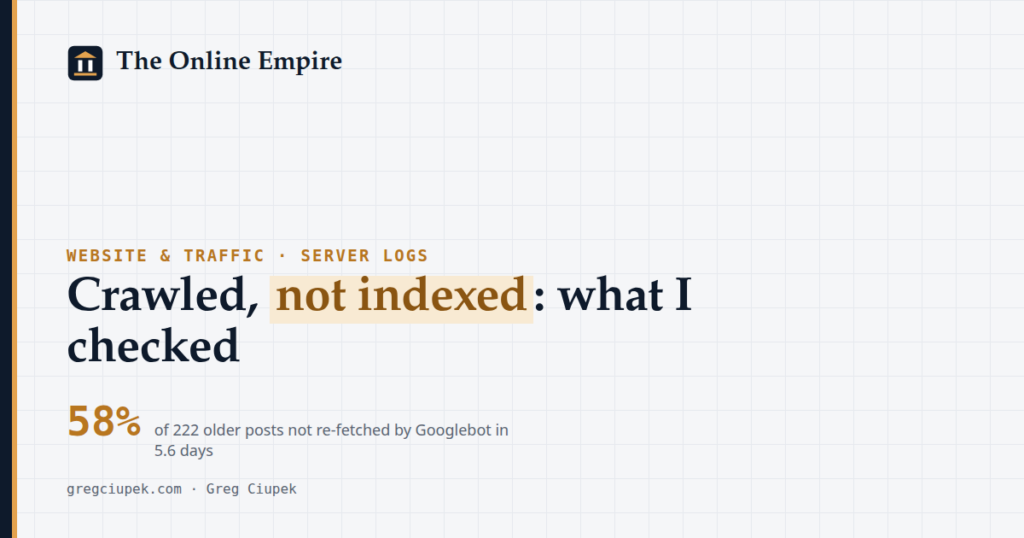
- My logs, 8–13 Nov 2026: Googlebot re-read only 93 of 222 older posts (42%) in 5.6 days; 20% of its requests went to my own counter file.
- Length did not explain it: median 3,125 words for skipped posts, 3,150 for fetched. Ten skipped posts all passed status, canonical and noindex checks.
- The fix costs nothing in tools (Search Console and your logs). Google says a fix validation typically takes up to about two weeks.
Contents · 7 sections
- 01What does "Crawled – currently not indexed" mean in Search Console?
- 02Crawled – currently not indexed on a young site: what my server logs show
- 03Why does Google crawl a page but not index it?
- 04How to fix Crawled – currently not indexed: the checklist I use
- 05How long does it take to fix Crawled – currently not indexed, and what does it cost?
- 06Frequently asked questions
- 07Sources
This guide is for you if Search Console lists your pages under "Crawled – currently not indexed" and you want to know whether it is a bug, a penalty or a verdict on your content. I show the order I check things in, with numbers from madrydochod.pl, a Polish blog about bank offers that I launched on 6 Oct 2026 and that publishes 6 articles a day.
How long Google takes to reach a new page at all is a separate question, timed in How long does it take Google to index a new site. Here I stay on pages Google has seen and chosen to leave out.
What does "Crawled – currently not indexed" mean in Search Console?
"Crawled – currently not indexed" means Googlebot fetched the URL, Google evaluated it and did not add it to the index, according to Google's Page indexing report help page (checked 13 Nov 2026). Google calls this a common message that "doesn't necessarily indicate an issue that needs attention", and it is not an error you can switch off.
The status sits in the "Why pages aren't indexed" table of the Page indexing report, and "currently" matters: the page may be indexed later. Google's crawl budget guide (last updated 22 Jul 2026) adds that every crawled page is evaluated and consolidated with duplicates before it can enter the index.
Crawled vs. Discovered – currently not indexed
Check which of the two you have before changing anything.
| Status | What happened | Last crawl date in the report | Where to look first |
|---|---|---|---|
| Discovered – currently not indexed | Google found the URL but has not fetched it; typically it rescheduled the crawl so as not to overload the site | Empty | Crawling: server speed, errors, how many URLs you ask Google to fetch |
| Crawled – currently not indexed | Google fetched the page and decided not to index it for now | Has a date | The page: duplication, value, canonical, rendering |
In short: "Discovered" is mostly a crawling problem, "Crawled" is mostly a page problem.
Crawled – currently not indexed on a young site: what my server logs show
On madrydochod.pl, verified Googlebot made 452 requests in the five full days from 8 to 12 Nov 2026, about 90 a day, and re-read only 93 of the 222 posts published before 8 Nov (42%) during the whole 5.6-day log window, according to my raw access logs read on 13 Nov 2026.
Method: raw access logs from 8 Nov 2026, 00:12 to 13 Nov 2026, 14:41 Warsaw time; requests with a Google user agent; all 23 IP addresses passed a reverse and forward DNS check. The 260 posts come from the WordPress REST API. A post counts as fetched if Googlebot got a 200 for its exact URL at least once. The commands I use for this read, step by step, are in server log analysis for SEO.
| Type of URL | Requests | Share |
|---|---|---|
| Blog posts | 124 | 27% |
| Traffic-counter file (/md-hit.txt with a random query string) | 92 | 20% |
| Bank-offer pages (a separate post type, 129 in the sitemap) | 77 | 17% |
| Other pages (bank profiles, hubs, homepage, about) | 73 | 16% |
| CSS, JavaScript and images | 62 | 14% |
| WordPress REST API | 13 | 3% |
| robots.txt and sitemaps | 11 | 2% |
| Total | 452 | 100% |
Of the 93 older posts fetched, 67 were read once, 20 twice and 6 three times or more. Of 35 posts published 8–12 Nov, it fetched 3; of 129 bank-offer pages, 70.
The counter line surprised me. My pages ping /md-hit.txt to count real readers, Google's renderer runs that script, and a random query string makes each ping a new URL. I have not blocked it: Google's crawl budget guide says freed-up crawling is not shifted to other pages unless the site is at its capacity limit, and my logs do not show that.
madrydochod.pl, 260 posts (13 Nov 2026); 41% of posts not indexed (Search Console, 15 Oct 2026). Logs, 8–13 Nov 2026: 58% of older posts not re-fetched, 1 server error (503) on a post on 13 Nov, 7 redirects (301) from an expired offer URL.
Why does Google crawl a page but not index it?
Google crawls a page but does not index it when the page looks like a duplicate of another URL, adds too little beyond what is already indexed, or signals that it should not be indexed, according to Google's crawl budget, duplicate-URL and helpful-content pages (updated 10 Jul to 5 Oct 2026, checked 13 Nov 2026).
Google does not say which reason applies to which URL, so rule them out from the easiest to check.
- Technical signals. A noindex tag, an X-Robots-Tag header, a canonical pointing elsewhere, or a 5xx error when Googlebot came.
- Duplication. Google treats a rel="canonical" link and a redirect as strong canonical signals, and sitemap inclusion as a weak one (Consolidate duplicate URLs, last updated 10 Jul 2026). Near-identical pages compete with each other.
- Value. Google's self-assessment questions ask whether the content gives original information, research or analysis, and whether it goes beyond the obvious (Creating helpful content, last updated 5 Oct 2026).
- Volume. Google's spam policies (last updated 28 Aug 2026) define scaled content abuse as many pages made mainly to manipulate rankings, however they are produced.
What I ruled out on 13 Nov 2026: I drew 10 random posts from the 129 Googlebot did not re-fetch. All 10 returned 200, carried a canonical pointing to themselves and had no noindex in the HTML or in the headers. All 260 posts are in the sitemap with a lastmod date. Length is not the difference either: median 3,125 words for skipped posts and 3,150 for fetched ones.
With the technical checks passed and length equal, what is left is what Google's documents point at: how different each page is from the others. That is where I look next.
How to fix Crawled – currently not indexed: the checklist I use
To fix "Crawled – currently not indexed", confirm the page is technically indexable, decide whether it deserves the index, make it clearly different and better linked, and only then ask Google to recrawl it. These are my steps, set against Google's documentation checked on 13 Nov 2026.
- Export the list and sort it. Open Indexing → Pages, click "Crawled – currently not indexed" and export. Separate pages you need in Google from those you do not (feeds, tag archives, parameter URLs).
- Run URL Inspection on five important pages. Check the crawl date and the Google-selected canonical. If Google picked another URL, you have a duplication problem, not a quality one.
- Check the technical signals yourself. Confirm a 200 status, a self-canonical and no noindex in the HTML or headers. In my sample, 10 of 10 passed.
- Read your server logs for Googlebot. See which URLs it fetched and what status it got; Google crawls less after 5xx errors and slow responses. I found one 503 on 13 Nov 2026, still to be explained.
- Merge or redirect near-duplicates. If two pages answer the same question, keep the stronger one and 301 the other to it.
- Add something only you have. A number you measured, a table from primary sources, a worked example. It takes the longest and it is what Google's helpful-content questions are about.
- Link the page from pages Google visits. In my logs Googlebot fetched the homepage or one of the hub pages (offers, business, guides) on each of the six days from 8 to 13 Nov 2026, while 58% of older posts were not fetched at all.
- Request a recrawl, then validate. Use "Request indexing" in URL Inspection for a few key URLs, then "Validate fix" in the report.
Do not noindex or delete pages in bulk to make the number drop. Google's crawl budget guide says noindex pages are still requested, so you save no crawling.
How long does it take to fix Crawled – currently not indexed, and what does it cost?
Fixing "Crawled – currently not indexed" costs nothing in tools, since Search Console and your server logs are free, and Google says a fix validation typically takes up to about two weeks, sometimes much longer (Page indexing report help, checked 13 Nov 2026). The real cost is your time rewriting and merging pages.
The recrawl itself can be fast: on 9 Nov 2026 a URL Inspection test ran on one madrydochod.pl post, and Googlebot fetched it 1 minute 57 seconds later (raw logs). A fetch is still not a promise of indexing.
One trap: validation stops when Google finds a single remaining instance of the issue. Google suggests validating against a small sitemap of your most important pages, which finishes faster.
When I set madrydochod.pl to 6 articles a day on 15 Oct 2026, I added a brake: if more than 40% of pages stay unindexed for two weeks, the pace drops to 4 a day. The full story of this blog is in my affiliate blog case study.
If you are still building the basics, start with How to get traffic to a new website. More guides are under Website and traffic, and the live traffic of my sites is on the Empire Counter.
Frequently asked questions
Is "Crawled – currently not indexed" a penalty?
No. Google describes it as a common status that does not necessarily need attention, and a manual action would show up in the Manual actions report instead. The status only says Google fetched the page and left it out for now.
What is the difference between "Crawled" and "Discovered – currently not indexed"?
"Discovered" means Google knows the URL but has not fetched it, so the last crawl date is empty. "Crawled" means Google fetched it and then left it out. The first points to crawling limits, the second to the page itself.
Should I click "Request indexing" for every affected page?
No. Google's recrawl page (last updated 10 Dec 2025) says there is a quota for individual URLs and that repeat requests for the same URL do not speed it up. A request does not change Google's decision if the page has not changed. Fix the page first, then request a recrawl for a handful of important URLs and let the sitemap cover the rest.
How many pages in this status is normal?
Google gives no threshold. On my Polish blog, 41% of posts were not indexed on 15 Oct 2026, nine days after launch, and I set a rule to slow publishing if the share stays above 40% for two weeks. Judge the trend over weeks, not one reading.
Sources
- Google Search Console Help, Page indexing report (no date shown, checked 13 Nov 2026): support.google.com
- Google Search Central, Crawl budget management for large sites (last updated 22 Jul 2026, checked 13 Nov 2026): developers.google.com
- Google Search Central, How to specify a canonical URL / consolidate duplicate URLs (last updated 10 Jul 2026, checked 13 Nov 2026): developers.google.com
- Google Search Central, Creating helpful, reliable, people-first content (last updated 5 Oct 2026, checked 13 Nov 2026): developers.google.com
- Google Search Central, Ask Google to recrawl your URLs (last updated 10 Dec 2025, checked 13 Nov 2026): developers.google.com
- Google Search Central, Spam policies for Google web search (last updated 28 Aug 2026, checked 13 Nov 2026): developers.google.com
- madrydochod.pl, Google Search Console Page indexing report, 15 Oct 2026 (41% of posts not indexed), from my fleet fact register.
- My raw server access logs for madrydochod.pl, 8 Nov 2026 00:12 to 13 Nov 2026 14:41 Warsaw time, the site's WordPress REST API and sitemaps, all read 13 Nov 2026.
As of 13 Nov 2026. That day I read the raw access logs of madrydochod.pl (8 Nov 00:12 to 13 Nov 14:41 Warsaw time), DNS-verified all 23 Googlebot addresses, took posts and word counts from the WordPress REST API, checked the sitemaps and tested 10 random unfetched posts. Request counts by type use full UTC days 8–12 Nov. The 41% is from Search Console on 15 Oct 2026; I took no new Search Console reading. Google pages checked 13 Nov 2026.