- Generative engine optimization (GEO) is the work of making your pages easy for AI answer engines such as ChatGPT, Google AI Overviews and Perplexity to find, quote and link to, so that you appear inside the answer rather than only in a list of links.
- The term comes from a Princeton and IIT Delhi paper (arXiv, first version 16 Nov 2023, presented at KDD 2024). On a benchmark of 10,000 queries, adding quotations, statistics and cited sources raised a page's visibility in AI answers by up to 41%; keyword stuffing made it slightly worse.
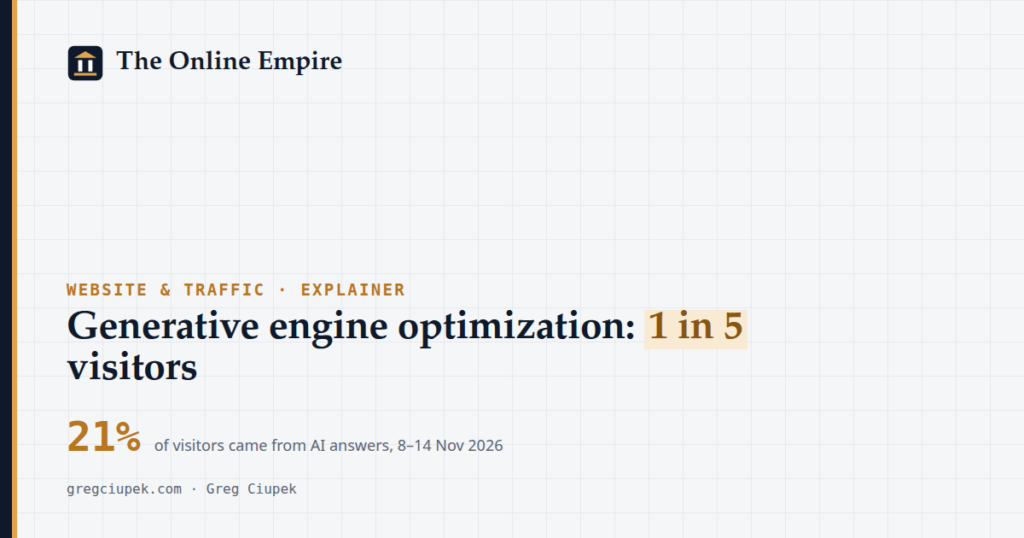
- On my Polish blog madrydochod.pl, 27 of 80 people (34%) came from ChatGPT in 17–25 Oct 2026 (server logs). Across five of my sites in 8–14 Nov 2026, 74 of 351 daily visitors (21%) came from an AI assistant, and every one of them from ChatGPT.
- Google says (page updated 10 Dec 2025) there are no extra requirements for AI Overviews or AI Mode: a page must be indexed and eligible for a snippet. For Google, GEO is SEO.
Contents · 7 sections
- 01What is generative engine optimization?
- 02Generative engine optimization in real traffic: how many visitors come from AI answers?
- 03How does generative engine optimization work?
- 04Generative engine optimization vs SEO: what is actually different?
- 05When does generative engine optimization matter, and when can you ignore it?
- 06Frequently asked questions
- 07Sources
This is for you if someone told you that "SEO is dead, now you need GEO" and you want a plain answer: what the term means, where it came from, how it works and whether it is worth your time on a small or new site. I count every visitor on my young sites from server logs, so I can show what GEO looks like in real traffic.
This page is the definition. If you want the practical checklist I used to get a new blog into ChatGPT answers, that is in my guide on how to get cited by ChatGPT.
What is generative engine optimization?
Generative engine optimization is the practice of shaping a web page so that AI systems which write answers, such as ChatGPT search, Google AI Overviews and Perplexity, pick it as a source, use its content and show a link to it. The term was introduced in a research paper first published on arXiv on 16 Nov 2023.
The paper, "GEO: Generative Engine Optimization" by Pranjal Aggarwal, Vishvak Murahari and colleagues from Princeton University and IIT Delhi, calls these systems "generative engines": search tools that fetch several sources and then use a language model to write one combined answer. Their point: in a generative engine there is no ranked list, only one answer with a few citations, so ranking metrics no longer describe whether anyone sees you.
AEO (answer engine optimization) and LLMO mean the same thing; GEO is the term with a primary source behind it.
Generative engine optimization in real traffic: how many visitors come from AI answers?
On my sites, AI answers already send a visible share of human visitors: in 8–14 Nov 2026, 74 of 351 daily visitors across five sites (21%) arrived from an AI assistant, all from ChatGPT. On madrydochod.pl in 17–25 Oct 2026 it was 27 of 80 people (34%). Counts come from server logs, not Google Analytics.
madrydochod.pl is a Polish finance blog I launched on 6 Oct 2026. Two weeks later a third of its readers came from ChatGPT answers, while Google had not yet indexed 41% of its posts (Search Console, 15 Oct 2026). A new site can show up in an AI answer before it shows up in a search engine.
Here is the fresh read for the last full week, site by site. I added up each site's daily visitor counts for 8–14 Nov 2026, so a person who came back on two different days is counted twice.
| Site | Visitors (sum of days) | From AI assistants | AI share | From search engines |
|---|---|---|---|---|
| tillradar.co.uk (UK, since 19 Oct 2026) | 50 | 20 | 40% | 22 |
| madrydochod.pl (Poland, since 6 Oct 2026) | 99 | 35 | 35% | 27 |
| mainstreetradar.com (US, since 25 Oct 2026) | 50 | 9 | 18% | 22 |
| kontowtescie.pl (Poland, since 25 Oct 2026) | 36 | 5 | 14% | 23 |
| gregciupek.com (this site) | 116 | 5 | 4% | 47 |
| Total | 351 | 74 | 21% | 141 |
Two things stand out. First, all 74 AI visitors came from ChatGPT; in those seven days no site recorded a single visitor from Perplexity, Gemini, Claude or Copilot. Second, the share swings from 4% to 40% between sites built the same way. The two sites with the highest share, tillradar.co.uk and madrydochod.pl, both answer narrow, practical money questions for small businesses. This site's total includes one unusual day, 10 Nov 2026, with 58 visitors, 49 of them direct. How these shares moved week by week is in my ChatGPT traffic share report, and today's numbers for the whole fleet are on the Empire Counter.
A high AI share on a young site often means search traffic has not arrived yet, not that AI traffic is large. Watch the number of people from each source over time, not the percentage.
How does generative engine optimization work?
Generative engine optimization works on the two steps every AI answer engine takes: first it retrieves candidate pages from a search index, then a language model reads them and writes an answer that cites some of them. GEO means being retrievable in step one and being the easiest page to quote in step two.
- Retrieval. The engine runs one or more searches. Google AI Overviews and AI Mode use the normal Google index and may issue several related searches at once, which Google calls "query fan-out" (Google Search Central, updated 10 Dec 2025). ChatGPT search uses its own index built by OpenAI's OAI-SearchBot crawler; OpenAI's documentation (checked 15 Nov 2026) says sites that block OAI-SearchBot will not be shown in ChatGPT search answers.
- Reading. The model gets the text of the retrieved pages. Content locked in images, scripts or behind a login is invisible here.
- Writing and citing. The model writes one answer and attaches links to the sources it leaned on. A page with a clear, self-contained sentence, a number and a date is easy to lift. A page that warms up for three paragraphs is not.
- The click. Only some readers click a citation. Many get what they need from the answer and move on, so being quoted and being visited are two different numbers.
The research behind the term measured step three. The authors built GEO-bench, 10,000 queries from 25 domains, rewrote source pages with different methods and measured how much of each page ended up in the generated answer, weighted by position. I took the overall scores from Table 1 of the paper and worked out the change against the unoptimized baseline.
| Method | What it changes on the page | Score | Change vs baseline |
|---|---|---|---|
| No optimization | Original text | 19.3 | 0% |
| Quotation Addition | Adds credible quotes | 27.2 | +41% |
| Statistics Addition | Replaces vague claims with numbers | 25.2 | +31% |
| Fluency Optimization | Makes the text read more smoothly | 24.7 | +28% |
| Cite Sources | Adds references to reliable sources | 24.6 | +27% |
| Keyword Stuffing | Adds more query keywords | 17.7 | −8% |
The finding I find most useful for small sites is in Table 2 of the same paper: adding cited sources raised visibility by 115.1% for pages ranked fifth in the underlying search results, while pages ranked first lost 30.3% on average. In that test, GEO helped the underdog more than the leader. It was measured mostly on a research engine built on GPT-3.5, plus a check on Perplexity.ai; real engines change often.
Generative engine optimization vs SEO: what is actually different?
Generative engine optimization and SEO share the same foundation: a page must be crawlable, indexed and useful. The difference is the goal. SEO aims for a high position in a list of links; GEO aims to be one of the few sources quoted inside a single written answer, often from an index other than Google's.
| SEO | GEO | |
|---|---|---|
| Where you appear | A ranked list of about ten links | A few citations next to one answer |
| Who reads your page | Googlebot, Bingbot | The same, plus OAI-SearchBot, ChatGPT-User and other AI fetchers |
| What helps (evidence) | Relevance, links, page experience | Quotes, statistics, cited sources (paper, Table 1); keyword stuffing does not |
| How you measure it | Search Console clicks and positions | Referrals from chatgpt.com and similar in your logs; Google counts AI Overviews inside normal Search Console data |
| Special files needed | robots.txt, sitemap | None for Google (no AI text files or special schema, per Google, 10 Dec 2025) |
So GEO is not a replacement for SEO. If Google has not indexed your page, it cannot appear in AI Overviews, and if your posts sit in "crawled, currently not indexed", that is the first thing to fix (my notes on crawled – currently not indexed). For ChatGPT the gate is different: OAI-SearchBot must be allowed in robots.txt and not blocked by your server or CDN.
When does generative engine optimization matter, and when can you ignore it?
Generative engine optimization matters most when people ask AI assistants the kind of question your page answers: practical how-to, comparisons, definitions and numbers. On my sites in 8–14 Nov 2026, the AI share ranged from 4% to 40%, highest on the two small-business money sites. It matters least for brand, local or purely visual searches.
It matters more when:
- Your site is new. madrydochod.pl got ChatGPT readers in its second week, while Google was still deciding what to index. For a young site, AI answers can be the first source of strangers.
- You publish facts with dates. Prices, thresholds, rules and measured results are what answer engines like to quote, and what the paper found raises visibility.
If Google has not indexed you yet, spend the next hour on that, not on GEO.
What I actually do for GEO on every site is short: OAI-SearchBot allowed, content in plain HTML, the first sentence under each heading answers the heading, every number has a unit and an "as of" date, and every claim from outside has a source. I buy no "GEO tools". More in the Website & traffic topic.
Frequently asked questions
What does GEO stand for in marketing?
GEO stands for generative engine optimization: making web content easy for AI answer engines such as ChatGPT, Google AI Overviews and Perplexity to use and cite. The term was introduced by researchers from Princeton University and IIT Delhi in a paper first posted on arXiv on 16 Nov 2023.
Is generative engine optimization the same as SEO?
Not the same, but built on it. Google says (10 Dec 2025) that AI Overviews and AI Mode have no extra requirements beyond normal SEO. ChatGPT uses its own crawler, OAI-SearchBot, so you also need to let that robot in. The writing style that helps, numbers, quotes and sources, is good SEO practice too.
Do I need an llms.txt file or special schema for GEO?
Not for Google: its documentation (updated 10 Dec 2025) says you do not need AI text files, new machine-readable files or special schema.org markup to appear in AI features. On my own sites I have not seen llms.txt bring any measurable traffic; I counted which crawlers actually request it in llms.txt: what it is and whether AI bots fetch it.
How do I measure traffic from AI answers?
Look at referrers in your server logs or analytics: visitors from chatgpt.com, or links tagged with utm_source=chatgpt.com, are ChatGPT clicks. Google does not separate AI Overviews: Search Console includes them in normal web search data. On five of my sites in 8–14 Nov 2026, 74 of 351 daily visitors came from ChatGPT.
Does generative engine optimization work for a brand-new site?
It can. My blog madrydochod.pl was launched on 6 Oct 2026, and in 17–25 Oct 2026, 27 of its 80 visitors (34%) came from ChatGPT answers. Google traffic was still small then, so treat it as one example, not a forecast.
Sources
- Aggarwal, Murahari, Rajpurohit, Kalyan, Narasimhan, Deshpande, "GEO: Generative Engine Optimization", KDD 2024 (arXiv v1 16 Nov 2023, v3 28 Jun 2024; read 15 Nov 2026): arxiv.org
- Google Search Central, "AI features and your website" (last updated 10 Dec 2025, checked 15 Nov 2026): developers.google.com
- OpenAI, "Overview of OpenAI Crawlers" (checked 15 Nov 2026): platform.openai.com
- Own server-log counters for tillradar.co.uk, madrydochod.pl, mainstreetradar.com, kontowtescie.pl and gregciupek.com, day files 8–14 Nov 2026 (read 15 Nov 2026); madrydochod.pl 17–25 Oct 2026: Empire Counter
As of 15 Nov 2026. I read the five sites' server-log day files for 8–14 Nov 2026 on 15 Nov 2026; the madrydochod.pl figures for 17–25 Oct 2026 and the indexing figure from 15 Oct 2026 come from my fact register. I re-read the GEO paper (arXiv v3), Google's "AI features and your website" page and OpenAI's crawler documentation on 15 Nov 2026.