- On five brand-new domains I launched in October 2026, Googlebot made its first request on the day the domain was registered, and the first visitor from Google arrived 0 to 6 days later (server-log counter, read 12 Nov 2026).
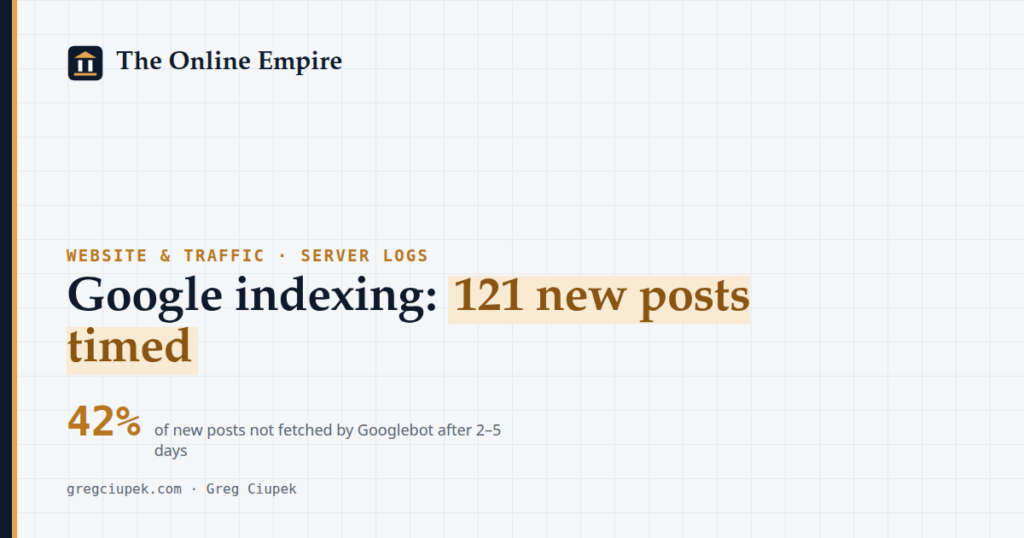
- Single posts wait longer. Of 121 posts published 7–10 Nov 2026 on six of my sites, Googlebot fetched 35% within 24 hours and 56% within 48 hours; 42% were still not fetched on 12 Nov 2026.
- The weak number: my busiest site (254 posts) got Googlebot to only 2 of 25 new posts, while Google re-read 186 older URLs.
- After a URL Inspection test, Googlebot fetched the page within 2 minutes in 3 of 3 cases. Google itself says crawling takes "a few days to a few weeks" (page updated 10 Dec 2025).
Contents · 7 sections
- 01How long does it take Google to index a new site? The dates from my logs
- 02How long does it take Google to crawl a new post on a young site?
- 03Why did Google skip 23 of 25 new posts on my busiest site?
- 04Does requesting indexing in Search Console make Google index a new site faster?
- 05How do you check if Google has indexed your new site?
- 06Frequently asked questions
- 07Sources
This is for you if you have just launched a site or published a post and keep searching for your URL to see if Google has it yet. Most answers to this question repeat the range from Google's help pages. I wanted dates, so I timed it in my server logs: when Googlebot first came to each new domain, and how many hours passed between publishing a post and Googlebot's first fetch.
The data comes from six sites in my fleet, five on domains registered in October 2026: small, weeks-old sites, which is what most new sites are. Where the first visitors came from is covered in How to get traffic to a new website; here I stay on timing.
How long does it take Google to index a new site? The dates from my logs
On five domains registered between 6 and 26 Oct 2026, Googlebot made its first request on the registration day itself, and the first visitor from Google search came 0 to 6 days later, according to the daily counter files built from my server logs (read 12 Nov 2026). A visit from Google means at least one page was already indexed.
Registration times come from the public registries (RDAP), checked 12 Nov 2026. A "visitor from Google" is a real browser with a Google referrer, with robots and data-center addresses removed. gregciupek.com is the exception: the domain dates from 2024 and only the new edition started on 28 Oct 2026.
| Site | Domain registered (UTC) | First Googlebot request | First visitor from Google | Days to first Google visitor |
|---|---|---|---|---|
| madrydochod.pl (Polish finance blog) | 6 Oct 2026, 19:08 | 6 Oct (11 requests) | 12 Oct | 6 |
| tillradar.co.uk (UK small-business money) | 19 Oct 2026, 20:31 | 19 Oct (1 request) | 23 Oct | 4 |
| mainstreetradar.com (US small-business money) | 25 Oct 2026, 07:09 | 25 Oct (68 requests) | 26 Oct | 1 |
| kontowtescie.pl (Polish bank reliability index) | 25 Oct 2026, 18:34 | 25 Oct (6 requests) | 29 Oct | 4 |
| internetoweimperium.pl (Polish edition of this site) | 26 Oct 2026, 06:22 | 26 Oct (76 requests) | 26 Oct (1 person) | 0 |
| gregciupek.com (old domain, new edition) | 12 Oct 2024 | daily before relaunch | 2 Nov | 5 after relaunch |
So for a whole site: Google found my new domains within hours, and some page was in the index within a week. The same-day visitor on internetoweimperium.pl is one person; I would not build on it.
Being found is only the start. Two days after launch (8 Oct 2026) madrydochod.pl had zero visitors from Google while Googlebot had fetched 53 pages, GPTBot 78 and ClaudeBot 181. On 15 Oct 2026 Search Console still showed 41% of its posts as not indexed.
How long does it take Google to crawl a new post on a young site?
Of 121 posts published from 7 to 10 Nov 2026 on six of my sites, Googlebot fetched 42 (35%) within 24 hours and 68 (56%) within 48 hours; 51 (42%) had not been fetched at all by 12 Nov 2026, 13:42 UTC. For the 70 posts it did fetch, the median wait was 16.3 hours.
Method: publish time from each site's WordPress REST API, then the first request to that exact URL from Googlebot in the raw access logs, which go back to 7 Nov 2026. I counted only addresses that pass Google's reverse DNS check, so fake "Googlebot" scrapers are out. Every post was at least 48 hours old at the end of the window.
| Site | Posts | Within 24 h | Within 48 h | Not fetched | Median hours | Fastest |
|---|---|---|---|---|---|---|
| madrydochod.pl | 25 | 2 | 2 | 23 | 6.4 | 1.1 h |
| tillradar.co.uk | 21 | 7 | 9 | 12 | 9.0 | 2.4 h |
| mainstreetradar.com | 19 | 4 | 12 | 6 | 35.6 | 9.2 h |
| gregciupek.com | 13 | 7 | 11 | 1 | 19.0 | 1.6 h |
| kontowtescie.pl | 22 | 12 | 19 | 3 | 17.5 | 6.5 h |
| internetoweimperium.pl | 21 | 10 | 15 | 6 | 11.3 | 5.3 h |
| Total | 121 | 42 (35%) | 68 (56%) | 51 (42%) | 16.3 | 1.1 h |
The fastest fetch on every site took hours, not minutes, even though each post enters the WordPress sitemap at once. And the spread is huge: gregciupek.com had 12 of 13 posts fetched, madrydochod.pl 2 of 25.
A fetch means Google read the page, not that it kept it. Google's words: "Indexing isn't guaranteed; not every page that Google processes will be indexed" (How Search works, updated 18 Dec 2025). The direct way to see the decision for one URL is URL Inspection in Search Console.
Why did Google skip 23 of 25 new posts on my busiest site?
On madrydochod.pl, my oldest and largest new site (254 published posts on 12 Nov 2026), Googlebot made 252 page requests to 186 different URLs between 7 and 12 Nov 2026, yet reached only 2 of the 25 posts published from 7 to 10 Nov. It spent its visits re-reading older pages.
The new posts were not hidden: they were in the sitemap (I checked one on 12 Nov 2026) and readers who opened them got a normal 200 response. Google simply chose other URLs. I cannot see its reasons, only what is different here: the site publishes 6 articles a day, it is the oldest in the group, and on 15 Oct 2026 41% of its posts were not indexed. If Search Console files your pages under that status, I go through the checks in Crawled – currently not indexed: what it means.
My reading, and only a reading: a young site gets a limited number of fetches, and adding six pages a day spends them on pages Google already knows. gregciupek.com, with 36 posts and about three new ones a day, got Googlebot to almost every new post within two days. That is why madrydochod.pl has a rule to slow to 4 articles a day if more than 40% of its pages stay unindexed for two weeks.
Do not read this as "smaller sites get crawled faster". Six sites and five days are too few for a rule, and mainstreetradar.com, with 61 posts, had the slowest median (35.6 hours). What the data does show is that "Google will index my post tomorrow" is a guess, not a schedule.
Does requesting indexing in Search Console make Google index a new site faster?
In my logs it sped up the crawl: three new posts went through Google's testing tool (it identifies itself as Google-InspectionTool) on 9 Nov 2026, and Googlebot fetched each of them 43 seconds to 1 minute 57 seconds later. Posts on the same sites that were not inspected waited a median of 16.3 hours.
Google's page on recrawling (updated 10 Dec 2025) adds the limits: you must be an owner or full user of the Search Console property, there is a quota for individual URLs, repeated requests for the same URL "won't get it crawled any faster", and a crawl request does not guarantee inclusion "instantly or even at all".
So I use it for a few pages that matter, the homepage and the first key articles, not for every post. For the rest the sitemap does the work, though Google calls a sitemap "merely a hint" (Build and submit a sitemap, updated 8 Jul 2026).
Three URL Inspection tests, three Googlebot fetches within 2 minutes (9 Nov 2026). Without one, 42% of new posts were not fetched within two to five days.
How do you check if Google has indexed your new site?
Check in Google Search Console rather than by searching: URL Inspection says for one URL whether it is on Google, and the Page indexing report shows how many pages are indexed and why the rest are not. Server logs add the earlier step, whether and when Googlebot fetched the page at all (my routine, checked against Google's documentation on 12 Nov 2026).
- Verify the site in Search Console on day one. Without it you cannot inspect URLs or see the indexing report.
- Submit the sitemap and list it in robots.txt. WordPress creates one at /wp-sitemap.xml. On my sites Googlebot requested sitemap files 7 to 11 times in five and a half days.
- Inspect the homepage and your three to five most important pages. Request indexing once per URL; in my logs Googlebot came within 2 minutes.
- Watch your logs for Googlebot on new URLs. No fetch after 48 hours is not a quality verdict yet; 42% of my new posts were in that state. Link the post from a page Google visits often, such as the homepage.
- Verify that "Googlebot" is really Google. Google's method: a reverse DNS lookup on the address (googlebot.com, google.com or googleusercontent.com), then a forward lookup that returns the same address.
- Judge results after weeks, not days. Google's SEO Starter Guide (updated 10 Dec 2025) says some changes show in hours, others take several months, and suggests waiting "a few weeks".
Google says its crawler should not access most sites more than once every few seconds on average (Googlebot page, updated 3 Feb 2026). My takeaway, not Google's wording: a slow server gets fewer pages read in the same time; I measure that as in How to measure TTFB. If you are still setting up, start with How to start a blog; more is under Website and traffic.
Frequently asked questions
How long does it take Google to index a brand-new website?
Google says crawling can take from a few days to a few weeks (page updated 10 Dec 2025). On five domains I registered in October 2026, Googlebot came the same day and the first visitor from Google arrived 0 to 6 days later. That does not mean every page was indexed.
How long does it take Google to crawl a new blog post?
On my six sites, posts published 7–10 Nov 2026 waited a median of 16.3 hours for Googlebot's first fetch, and 56% were fetched within 48 hours. But 42% were not fetched at all by 12 Nov 2026, so plan for days, not hours.
Does "Request indexing" guarantee my page gets indexed?
No. In my logs it brought Googlebot within 2 minutes in 3 of 3 cases, but Google says a crawl request does not guarantee inclusion in results. There is a quota, and repeating the request does not speed it up.
Why does Googlebot visit my site but not my new posts?
Google picks which URLs to fetch, and on a young site it often re-reads pages it knows. On my busiest site it fetched 186 different URLs in five days but only 2 of 25 new posts. Internal links from busy pages and inspecting key URLs are the practical levers.
Sources
- Google Search Central, Ask Google to recrawl your URLs (last updated 10 Dec 2025, checked 12 Nov 2026): developers.google.com
- Google Search Central, In-depth guide to how Google Search works (last updated 18 Dec 2025, checked 12 Nov 2026): developers.google.com
- Google Search Central, Build and submit a sitemap (last updated 8 Jul 2026, checked 12 Nov 2026): developers.google.com
- Google Search Central, SEO Starter Guide (last updated 10 Dec 2025, checked 12 Nov 2026): developers.google.com
- Google Search Central, Googlebot (last updated 3 Feb 2026, checked 12 Nov 2026): developers.google.com
- Google Search Central, Verifying Googlebot and other Google crawlers (last updated 20 Mar 2026, checked 12 Nov 2026): developers.google.com
- Google Search Central, Google's common crawlers, including Google-InspectionTool (last updated 30 Oct 2026, checked 12 Nov 2026): developers.google.com
- Domain registration dates from RDAP (Verisign for .com, Nominet for .co.uk, NASK for .pl), checked 12 Nov 2026: rdap.verisign.com
- My server logs and daily log-counter files for six sites, read 12 Nov 2026; method and live numbers on the Empire Counter.
As of 12 Nov 2026. That day I read the daily counter files of six sites, the raw access logs from 7 Nov 2026 00:10 to 12 Nov 2026 13:42 UTC, post publish times and counts from each site's WordPress REST API, domain registration dates from RDAP, and the Google pages above. The madrydochod.pl figures for 8 and 15 Oct 2026 come from my fleet fact register.