- An online empire is a portfolio of sites, stores and companies that share leverage: one content model, one platform, one team, one set of data. It is not one big site. Mine today is 6 content sites, 6 stores I run myself and 3 companies.
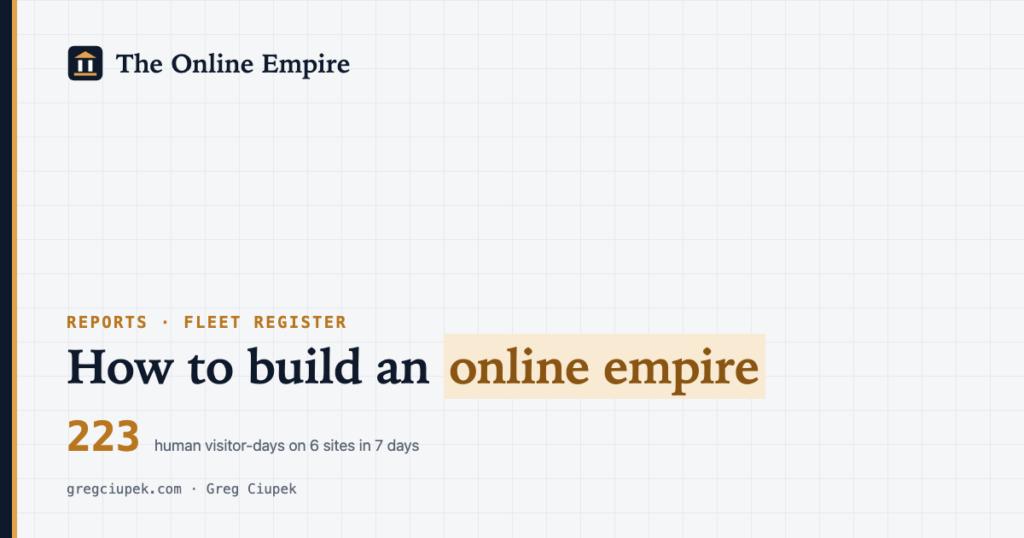
- In the 7 days from 28 Oct to 3 Nov 2026 my six content sites had 223 human visitor-days in total, counted from server logs. The biggest, madrydochod.pl, had 76; the youngest pages of this site had 7.
- The first new content site of the current fleet, madrydochod.pl, is 29 days old. It has 199 published posts (4 Nov 2026) and one confirmed conversion so far: a business-account application that pays about $75 if the account stays open 30 days.
- Leverage cuts both ways. One localization bug set VAT to 0 in about 50 stores on my platform at once, and my Instagram, with 11,200 followers, had an engagement rate of 0.07% (20 Oct 2026).
- The order that worked for me: one asset, measured honestly; then copy the model to a second market; then build the shared tool that every asset uses. The step plan is below.
Contents · 9 sections
- 01How to build an online empire: what is an "online empire", actually?
- 02How big is an online empire after one month? My fleet, as of 4 Nov 2026
- 03How to build an online empire from one content site
- 04How to build an online empire with online stores
- 05How to build an online empire with companies and AI tools
- 06How to build an online empire step by step
- 07How long does it take to build an online empire, and what can go wrong?
- 08Frequently asked questions
- 09Sources
This is for you if you already have one site, one store or one small company and wonder how people turn that into several businesses that feed each other. Or if you have nothing yet and want to see the whole road before the first step. I will show you mine, with dates, with the numbers from my own server logs and databases, and with the weak numbers I would rather not publish.
I do not promise you any result. Nothing here says you will earn a certain amount in a certain time; the FTC in the US and the ASA and CMA in the UK act against exactly that kind of claim, and rightly. What I can show is what I built, in what order, what it cost me in time and nerves, and what came out of it as of 4 Nov 2026. Most of it is weeks old. That is the point: you see an empire being built, not a story told backwards from the top.
How to build an online empire: what is an "online empire", actually?
An online empire is a set of online assets (content sites, stores, software companies) owned by one person or family and connected by leverage, so that each new asset costs less to build than the one before. On 4 Nov 2026 mine was 6 content sites, 6 stores and 3 companies, all measured from server logs and databases.
The key word is leverage. One site with a lot of traffic is a business, and a fragile one. Five sites that use the same content pipeline, the same tracking, the same legal templates and the same lessons are something else: the fifth one starts where the first one ended a year later.
I learned that word long before the internet. At 14 I sold watermelons by the roadside through the summer. At 17 I had eleven stalls and people working for them. I could not stand at eleven stalls at once, so I had to find people, train them and trust them. That was my first lesson in leverage, and every business I have built since repeats it in some form.
In 2003 I had a market stall with women's clothing, then several. I was the first trader there who dressed the mannequins instead of piling the clothes on a table. It sounds trivial. It was a lesson in presentation that I still use in every online store: people buy what they can picture on themselves, not what lies in a heap.
In 2011 I opened my first online stores. The products were added by hand, one by one. In September 2015 I started a Polish blog about making money online and a podcast, and I have been writing about it ever since. In 2015 I also wrote a 54-page Polish e-book in seven days, called, a little embarrassingly, "How to Build Your Online Empire in 30 Days". It sold for about $9 to $18 and brought about $500 a month for two years.
The e-book's sales died when I stopped building my personal brand and turned to other companies. One product tied to one person is not an empire: it stops when the person stops. I wrote about that promise and what I would change today on the manifesto page.
The same model in one table: what I had at each stage, and what the leverage was.
| When | What I had | Where the leverage came from |
|---|---|---|
| Age 14 | Roadside watermelons, one summer | None yet: my own hours |
| Age 17 | Eleven stalls with people working for me | People I trained and trusted |
| 2003 | A market stall with women's clothing, then several | A better way of presenting the same goods |
| 2011 | First online stores, products added by hand | A shop open 24 hours without a person behind the counter |
| 2015 | A blog, a podcast and a 54-page e-book | Content written once and read for years |
| 2026 | 6 content sites, stores on my own platform, a hosting company, an AI assistant | Shared pipelines, a shared platform and shared data |
How big is an online empire after one month? My fleet, as of 4 Nov 2026
After one month, my online empire is small: in the 30 days to 3 Nov 2026 my six content sites had 462 human visitor-days, and the busiest single day on any of them was 18 people. The table below lists every asset with its own "as of" date, including the ones that are going badly.
Here is the live view first. The Empire Counter below reads the same server logs every day, so by the time you read this it shows newer numbers than my table. The day-by-day log of this site's first ten days in English is in The Online Empire's first week: the logs. Robots, data-center traffic and AI crawlers are removed; what is left are people.
| Site | People | Page views | From Google and Bing | From ChatGPT and other AI |
|---|---|---|---|---|
| The Online Empire gregciupek.com · this site, English, since 28 Oct 2026 | 275 | 310 | 94 | 29 |
| Internetowe Imperium (PL) internetoweimperium.pl · Polish edition of The Online Empire, since 26 Oct 2026 | 142 | 367 | 22 | 0 |
| Mądry Dochód (Poland) madrydochod.pl · affiliate blog, since 6 Oct 2026 | 402 | 613 | 148 | 132 |
| TillRadar (UK) tillradar.co.uk · UK business banking, since 20 Oct 2026 | 278 | 314 | 128 | 51 |
| Konto w Teście (Poland) kontowtescie.pl · bank reliability index, since 26 Oct 2026 | 145 | 183 | 97 | 9 |
| MainStreetRadar (US) mainstreetradar.com · US business banking, since 27 Oct 2026 | 156 | 167 | 61 | 22 |
| Dziennik Firm (Poland) dziennikfirm.pl · Polish business daily from the company register (KRS), since 5 Nov 2026 (counter since 6 Nov, counts only people who accepted statistics) | 214 | 498 | 176 | 3 |
| Companies Daily (UK) companiesdaily.co.uk · UK business daily from Companies House, since 6 Nov 2026 (counter since 7 Nov, counts only people who accepted statistics) | 173 | 244 | 148 | 11 |
| Companies Daily US companiesdaily.com · US business daily from SEC EDGAR filings, since 11 Nov 2026 (counter since 12 Nov, counts only people who accepted statistics) | 10 | 11 | 10 | 0 |
| Total | 1,795 | 2,707 | 884 | 257 |
Source: web01 server logs, counted by a script every 30 minutes. A person is a browser that ran our script; bots, data-centre addresses and our own visits are removed. Google Analytics shows less because it runs only after consent. How we count
And here is the frozen snapshot I took on 4 Nov 2026 for this article. "Visitor-days" means daily human visitors added up; a person who came back on three different days counts three times. Post counts come from each site's public WordPress API, read the same day.
| Asset | What it is | Started | Latest number | As of |
|---|---|---|---|---|
| madrydochod.pl | Polish affiliate blog: bank offers and small-business finance | 6 Oct 2026 | 199 posts; 76 visitor-days in 7 days (6 to 15 a day); 254 since launch | 28 Oct–3 Nov 2026 (logs), posts 4 Nov 2026 |
| tillradar.co.uk | The same model for UK readers | 19 Oct 2026 | 85 posts; 49 visitor-days in 7 days (4 to 10 a day) | 28 Oct–3 Nov 2026 (logs), posts 4 Nov 2026 |
| mainstreetradar.com | The same model for US readers | 25 Oct 2026 | 13 posts; 14 visitor-days in 7 days, three days with 0 | 28 Oct–3 Nov 2026 (logs), posts 4 Nov 2026 |
| kontowtescie.pl | Reliability index of 12 Polish banks, computed automatically | 25 Oct 2026 | 58 posts; 59 visitor-days in 7 days, 48 of them from search engines | 28 Oct–3 Nov 2026 (logs), posts 4 Nov 2026 |
| internetoweimperium.pl | The Online Empire, Polish edition | Oct 2026 | 33 posts; 18 visitor-days in 7 days | 28 Oct–3 Nov 2026 (logs), posts 4 Nov 2026 |
| gregciupek.com | This site, The Online Empire in English | 28 Oct 2026 | 10 posts; 7 visitor-days in 7 days | 28 Oct–3 Nov 2026 (logs), posts 4 Nov 2026 |
| Five stores on the GAPLI platform (Poland) | Adult, home and garden, smart home, pets, health | Oct 2026 (latest builds) | 54,767 products in total; the health store has 183 | 27 Oct 2026 (store APIs) |
| An adult-industry store | My store with the most measured funnel | n/a | conversion rate 1.76%; cart to order 14%; 92% of traffic bots | 24 Oct 2026 |
| GAPLI | Dropshipping platform for online stores (my company) | n/a | about 50 stores; 383 active users with marketing consent | 16 Aug 2026 |
| Emily | GAPLI's AI phone and chat assistant | 9 Oct 2026 | 305 calls; 46% of inbound calls resolved; 18% of outbound calls reached a conversation | 27 Oct 2026 (database) |
| Aderlo Cloud | Hosting company (mine) | n/a | 100 customers, 39 paying | Aug 2026 |
| Instagram @grzegorzciupek | My personal account | restarted 20 Oct 2026 | 11,200 followers; 6.7 likes per post; engagement 0.07% | 20 Oct 2026 |
| "The Weight of Winning" | My book, in English, Spanish and Polish | 2026 | book one of three | 2026 |
Three things this table says that a revenue screenshot would hide. First, the sites with the most posts are not automatically the ones with the most readers: kontowtescie.pl has fewer posts than tillradar.co.uk and more visitor-days, because an index people search for by bank name pulls search traffic that general articles do not. Second, the US site is the weakest in the fleet after 10 days. Third, my biggest audience on paper, Instagram, is the weakest asset in practice.
Fleet totals from server logs: 223 human visitor-days in the 7 days 28 Oct–3 Nov 2026 and 462 in the 30 days 5 Oct–3 Nov 2026 (most sites existed for only part of that window). The money side is still tiny: one confirmed bank-account application on 23 Oct 2026, with a payout of about $75 only if the account stays open for 30 days.
How to build an online empire from one content site
To build an online empire from one content site, you make that site prove a model first: a niche, a publishing pace and a way of measuring people, not bots. madrydochod.pl did that in 29 days: 199 posts by 4 Nov 2026, 254 human visitor-days since launch, 27% of them from AI assistants.
A content site is the cheapest first asset I know. It needs a domain, hosting and your time, and it teaches you the three skills every later asset needs: writing for a real question, getting found, and measuring honestly. If you are new to the model, start with what affiliate marketing is and how the money flows.
What I set up on day one
madrydochod.pl launched on the evening of 6 Oct 2026. On 15 Oct 2026 I set its pace at 6 new articles a day in its niche, with a written brake: drop to 4 a day if more than 40% of posts stay unindexed by Google for two weeks. On that same day Search Console showed 41% of posts not indexed, so the brake was close from the start.
Two days after launch, on 8 Oct 2026, the site had zero people from Google and social media. It did have robots: Googlebot fetched 53 pages, GPTBot 78 and ClaudeBot 181. Robots arrive first, people later. If you count robots as readers in that phase, you will believe in an audience that does not exist.
What the first month showed
In the 29 days from launch to 3 Nov 2026 the site had 254 human visitor-days: 105 from search engines and 68 from AI assistants, mostly ChatGPT. The busiest day had 18 people. I described how ChatGPT started sending readers, and what I changed for it, in how to get cited by ChatGPT.
The first conversion came on 23 Oct 2026: a bank reported the first business-account application with our partner code. The payout is about $75, and only if the account stays open for 30 days. That is the entire revenue picture of the fleet's first new content site after four weeks: one application, not yet paid.
An affiliate network recorded 153 clicks on my partner links at a time when about 1 real reader was behind them. The rest were bots. That is why every site in my fleet counts outgoing clicks through its own /go/ counter that counts only humans. If you plan your empire on the network's click numbers, you plan it on robots.
Copying the model to a second market
The first real leverage came when I copied the model, not the content. On 20 Oct 2026 the same pipeline started tillradar.co.uk for the UK, and on 27 Oct 2026 mainstreetradar.com for the US. In the week 28 Oct–3 Nov 2026 tillradar.co.uk had 49 visitor-days and mainstreetradar.com 14, with three days at 0.
Copying the model gave me speed: tillradar.co.uk had 85 posts on 4 Nov 2026, 16 days after its start. It did not give me readers for free. Every country has its own search results, its own competitors and its own rules, and the US site is behind the UK one even though the machine behind them is the same.
How to build an online empire with online stores
Stores add a second leg to an online empire: they sell products instead of recommendations, and in the US e-commerce was 17.1% of all retail sales in the second quarter of 2026 (Census Bureau, 18 Aug 2026). In my fleet, five stores on one platform held 54,767 products on 27 Oct 2026.
The UK is further along. The Office for National Statistics puts internet sales at 28.3% of all retail sales in September 2026 (released 23 Oct 2026). The market is there in both countries. Whether your store gets a share of it is a different question, and my numbers below show how far a store can be from that share even with tens of thousands of products.
My stores run on GAPLI, a dropshipping platform for online stores that is my own company. Dropshipping means the store sells products it does not keep in stock; a wholesaler ships them to the customer. I explain the trade-offs in how to start an online store, including when you should not use a platform like mine.
| Store | Category | Products | What is weak |
|---|---|---|---|
| rozkoszownia.pl | Discreet adult store for women and couples | 22,232 | 24% duplicate titles, 57% of product names in English, 0 reviews; 0 of 22 blog posts indexed (22 Oct 2026) |
| domiogrodstyl.pl | Home, garden, patio | 19,899 | built on 20 Oct 2026, so no sales history yet |
| smartinghome.pl | Smart home, home energy storage for Home Assistant | 10,257 | no measured funnel yet |
| akwasfera.pl | Pet store | 2,196 | no measured funnel yet |
| zdrowinka.pl | Health | 183 | still being built |
| Total | 54,767 |
A large catalog is not a business. My adult-industry store, the one with the best-measured funnel, had a conversion rate of 1.76% after we fixed its payments, and the step from cart to order was only 14% on 24 Oct 2026. Real traffic was a dozen or so people a day, and 92% of all its traffic was bots, according to the log counter.
Where shared leverage hurt me
Running many stores on one platform is leverage, and leverage multiplies mistakes as well as work. Three examples from my own platform, all documented with data:
- VAT at 0 in about 50 stores. A localization bug set the tax rate to zero in roughly 50 stores at once. It was fixed in version 1.9.12. One bug, fifty businesses.
- Shipping charged per item. Every extra item in an order was charged as a full parcel, about $3.25 more each time. A customer adding a second product paid shipping twice.
- A catalog without categories. In one import, 9,000 of 9,000 items had no category. Nobody could browse that store; they could only search it.
If you build several stores on one system, the fix is not to avoid shared systems. It is to check one store in detail before you copy anything to the next, and to measure each step of the funnel (visit, product page, cart, order) separately, because a 14% cart-to-order step tells you where to work and a total sales number does not.
How to build an online empire with companies and AI tools
The third layer of an online empire is companies that serve other builders: a platform, hosting, an AI tool. They turn your own problems into a product. Mine are GAPLI (about 50 stores, 16 Aug 2026), Aderlo Cloud (100 customers, 39 paying, Aug 2026) and Telofia, where we built Emily, GAPLI's AI assistant, live since 9 Oct 2026.
Each of these started as something I needed for my own assets. GAPLI exists because adding products by hand, as I did in 2011, does not scale to 20,000 products. A hosting company exists because a fleet of sites needs servers someone understands. An AI assistant exists because about 50 store owners ask the same questions on the phone.
Aderlo Cloud: 39 of 100 customers pay
Aderlo Cloud is my hosting company. In August 2026 it had 100 customers, and 39 of them were paying. The other 61 were not, and I count that as the honest number: a customer list is not revenue. Its partner program gives partners 50% of a referred customer's first invoice and 20% of later ones, paid in points (1 point is worth about $0.25 of net value), not cash.
If you only need hosting for one small site, Aderlo Cloud is not necessarily your best choice: a large international host with a free tier or a managed WordPress plan may be simpler, and if your readers are mostly in the US, a data center near them matters more than who owns the company.
Emily: what an AI assistant really does in its first weeks
Emily is an AI assistant that answers the phone, the browser chat and Telegram for GAPLI. We built her in Telofia, another of my companies. Before launch, on 9 Oct 2026, she scored 85/100 in our test, with a knowledge base of 189 FAQs and 239 passages from 49 pages. If the term is new, read what an AI agent is first.
Here is what the GAPLI database said on 27 Oct 2026, after excluding 13 of my own test calls:
Of the 136 inbound calls, 63 came from people without an account. 70 ended without a "resolved" status, 9 opened a ticket during the call, and 1 was handed over to a human. Outbound, 94 calls went unanswered and 45 reached voicemail. Of 52 onboarding leads, 28 (54%) never had a conversation, and only 2 of the 24 who talked moved a step forward before the next call.
So an AI assistant took real work off our team: 63 inbound questions answered without a person. It did not sell anything, and it barely moved new operators forward. If you are thinking of Telofia or any other voice tool, expect support relief first and sales effects later, if at all. For a store with a few calls a week, a good FAQ page and an email reply within a day are cheaper.
And the same rule for the platform: GAPLI is built for the Polish market, with Polish wholesalers and marketplaces. If you sell in the US or the UK, a platform with local suppliers and local tax handling is the better choice.
How to build an online empire step by step
To build an online empire step by step, you prove one asset, measure it with your own counter, copy the model to a second market, add a different type of asset, and only then build shared tools. In my fleet, that order took one site from launch on 6 Oct 2026 to six content sites by 28 Oct 2026.
Those 22 days are not a recipe for speed. Behind them are years of earlier work, an existing team and existing companies. What you can copy is the order, not the pace.
- Write down your one-sentence answer. Before you build anything, answer: "What will this site or store give that the first ten results on Google do not?" If you have no answer, you have a hobby, not an asset. Every article on this site starts with that sentence.
- Set up the legal shell before the first dollar. In the US that is a sole proprietorship or an LLC and a free EIN from the IRS; in the UK a sole trader registered with HMRC or a limited company. I put every official fee in one table in how to start an online business. Report every dollar from day one.
- Build one asset and give it a pace with a brake. For madrydochod.pl that was 6 articles a day, with a written rule to slow down to 4 if more than 40% stayed unindexed for two weeks. A pace without a brake turns into a content farm.
- Count people, not robots, from the first day. Server logs with robots and data centers removed, plus your own click counter. Analytics tools that depend on cookie consent undercount, and affiliate networks overcount: I saw 153 clicks with about 1 real reader behind them.
- Find the first proof of money, however small. One application worth about $75, paid only after 30 days, is small. It is also proof that the chain from article to partner to payout works. Until you have that proof, do not build asset number two.
- Copy the model, not the content, to a second market. Same pipeline, new country, new language, new rules. Expect the copy to start weaker: my US copy had 14 visitor-days in its second week, against 49 for the UK copy.
- Add a different type of asset. A store next to a content site, or a data product (like a bank index) next to articles. Different types fail for different reasons, so they protect each other.
- Build the shared tool last. A platform, an AI assistant or a hosting company only makes sense when several of your own assets need it. Check one asset in detail before you roll a change out to all of them, because one bug in a shared system hit about 50 stores at once.
- Publish your numbers on a schedule. Mine are on the Empire Counter every day and in the reports section. Publishing the weak numbers is what keeps me from lying to myself.
Anything that promises an empire without building assets. Paid "systems", MLM, trading signals and get-rich courses are not part of this plan; I show the most common traps, with the official warnings, in make money online scams.
How long does it take to build an online empire, and what can go wrong?
Building an online empire takes years, not 30 days: my first online stores opened in 2011, my first blog in 2015, and the current fleet of six content sites dates from Oct 2026. In between, in December 2018, I had seven days to return about $53,000 with about $1,000 in the accounts.
That week, the week before Christmas, opens my book "The Weight of Winning". There had been months without money for wages. My people worked three months without pay, and they did not leave. I tell that story here because every "how to build an empire" guide skips this part: the period when the leverage you built (people, suppliers, obligations) becomes weight.
The book is out in English as a paperback (ISBN 8396708851) and on Kindle (ASIN B0HHFBJRCS), and in 2026 also in Spanish ("El Peso de Ganar") and Polish ("Ciężar Zwycięstwa"). It is book one of three. You will find all editions on the books page.
The four ways I have seen an online empire fail
- It depends on one person. My 2015 e-book earned about $500 a month for two years and stopped when I stopped building the personal brand behind it.
- It depends on one channel. My Instagram has 11,200 followers, an average of 6.7 likes per post and no comment on 71 of the last 96 posts: an engagement rate of 0.07% (20 Oct 2026). A follower count is not an audience.
- It grows obligations faster than cash. December 2018 is my example: more people and suppliers than the cash in the accounts could carry.
- It copies mistakes as fast as it copies success. A shared platform spread one VAT bug to about 50 stores.
In the US, the FTC's Business Opportunity Rule (16 CFR 437.4) makes it a violation to give a prospective buyer of a business opportunity any earnings claim without a reasonable basis, written substantiation and a formal earnings claim statement. The Endorsement Guides (16 CFR 255.5) require clear disclosure of a material connection, such as owning the company you recommend. That is why this site shows what I did and what it cost, and labels my own companies every time.
None of this is legal, tax or investment advice. When a decision involves taxes or a company structure, check the IRS or GOV.UK pages directly, or ask a tax professional, and report everything you earn.
Frequently asked questions
What is an online empire?
An online empire is a portfolio of online assets (content sites, stores, software or service companies) owned by one person or family and connected by shared leverage: the same content model, platform, team or data. On 4 Nov 2026 mine was 6 content sites, 6 stores and 3 companies.
How much money do you need to build an online empire?
The first asset can start with a domain, hosting and your time; official fees for a US sole proprietorship or a UK sole trader can be $0. The real cost is time and, later, people. I do not give a total, because my fleet stands on companies I built over years.
How long does it take to build an online empire?
Years. My first online stores opened in 2011 and my first blog in 2015. The first new site of my current fleet launched on 6 Oct 2026 and, after 29 days, had one confirmed conversion worth about $75, payable only if the account stays open 30 days.
Should the first asset be a blog or an online store?
For most people a content site is the cheaper first asset: no stock, no returns, no payment provider, and it teaches you to get found. A store makes sense first if you already know a product and its suppliers. My stores had 54,767 products on 27 Oct 2026 and still need traffic.
Can AI build an online empire for you?
AI can do much of the repeated work: my content pipeline publishes 6 articles a day on madrydochod.pl, and Emily resolved 63 of 136 inbound calls for GAPLI by 27 Oct 2026. It did not decide what to build, it attributed no sales, and it does not replace measuring people instead of robots.
Is it legal to show my income online?
Showing your real results is legal, but promising others a result is regulated. The FTC's Business Opportunity Rule requires substantiation for earnings claims, and the UK ASA and CMA act against misleading income claims. Show what you did, what it cost and how long it took, and disclose any company you own.
Sources
- madrydochod.pl, tillradar.co.uk, mainstreetradar.com, kontowtescie.pl, internetoweimperium.pl and gregciupek.com, daily human-visitor statistics computed from web01 server logs, 6 Oct–3 Nov 2026 (read 4 Nov 2026): madrydochod.pl, tillradar.co.uk, mainstreetradar.com, kontowtescie.pl
- WordPress REST API post counts (X-WP-Total) of the same six sites (read 4 Nov 2026): kontowtescie.pl/wp-json
- GAPLI store APIs (product counts, 27 Oct 2026) and GAPLI database (Emily call records, read 27 Oct 2026); Aderlo Cloud customer records (Aug 2026); Instagram @grzegorzciupek account statistics (20 Oct 2026): internal data
- Greg Ciupek, "The Weight of Winning" (2026), paperback ISBN 8396708851, Kindle ASIN B0HHFBJRCS: gregciupek.com/books
- U.S. Census Bureau, Quarterly Retail E-Commerce Sales, 2nd Quarter 2026 (18 Aug 2026, checked 4 Nov 2026): census.gov
- Office for National Statistics, Internet sales as a percentage of total retail sales, series J4MC (released 23 Oct 2026, checked 4 Nov 2026): ons.gov.uk
- Electronic Code of Federal Regulations, 16 CFR 437.4 Earnings claims (Business Opportunity Rule), version of 1 Oct 2026 (checked 4 Nov 2026): ecfr.gov
- Electronic Code of Federal Regulations, 16 CFR 255.5 Disclosure of material connections (Endorsement Guides), version of 1 Oct 2026 (checked 4 Nov 2026): ecfr.gov
As of 4 Nov 2026. That day I read the daily statistics files of all six content sites (server logs with robots and data-center traffic removed) for 28 Oct–3 Nov 2026 and for the 30 days 5 Oct–3 Nov 2026, read each site's post count from its WordPress API, and checked the Census Bureau, ONS and eCFR pages. Store, Emily, Aderlo Cloud and Instagram numbers come from my fact register with the dates shown. Amounts that were originally in Polish currency ($53,000, $1,000, $500, $9–$18, $75, $3.25, $0.25) were converted at the October 2026 rate. I will update this article when the 3rd quarter 2026 Census release (19 Nov 2026) and the first full kontowtescie.pl index (24 Nov 2026) are out.