- An AI agent is a system in which a language model decides its own next steps and uses tools (a phone line, a ticket system, a calendar, a database) to reach a goal, instead of following a fixed script.
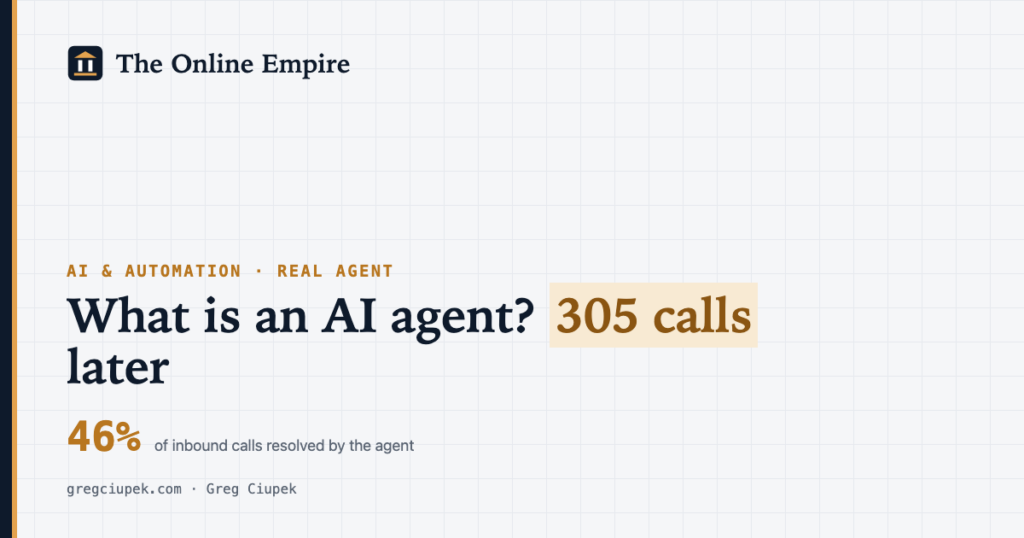
- My example is Emily, the AI assistant of GAPLI, live since 9 Oct 2026 on the phone, in the browser and on Telegram. By 27 Oct 2026 she had handled 305 calls (excluding 13 test calls): 136 inbound and 169 outbound.
- Inbound, Emily resolved 63 of 136 calls (46%) and opened 9 tickets plus 1 handover to a human. Outbound, only 30 of 169 calls (18%) became a conversation, and no sales are attributed to the calls.
- Costs come per minute. Published price lists checked on 28 Oct 2026: a voice agent at $0.08 a minute (ElevenLabs), plus phone carriage of $0.0085 a minute inbound and $0.0140 outbound in the US (Twilio) and $1.15 a month for a local number.
Contents · 7 sections
This is for you if you keep hearing "AI agents will run your business" and want to know what one actually is, what it does on an ordinary Tuesday and what it costs. Instead of a diagram, I use a real agent that works in one of my companies, with its call log as of 27 Oct 2026, including the parts that did not work.
Emily runs on Telofia and works for GAPLI, and both are my companies, so read the disclosure below and judge my enthusiasm accordingly. I give her results as they are: good at answering questions, weak at reaching people by phone, and not yet proven to sell anything.
What is an AI agent, in one sentence?
An AI agent is software in which a large language model decides what to do next and calls tools to do it, such as answering a phone, looking up an order, opening a ticket or scheduling a callback, until a goal is met; GAPLI's agent Emily did that in 305 calls between 9 and 27 Oct 2026.
The cleanest definition I know comes from Anthropic's engineering article "Building effective agents" (19 Dec 2024). It separates two things that are often both called "AI agents":
- Workflows are systems where language models and tools are orchestrated through predefined code paths. The steps are written by a developer; the model fills in the blanks.
- Agents are systems where the language model dynamically directs its own process and tool usage, keeping control over how it accomplishes the task.
Most "agents" sold to small businesses are, by that definition, workflows with a chat window. That is not an insult. The same article recommends finding the simplest solution possible and adding complexity only when needed, and I agree: a fixed workflow is cheaper to test and easier to trust.
| Chatbot | Workflow | Agent | |
|---|---|---|---|
| Who decides the next step | The user | The developer's code | The model, within limits |
| Uses tools | No | Yes, in a fixed order | Yes, chooses which and when |
| Example in my company | An FAQ box on a website | The announcement SMS sent before Emily's first call | Emily on a call deciding to answer, open a ticket or hand over to a human |
| Main risk | Wrong answer | Breaks on an unexpected case | Does something you did not plan for |
What does a real AI agent do? Emily's 305 calls
A real AI agent mostly answers routine questions and logs what it cannot solve: between 9 and 27 Oct 2026 Emily handled 136 inbound calls, resolved 63 of them (46%) and opened tickets in 10 cases, while 169 outbound calls produced only 30 conversations. These figures come from the GAPLI database, read on 27 Oct 2026, with 13 of my own test calls removed.
| Direction | What happened | Calls |
|---|---|---|
| Inbound | All inbound calls | 136 |
| Inbound | …from people without a GAPLI account | 63 |
| Inbound | Marked "resolved" | 63 (46%) |
| Inbound | Completed without "resolved" status | 70 |
| Inbound | Ticket opened during the call | 9 |
| Inbound | Handed over to a human (also with a ticket) | 1 |
| Outbound | All outbound calls (51 store operators and 3 others) | 169 |
| Outbound | Not answered | 94 |
| Outbound | Went to voicemail | 45 |
| Outbound | Became a conversation | 30 (18%) |
| Both | Callback requests | 15 |
What surprised me is who calls. Almost half of the inbound callers (63 of 136) had no GAPLI account yet: people checking what the platform is before signing up. An agent that picks up at any hour turns out to be a pre-sales line as much as a support line.
The outbound side is humbling. Emily phoned store operators on a fixed sequence: an announcement SMS, then calls on day 0, 3, 7 and 14, with four goal-based conversations and a 12-step operator journey behind them. Of 52 onboarding leads, 24 had at least one conversation and 28 (54%) had none; 30 leads were closed after three unanswered calls in a row and 1 asked not to be called. Progress to the next onboarding step before the next call: 2 of the 24 who talked and 2 of the other 28. In other words, talking to the agent did not visibly move people faster than not talking to it.
Before launch, on 9 Oct 2026, Emily scored 85/100 in Telofia's pre-launch test, with a knowledge base of 189 FAQs and 239 passages taken from 49 pages. That knowledge base is what lets her resolve almost half of inbound calls. It does nothing for an outbound call that nobody picks up.
How much does an AI agent cost to run?
A voice AI agent costs money per minute of conversation plus the phone line: on published price lists checked on 28 Oct 2026, that is $0.08 a minute for a voice agent (ElevenLabs) plus $0.0085 a minute to receive or $0.0140 a minute to place a US call (Twilio), and $1.15 a month for a local US number. Building and testing the agent is a separate, mostly time-based cost.
These are not Emily's invoices. Emily runs on Telofia, my own company, and I am not going to present an internal transfer price as a market price. What I can do is show the arithmetic on public prices, so you can plug in your own call lengths.
| Item | Price | Source |
|---|---|---|
| Voice agent (speech engine with model), per minute | $0.08 | ElevenLabs API pricing |
| Receiving a call on a local US number, per minute | $0.0085 | Twilio US voice pricing |
| Placing a call to a US number, per minute | $0.0140 | Twilio US voice pricing |
| Local US phone number, per month | $1.15 | Twilio US voice pricing |
| Inbound minute, total | $0.0885 | sum of the rows above |
| Outbound minute, total | $0.094 | sum of the rows above |
Now the calculation. Call lengths below are examples I picked to show the scale, not Emily's averages:
- One 3-minute inbound call. 3 × $0.0885 = about $0.27.
- 100 such calls a month. 100 × $0.27 = about $27, plus $1.15 for the number, so about $28 a month in usage.
- Outbound with Emily's answer rate. If 18% of outbound calls become a conversation, as in Emily's data, then for every 100 dials you get about 18 conversations. The unanswered and voicemail calls still cost a little each, so the cost per real conversation is higher than the per-minute price suggests.
- What is not in the table. Your time to write the knowledge base, test it and read the transcripts. For Emily that meant 189 FAQs and 239 passages from 49 pages before launch. If your hour is worth more than a few dollars, this is the biggest cost.
Price lists change, and some vendors charge separately for the language model on top of the per-minute voice price. Before you budget, read the current page of each vendor you will use and add a line for every component: voice, model, phone carriage, number, and any monthly plan minimum.
What is an AI agent good at, and where does it fail?
An AI agent is good at answering repeatable questions at any hour and at logging what it cannot answer; in Emily's case 46% of inbound calls were resolved and the rest ended with an answer, a ticket or a handover. It is weak where success depends on someone else picking up: 94 of 169 outbound calls were not answered.
| Task | Result | My verdict |
|---|---|---|
| Answering questions about the platform | 63 of 136 inbound resolved | Worth it |
| Talking to people who do not have an account yet | 63 of 136 inbound callers | An unexpected pre-sales channel |
| Escalating what it cannot solve | 9 tickets + 1 handover | Works, few cases |
| Reaching operators by phone | 30 conversations from 169 calls | Weak |
| Moving operators through onboarding | 2 of 24 vs 2 of 28 | No visible effect yet |
| Selling | 0 sales attributed | Not proven |
If I were starting again, I would deploy the agent inbound first, on questions that already fill my inbox, and leave outbound calling for later. If you want to see Emily or build something similar, the platform is here: Telofia. It is not the best choice if you only need a written FAQ on your website; a well-structured help page costs nothing per minute.
How do you start with an AI agent in a small business?
Start with one inbound task you already answer by hand, write the knowledge base from your real questions, test it before going live and measure it with the same counts as Emily's: calls, resolved, tickets, handovers. Emily went from knowledge base to live in October 2026 with a pre-launch test score of 85/100.
- Pick one job. "Answer questions about shipping times" is a job. "Run customer service" is not.
- Collect the questions you really get. Emails, chats, call notes. Emily's base had 189 FAQs and 239 passages from 49 pages.
- Decide the exits. When does the agent open a ticket, when does it hand over to a human, and what may it never promise? Write it down before launch.
- Test before people hear it. Run your own calls, score them and fix the base. I excluded my 13 test calls from the numbers above so they do not flatter the result.
- Count outcomes, not minutes. Resolved, tickets, handovers, callbacks, and later sales. Minutes tell you the cost; outcomes tell you whether to keep paying it.
- Tell people it is an AI. Callers should know they are speaking to an assistant and how to reach a person.
Emily is one of five automations I run; how the other four sort into agent, AI workflow or plain script is in AI agent examples from my companies.
If you want AI agents to find and use your website, not just answer your phone, that is a different topic, covered in How to get your site cited by ChatGPT. More on tools and automation is in the AI & automation topic, and how this site earns money is on How we make money.
If you want to go from the definition to a working agent, I walked through the six build steps with the numbers each one produced in how to build an AI agent.
Frequently asked questions
What is an AI agent in simple terms?
It is software where a language model decides its next step and uses tools to complete a task, such as answering a call, looking something up or opening a ticket. A chatbot only replies; an agent acts. Emily, GAPLI's assistant, handled 305 calls between 9 and 27 Oct 2026.
What is the difference between an AI agent and a chatbot?
A chatbot answers what the user types and stops there. An agent can choose and use tools, for example open a support ticket or schedule a callback, without a person pressing a button. Anthropic separates fixed "workflows" from "agents" that direct their own process.
How much does an AI voice agent cost per call?
On public price lists checked on 28 Oct 2026, a US inbound minute costs about $0.0885 ($0.08 voice agent plus $0.0085 phone carriage), so a 3-minute call is about $0.27. Add the phone number and any separate model or plan fees, and above all your time to build and test it.
Can an AI agent replace customer service staff?
Not in my data. Emily resolved 46% of inbound calls and passed the rest on as answers, tickets or a handover. That takes load off people, but someone still handles the tickets and the cases the agent should not decide.
Do AI agents make sales?
Not yet in my case. Emily's outbound calls produced 30 conversations from 169 calls and no sales attributed to them by 27 Oct 2026. An agent can support sales by answering questions early, but I have no evidence that it closes them.
Sources
- GAPLI database, Emily call records 9–27 Oct 2026, 13 owner test calls excluded (read 27 Oct 2026); Telofia pre-launch test report (9 Oct 2026).
- Anthropic, Building effective agents (19 Dec 2024, checked 28 Oct 2026): anthropic.com
- ElevenLabs, API pricing, Speech Engine agents per minute (checked 28 Oct 2026): elevenlabs.io
- Twilio, Programmable Voice pricing for the United States (checked 28 Oct 2026): twilio.com
As of 28 Oct 2026. Emily's call figures are from the GAPLI database as read on 27 Oct 2026. The ElevenLabs and Twilio price lists and the Anthropic article were checked on 28 Oct 2026; the per-call examples are my arithmetic on those prices, not Emily's invoices. I will update this article with Emily's first full month.