- Dropshipping is selling products you do not stock, with a supplier shipping each order to your customer; it is worth it only when one order leaves more money than it costs you to bring in the visitors who produce it.
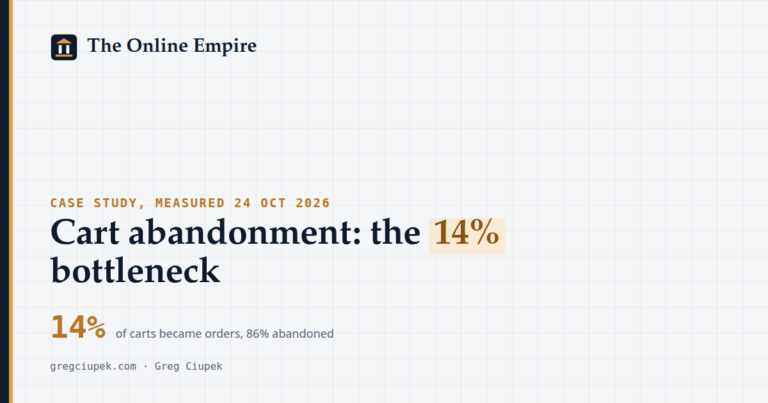
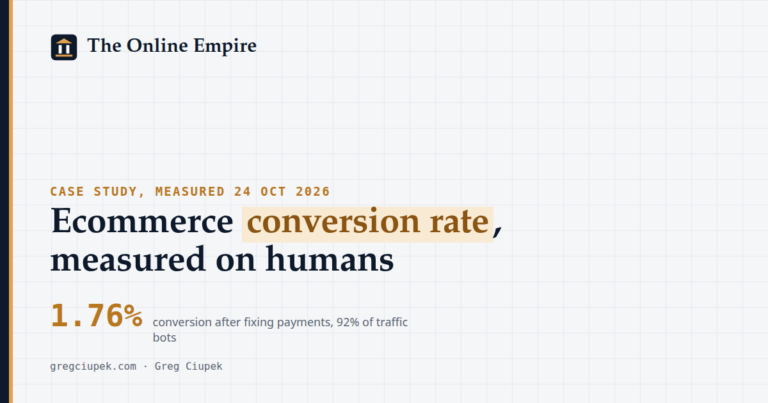
- In an adult-industry store of mine, 1.76% of visitors bought after I fixed payments, and only 14% of carts became orders (24 Oct 2026). That is about 57 visitors per order.
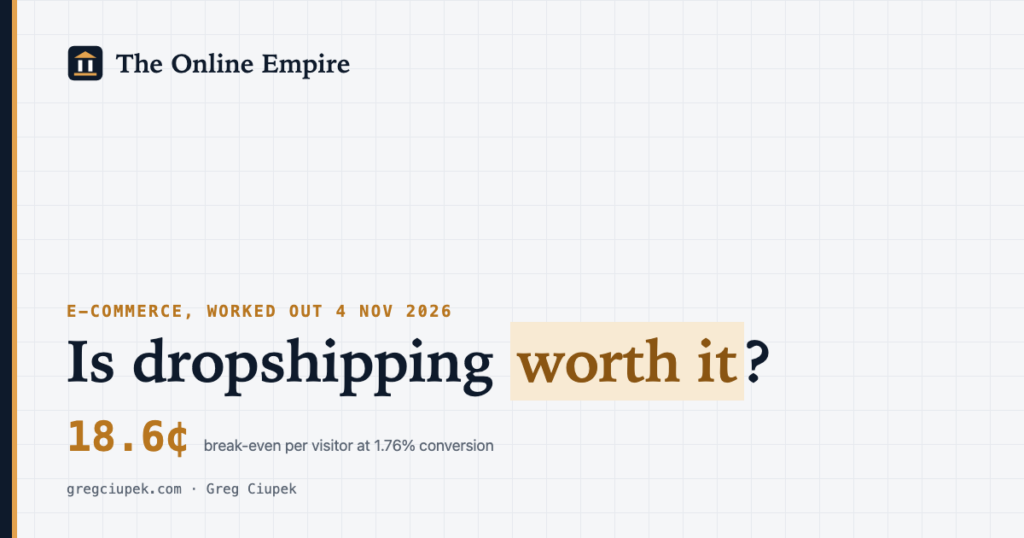
- On an example $40 order that leaves $10.54 after supplier, shipping and a $1.46 card fee, you break even at about 18.6¢ per visitor. Pay 50¢ a visitor and each order loses about $17.87.
- Three settings mistakes I measured in my own stores (0% VAT, $3.25 per extra item, 9,000 of 9,000 items without categories) cut that margin before a single ad runs.
Contents · 7 sections
- 01Is dropshipping worth it? The short answer with real numbers
- 02Is dropshipping worth it at a 1.76% conversion rate? A worked calculation
- 03Is dropshipping worth it once you count bots, shipping and tax mistakes?
- 04Is dropshipping worth it for you? Five checks before you spend on ads
- 05Is dropshipping worth it on GAPLI, the platform my stores run on?
- 06Frequently asked questions
- 07Sources
Dropshipping is a way of running an online store in which you sell a product you do not hold, and a supplier ships it to your customer after you pass on the order. Whether it is worth it is not a question of the model; it is a question of three numbers in your own store: what one order leaves you, how many visitors it takes to get one, and what a visitor costs.
This article is for you if you are deciding whether to start a dropshipping store or keep one going. I run dropshipping stores in Poland, so I take the conversion rate I measured in one of them, put it into a worked calculation with Stripe and Shopify fees read on 4 Nov 2026, and show at what numbers the answer turns from yes to no. How an order flows is in what is dropshipping. The numbers below are a method, not an income forecast.
Is dropshipping worth it? The short answer with real numbers
Dropshipping is worth it when the money one order leaves you, multiplied by your conversion rate, is higher than what you pay per visitor. In my adult-industry store the conversion rate was 1.76% on 24 Oct 2026, so an order that leaves $10.54 supports at most about 18.6¢ per visitor.
That line is the whole test; the rest is about getting its inputs right.
The first three are measured in one of my stores; the fourth is computed in the next section.
Is dropshipping worth it at a 1.76% conversion rate? A worked calculation
At a 1.76% conversion rate you need about 57 visitors for one order (1 ÷ 0.0176 = 56.8), so dropshipping is worth it only if 57 visitors cost you less than one order leaves. With an example $40 order and Stripe's 2.9% + 30¢ (read 4 Nov 2026), the ceiling is about 18.6¢ per visitor.
The product price, supplier price and shipping below are example numbers, not data from my stores; I have not measured a typical margin across them. The conversion rate and the fees are real.
If you want the margin of a single order line by line, with refunds, the platform fee and a calculator for your own numbers, see dropshipping profit margin: a per-order calculation.
- Price. The customer pays $40 for one item, delivery included. Sales tax or VAT is charged on top and goes to the tax authority, so I leave it out here (and come back to it below).
- Payment fee. Stripe's US pricing page listed 2.9% + 30¢ per successful domestic card transaction on 4 Nov 2026. On $40 that is $1.16 + $0.30 = $1.46. Shopify Payments on the Basic plan listed the same online card rate the same day.
- Supplier and shipping. In this example the supplier charges $22 for the item and $6 to ship it. What is left: $40 − $22 − $6 − $1.46 = $10.54 per order, before ads, returns, platform fee and your time.
- Visitors per order. At 1.76%, one order takes 56.8 visitors. The most you can pay per visitor and still break even is $10.54 × 0.0176 = $0.1855, about 18.6¢.
- An ad price above that. If a visitor costs you 50¢ (an example, not a market average), 56.8 visitors cost $28.41. The order leaves $10.54, so you lose about $17.87 on every sale.
- The platform on top. Shopify Basic was $39 a month billed monthly, or $29 a month billed yearly, on 4 Nov 2026. At $10.54 per order, $39 takes 3.7 orders a month, which at 1.76% means about 210 human visitors a month just to pay for the plan, even if every one of them came free.
Each row below changes one thing and keeps the rest.
| Scenario | Left per order | Conversion | Break-even per visitor |
|---|---|---|---|
| Base: $40 order, Stripe 2.9% + 30¢ | $10.54 | 1.76% | 18.6¢ |
| Shopify Basic with a third-party payment provider (extra 2% Shopify fee = $0.80) | $9.74 | 1.76% | 17.1¢ |
| You absorb the "extra item as a full parcel" charge (about $3.25) | $7.29 | 1.76% | 12.8¢ |
| Tax set to 0 by mistake, 20% UK VAT owed out of the $40 ($6.67) | $3.87 | 1.76% | 6.8¢ |
| Weaker store: 1% conversion | $10.54 | 1% | 10.5¢ |
| Stronger store: 3% conversion | $10.54 | 3% | 31.6¢ |
Only the 1.76% row is measured; 1% and 3% are there to show the slope. The lesson I take from it: a settings mistake can cost more than a weak conversion rate. A wrong tax setting cut the break-even price per visitor by almost two thirds, from 18.6¢ to 6.8¢.
Is dropshipping worth it once you count bots, shipping and tax mistakes?
Dropshipping is worth less than a clean calculation suggests, because real stores leak margin through bots, shipping rules and tax settings. In my stores in October 2026, 92% of one store's traffic was bots, extra items were charged as full parcels at about $3.25 each, and about 50 stores had VAT set to 0.
Bots: check what your visitor number counts
The adult-industry store had a dozen or so real people a day, while 92% of its traffic was bots, according to a counter built on server logs (Oct 2026). If you pay for clicks or judge a channel by a dashboard that counts bots as visitors, your cost per real visitor is higher than it looks, and the break-even test above gets the wrong input. Count humans first, then calculate.
Shipping: one parcel, not one per item
In my stores, a shipping setting charged each extra item in a cart as a full parcel, about $3.25 per item. That leaves two bad options. Pass it on, and a two-item cart shows the buyer $3.25 more than one parcel costs, in a store where only 14% of carts became orders. Absorb it, and the example order drops from $10.54 to $7.29.
Tax: a 0% rate looks normal to every buyer
A localization bug set VAT to 0 in about 50 stores on the platform until version 1.9.12 fixed it. If you are VAT-registered in the UK, where GOV.UK lists the standard rate as 20% (checked 4 Nov 2026), VAT is owed whether you charged it or not: on a $40 sale that is $40 × 20/120 = $6.67 out of your margin. In the US, sales tax rules differ by state; check your state revenue department. This is not tax advice.
Supplier feeds rarely arrive ready to sell. A catalog of mine came in with no categories on 9,000 of 9,000 items. Before you calculate whether dropshipping is worth it, count how many hours it will take to make the catalog browsable and add those hours to the cost side.
Is dropshipping worth it for you? Five checks before you spend on ads
Dropshipping is worth it for you if five checks pass: you know your margin per order, you measure conversion on human visitors, your cart-to-order rate is not leaking, tax and shipping settings are tested, and your cost per visitor is below the break-even line. Each check comes from a number I measured in my own stores in 2026.
- Write down what one order leaves. Price minus supplier price, shipping you pay, card fee (2.9% + 30¢ at Stripe on 4 Nov 2026) and platform transaction fees.
- Measure conversion on people, not hits. Use server logs or an analytics setup that filters bots. My conversion figure, 1.76%, only became meaningful after payments were fixed.
- Check cart-to-order separately. At 14% in my store, most of the loss was between the cart and the order, not on the product page. Fixing that step is cheaper than buying more traffic.
- Place three test orders. One item, two items, and a delivery to a different region. Read the tax and shipping lines on each. This is how a per-item parcel charge or a 0% tax rate shows up.
- Compare with what a visitor really costs. Multiply what one order leaves by your conversion rate. If your channel costs more per human visitor than that, the store is not worth more ad money until something on this list changes.
If you have not built the store yet, the setup steps and platform costs are in how to start an online store, and what the site itself costs is in how much does a website cost.
Is dropshipping worth it on GAPLI, the platform my stores run on?
Dropshipping on GAPLI can be worth it if you sell to customers in Poland, because it connects stores with Polish wholesalers and couriers; for US or UK customers it usually is not the right tool. GAPLI is my company, and the shipping, tax and catalog problems in this article were measured on it in 2026.
I show those problems on purpose: the VAT bug, the per-item parcel charge and the uncategorized catalog are all from the platform I build, and the VAT one was fixed in version 1.9.12. The platform had about 50 stores on 16 Aug 2026. If your buyers are in the US or the UK, a platform with suppliers and carriers in your own market will serve you better, and the calculation above works on any of them. If you plan to sell in Poland, you can look at GAPLI.
One of my stores, an adult-industry shop, converted 1.76% of visitors after I fixed payments, with 14% of carts becoming orders (24 Oct 2026) and a dozen or so real people a day behind 92% bot traffic (Oct 2026). With the example $40 order from this article, that conversion rate supports at most about 18.6¢ per human visitor. More store numbers and the human-only traffic of my sites are on the Empire Counter, and all store articles are under E-commerce.
Frequently asked questions
Is dropshipping still worth it in 2026?
It can be, if one order leaves more than it costs to bring in the visitors behind it. With an example $40 order leaving $10.54 and a 1.76% conversion rate, the break-even cost was about 18.6¢ per visitor on 4 Nov 2026 fees. Above that, every sale loses money.
What is a good conversion rate for a dropshipping store?
I can only give you mine: 1.76% in an adult-industry store after fixing payments (24 Oct 2026). What matters more than a benchmark is whether your conversion rate times your margin per order covers your cost per visitor.
How much can you make from dropshipping?
Nobody can tell you in advance, and I make no such claim. You can calculate what one order leaves and how many visitors it takes; the result depends on your supplier, prices, traffic and settings. The full margin calculation is the subject of a separate article on this site.
Is GAPLI a good choice for a US or UK dropshipping store?
Usually not. GAPLI is my company and is built around Polish wholesalers, couriers and marketplaces. For customers in the US or the UK, a platform with suppliers and carriers in your own market will fit better.
Sources
- Stripe, Pricing, US (Internet Archive capture of 4 Nov 2026): web.archive.org, live page stripe.com
- Shopify, Pricing, US (Internet Archive capture of 4 Nov 2026): web.archive.org, live page shopify.com
- GOV.UK, VAT rates (checked 4 Nov 2026): gov.uk
As of 4 Nov 2026. That day I read Stripe's and Shopify's US pricing pages (from Internet Archive captures of 4 Nov 2026, because both show local prices to visitors from Poland) and the GOV.UK VAT rates page. The $40 price, $22 supplier price, $6 shipping and the 50¢ cost per visitor are example numbers, not measurements. Store data: conversion and cart-to-order (24 Oct 2026), human visitors and bot share from a server-log counter (Oct 2026), the VAT bug fixed in GAPLI 1.9.12, the per-item parcel charge and the uncategorized catalog from my platform's documented issues. The $3.25 parcel figure was converted at the October 2026 rate (about 4.0 to the dollar).