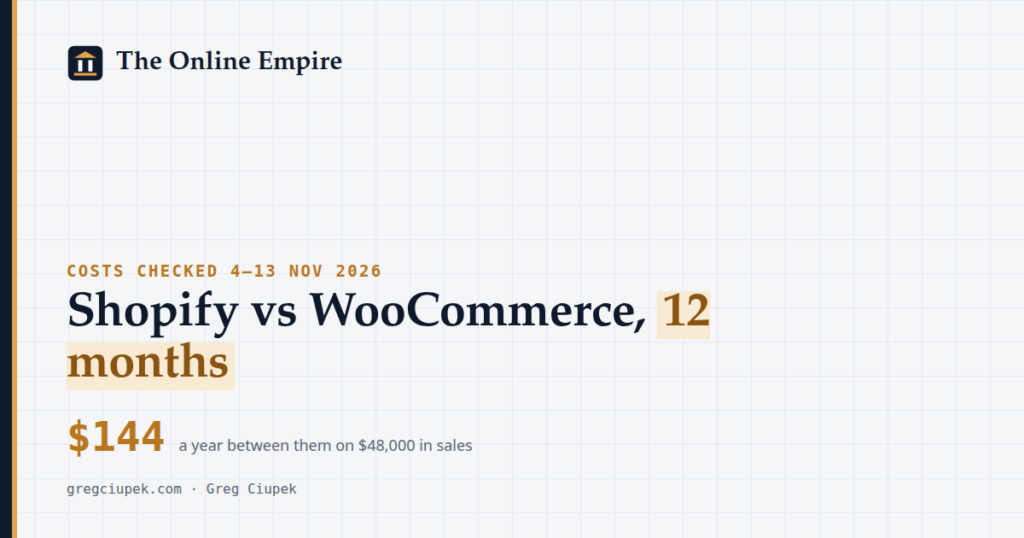
- For my example US store (1,200 orders a year at $40, so $48,000 in sales), 12 months cost $2,214.05 on Shopify Basic and $2,069.93 on WooCommerce, at prices on the providers' own pages checked 4–13 Nov 2026.
- Payment fees are $1,854.24 on both sides, 84% of the Shopify total and 90% of the WooCommerce one. The platform choice moves the bill by $144, not by thousands.
- WooCommerce stays cheaper only while hosting plus paid plugins cost less than $348 a year, which is exactly Shopify Basic billed yearly ($29 a month).
- Shopify gets expensive if you skip Shopify Payments: a 2% third-party fee on Basic adds $960 a year on $48,000 in sales.
- The seven of my stores I checked all run on WooCommerce, about 75,000 products in total (13 Nov 2026), and I still show below when Shopify is the better pick.
Contents · 8 sections
- 01Shopify vs WooCommerce: what does each cost over 12 months?
- 02Shopify vs WooCommerce: where do my own stores fit?
- 03Shopify vs WooCommerce: which payment fees apply on each?
- 04Shopify vs WooCommerce: when is Shopify the cheaper or better choice?
- 05Shopify vs WooCommerce: when does a bigger Shopify plan pay off?
- 06Shopify vs WooCommerce: what about the UK and VAT?
- 07Frequently asked questions
- 08Sources
This comparison is for you if you are about to open an online store, or move one, and want the real 12-month bill for Shopify vs WooCommerce instead of a feature checklist. I priced one example store line by line, with the date I read each price.
I am not neutral. My stores run on WooCommerce through GAPLI, a platform of my own company, so I have a reason to prefer it. That is why every number below comes from Shopify's, WooCommerce's, Stripe's and PayPal's own pages, and why there is a section on when Shopify wins.
Shopify vs WooCommerce: what does each cost over 12 months?
Shopify vs WooCommerce over 12 months comes to $2,214.05 against $2,069.93 for a US store selling $48,000 a year (1,200 orders at $40), using Shopify Basic billed yearly and WooCommerce on a $16.99-a-month host, with prices checked 4–13 Nov 2026. The $144.12 gap is smaller than most people expect, because card fees are the same.
The example store: 1,200 orders a year, $40 average order, 80% paid by card (960 orders, $38,400) and 20% by PayPal (240 orders, $9,600). It needs a .com domain and nothing else paid. US prices only, before sales tax.
| Cost line | Shopify Basic | WooCommerce | Price used (source, date) |
|---|---|---|---|
| Platform or software | $348.00 | $0.00 | Shopify Basic $29/mo billed yearly; WooCommerce core is free (Shopify pricing page, US capture 13 Nov 2026; WooCommerce pricing page, 13 Nov 2026) |
| Hosting | included | $203.88 | Hostinger WooCommerce plan, renewal rate $16.99/mo (hostinger.com, 13 Nov 2026) |
| Domain (.com) | $11.81 | $11.81 | Porkbun .com registration and renewal (Porkbun pricing API, 13 Nov 2026) |
| Card payments, 960 orders, $38,400 | $1,401.60 | $1,401.60 | 2.9% + 30¢ on both: Shopify Payments (Basic), WooPayments US and Stripe Standard |
| PayPal, 240 orders, $9,600 | $452.64 | $452.64 | 3.49% + 49¢ on both: Shopify's PayPal Wallet rate and PayPal Checkout (PayPal US fees, updated 4 Nov 2026) |
| Apps or plugins | $0.00 | $0.00 | Free tools only in the base case (paid case below) |
| Total, 12 months | $2,214.05 | $2,069.93 | Payment fees: $1,854.24 on each side |
The math, to redo with your own numbers: 2.9% of $38,400 is $1,113.60, plus 30¢ on 960 orders is $288.00, so $1,401.60. For PayPal, 3.49% of $9,600 is $335.04, plus 49¢ on 240 orders is $117.60, so $452.64.
On 13 Nov 2026 Hostinger advertised its WooCommerce plan at $2.79 a month, but only when you prepay 48 months ($133.92 at checkout), and it renews at $16.99 a month. I used $16.99 because that is the steady price. If you take the promotion, the WooCommerce column drops by about $70 in year one and you are locked in for four years. WooCommerce's own pricing page puts hosting for most stores at $25–$350 a month (13 Nov 2026).
Shopify vs WooCommerce: where do my own stores fit?
The seven of my stores I checked all run on WooCommerce, from 48 products to 20,590, and together they held 75,202 products on 13 Nov 2026, read from each store's public WooCommerce Store API. They are built on GAPLI, a platform of my own company, which sits on top of WooCommerce rather than replacing it.
| Store | What it sells | 27 Oct 2026 | 13 Nov 2026 |
|---|---|---|---|
| agdkomp.pl | Home appliances, computers (opened 4 Nov 2026) | not open | 20,590 |
| rozkoszownia.pl | Discreet adult store for women and couples | 22,232 | 20,445 |
| domiogrodstyl.pl | Home, garden, patio | 19,899 | 16,237 |
| smartinghome.pl | Smart home, home energy storage | 10,257 | 9,880 |
| zdrowinka.pl | Health (being built) | 183 | 5,814 |
| akwasfera.pl | Pet store | 2,196 | 2,188 |
| thegoodhound.co.uk | My own designs for dog owners, UK (opened 12 Nov 2026) | not open | 48 |
The counts go down as well as up. Catalogs that come from wholesalers get cleaned: duplicates and dead offers are removed, which is why rozkoszownia.pl and domiogrodstyl.pl are smaller than two weeks earlier. That kind of bulk work on tens of thousands of products, straight in my own database, is the main reason I am on WooCommerce.
Product counts are listings, not sales. A big catalog on WooCommerce also needs a stronger server than the $16.99 plan in my example, so do not copy my setup for a 50-product shop.
Shopify vs WooCommerce: which payment fees apply on each?
On both platforms a US domestic card payment costs 2.9% + 30¢ at the entry level, checked 12–13 Nov 2026: Shopify Payments on the Basic plan, WooPayments in the US and Stripe Standard all list that rate. The differences are in international cards, PayPal on Shopify, and the fee Shopify adds when you use another processor.
| Term | Shopify Payments (Basic) | WooPayments (US) | Stripe Standard (US) | PayPal Checkout (US) |
|---|---|---|---|---|
| Domestic card | 2.9% + 30¢ | 2.90% + $0.30 | 2.9% + 30¢ | 2.99% + 49¢ (cards via PayPal) |
| International card, extra | +1% | +1.50% | +1.5% | extra % (see PayPal table) |
| Currency conversion, extra | not listed on pricing page | +1.00% | +1% | see PayPal page |
| PayPal wallet | from 3.49% + 49¢ | n/a | n/a | 3.49% + 49¢ |
| Fee for using another processor | 2% on Basic | none | none | none |
| Dispute fee | not checked | $15.00 | not checked | not checked |
Two things follow. First, if a tenth of your card volume in my example came from abroad ($3,840), the extra would be $38.40 on Shopify Payments and $57.60 on WooPayments or Stripe. Second, Shopify lists PayPal Wallet among its Shopify Payments rates, so I did not add the 2% third-party fee to the PayPal line. If your store ends up paying it on PayPal orders, add $192 (2% of $9,600) to the Shopify column.
On Shopify, the third-party transaction fee is 2% on Basic, 1% on Grow, 0.6% on Advanced and 0.2% on Plus (pricing page, US capture 13 Nov 2026). It is charged on top of what your processor takes. On my example store, running all $48,000 through an outside processor on Basic would add $960 a year, more than the plan itself.
Shopify vs WooCommerce: when is Shopify the cheaper or better choice?
Shopify is the better choice when your WooCommerce hosting and paid plugins would cost more than $348 a year, the price of Shopify Basic billed yearly on 13 Nov 2026. Because card fees are equal, that is the whole break-even line. One paid subscription plugin, $279 a year on 13 Nov 2026, already pushes WooCommerce past Shopify in my example.
Here is that case worked through. If the store sells subscriptions, WooCommerce needs the WooCommerce Subscriptions extension at $279 a year (1-year plan, woocommerce.com, 13 Nov 2026). Shopify's own Shopify Subscriptions app is listed as free in the App Store (13 Nov 2026). The totals become $2,348.93 for WooCommerce and $2,214.05 for Shopify, so Shopify is $134.88 cheaper.
Shopify also wins on things the table does not price:
- Your time. On WooCommerce you keep WordPress, the theme and plugins updated, and you need backups. WooCommerce's server requirements page asks for PHP 8.3 or newer, MySQL 8.0 or newer and a 256 MB memory limit (13 Nov 2026). If none of that means anything to you, it is a cost.
- Selling in person. Shopify lists in-person card rates of 2.6% + 10¢ on Basic and a POS Pro add-on at $89 a month per location (13 Nov 2026).
And when is GAPLI, my own company, not the right choice? If you sell your own products in the US and do not need its wholesale catalogs, you would be paying for a layer you do not use. Plain Shopify or plain WooCommerce is simpler. GAPLI makes sense when you want to stock a store from suppliers' feeds without building the import yourself.
Shopify vs WooCommerce: when does a bigger Shopify plan pay off?
A bigger Shopify plan pays off only at high card volume: moving from Basic to Grow cuts the US online card rate from 2.9% to 2.7% (13 Nov 2026), so the 0.2-point saving covers the extra $600 a year only above $300,000 in annual card sales. At my example's $38,400, Grow would cost about $523 more than it saves.
Check the Grow price yourself on the day you buy. In two US captures of Shopify's pricing page a few hours apart, Grow billed yearly was $89 a month (12 Nov 2026, 20:59 UTC) and $79 a month (13 Nov 2026, 12:36 UTC), and Advanced was $359 and $299. At $89 the break-even rises to $360,000 in card sales. Basic was the same, $29 yearly and $39 monthly, in all eight captures I read from 4 to 13 Nov 2026.
- Write down your own year. Expected orders, average order value and the share paid by PayPal.
- Price the fees first. Multiply card volume by the percentage and orders by the fixed fee, for cards and PayPal separately. This will be most of your bill on either platform.
- List the paid extras. Subscriptions, bookings, product add-ons, multi-currency. Price each one on the WooCommerce Marketplace and in the Shopify App Store on the same day.
- Price hosting at the renewal rate. Compare hosting plus WooCommerce extras against the Shopify plan.
- Add your time honestly. If you will pay someone to update and back up WordPress, that monthly fee belongs in the WooCommerce column.
To see what these costs do to your margin, run them through the break-even calculator for an online store. If you have not chosen what to sell yet, start with how to start an online store, and for the hosting side see best web hosting for small business. More in the ecommerce topic.
Shopify vs WooCommerce: what about the UK and VAT?
For a UK store the logic is the same, but the prices are not: Shopify's UK pricing page showed Basic at £25 a month, or £19 billed yearly, on 13 Nov 2026. I kept this article in US dollars and US rates, so redo the table with UK prices and your processor's UK card rates before deciding.
Whether you must register for VAT or sales tax is a question for HMRC or your state revenue department, not for your store software. This is not tax advice.
Frequently asked questions
Is WooCommerce really free?
The WooCommerce software is free and open source, and WooCommerce's own pricing page lists a $0 platform fee (13 Nov 2026). You still pay for hosting, a domain, payment processing and any paid extensions. In my example those came to $2,069.93 for 12 months.
Is Shopify cheaper than WooCommerce for a small store?
In my example, not by much either way: the difference was $144.12 a year in WooCommerce's favor, because both pay the same 2.9% + 30¢ on US cards. One paid WooCommerce extension, such as Subscriptions at $279 a year, flips the result.
Does Shopify charge transaction fees?
Not when you use Shopify Payments, which charges its own card rate (2.9% + 30¢ on Basic in the US, 13 Nov 2026). If you use another processor, Shopify adds a third-party fee of 2% on Basic, 1% on Grow, 0.6% on Advanced and 0.2% on Plus, on top of the processor's fee.
Can I move from WooCommerce to Shopify later?
Yes, products, customers and orders can be exported and imported, but plan for redirects of every old URL so you keep search traffic. The bigger the catalog, the more work: with tens of thousands of products, as in my stores, a move is a project, not an afternoon.
Sources
- Shopify, Pricing, US version via Internet Archive captures of 4–13 Nov 2026 (the live page showed me non-US prices from Poland); capture of 13 Nov 2026, 12:36 UTC: web.archive.org
- Shopify, Pricing, capture of 12 Nov 2026, 20:59 UTC (Grow $89, Advanced $359 billed yearly): web.archive.org
- Shopify, Pricing, UK version (read 13 Nov 2026): shopify.com
- Shopify App Store, Shopify Subscriptions (read 13 Nov 2026): apps.shopify.com
- WooCommerce, Pricing (read 13 Nov 2026): woocommerce.com
- WooCommerce documentation, WooPayments fees, United States table (read 13 Nov 2026): woocommerce.com
- WooCommerce documentation, Server requirements (read 13 Nov 2026): woocommerce.com
- WooCommerce Marketplace, WooCommerce Subscriptions (read 13 Nov 2026): woocommerce.com
- Stripe, Pricing, US version via Internet Archive capture of 12 Nov 2026 (the live page showed me Polish pricing): web.archive.org
- PayPal, Merchant fees, United States, last updated 4 Nov 2026, via Internet Archive capture of 13 Nov 2026: web.archive.org
- Hostinger, WooCommerce hosting, US dollars (read 13 Nov 2026): hostinger.com
- Porkbun, domain pricing API, .com (read 13 Nov 2026): porkbun.com
- Own measurement: product counts from each store's public WooCommerce Store API,
/wp-json/wc/store/v1/products, X-WP-Total header (13 Nov 2026); 27 Oct 2026 counts from my fleet records.
As of 13 Nov 2026. I read Shopify's US prices from Internet Archive captures of its pricing page dated 4–13 Nov 2026, because the live page showed me prices for Poland; WooCommerce, WooPayments, Hostinger, Porkbun and the Shopify App Store live on 13 Nov 2026; Stripe US from a capture of 12 Nov 2026 and PayPal US fees (updated 4 Nov 2026) from a capture of 13 Nov 2026. Product counts were read from my stores' public APIs on 13 Nov 2026. The example store is a model, not one of my stores, and none of this is a forecast of sales.