- The latest Shopify annual report is the Form 10-K for fiscal 2025 (year ended 31 Dec 2025), filed with the SEC on 11 Feb 2026; a 10-K/A with Part III followed on 29 Apr 2026.
- Revenue was $11.56 billion (+30%): $2.75 billion subscription solutions (24%) and $8.80 billion merchant solutions (76%). Merchants sold $378.4 billion of goods (GMV).
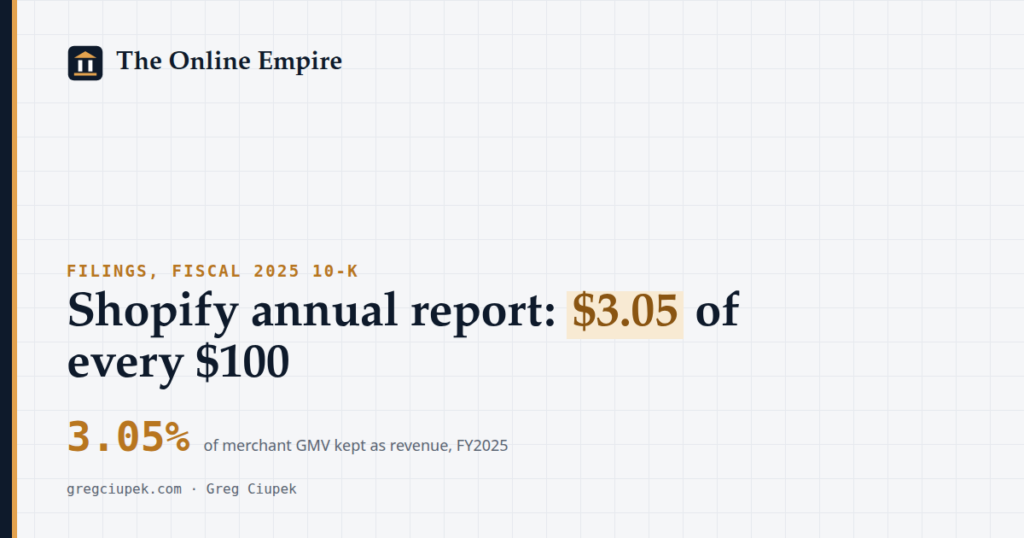
- My calculation: Shopify keeps $3.05 of every $100 merchants sell, and $1.47 of that is gross profit after card-network and other direct costs.
- Gross margin fell to 48.1% from 50.4%; net income fell to $1.23 billion from $2.02 billion, while operating income rose 37% to $1.47 billion.
- Headcount dropped from about 8,100 to about 7,600, so revenue per employee rose from $1.10 million to $1.52 million.
Contents · 8 sections
- 01Shopify annual report: which filing is the latest and where do you find it?
- 02Shopify annual report figures: revenue, margin, GMV and take rate in one table
- 03Shopify annual report revenue split: what is subscription vs merchant solutions?
- 04Shopify annual report margins: why did gross margin fall to 48%?
- 05Shopify annual report from a merchant's side: how does 3.05% compare with what a small store pays?
- 06Shopify annual report details: where do merchants sit and how big is the team?
- 07Frequently asked questions
- 08Sources
This is for you if you sell on Shopify, or are deciding whether to, and want the company's own numbers instead of press-release headlines. A 10-K carries legal liability under US securities law, so it is the most careful account Shopify gives of how it makes money from merchants like you.
I downloaded the filing from SEC EDGAR on 8 Nov 2026 and recalculated the figures that matter to a merchant. Everything below is in US dollars, as Shopify reports it. This is not investment advice, and I make no claim about the share price.
Shopify annual report: which filing is the latest and where do you find it?
The latest Shopify annual report is the Form 10-K for the fiscal year ended 31 Dec 2025, filed with the SEC on 11 Feb 2026 under accession number 0001594805-26-000007. Shopify, a Canadian company, has filed a US-style 10-K only since fiscal 2024; earlier annual reports were 40-F forms.
The filing history on EDGAR (Shopify's company ID, CIK, is 1594805) shows the switch: a 20-F for fiscal 2015, 40-F forms for fiscal 2016 to 2023, then 10-K forms filed on 11 Feb 2025 and 11 Feb 2026. In the amendment of 29 Apr 2026, Shopify writes that it qualifies as a foreign private issuer and is not required to file 10-K forms, but has chosen to.
That amendment (10-K/A) adds only Part III: directors, executive pay and share ownership. The financial statements and the merchant metrics are in the original filing of 11 Feb 2026. The next annual report, for fiscal 2026, should follow in early 2027 if Shopify keeps its February pattern.
The earnings release leads with growth rates and adjusted figures. The 10-K gives the full income statement, cost of each revenue line, revenue by country and headcount, with three years side by side. That is what I use below.
Shopify annual report figures: revenue, margin, GMV and take rate in one table
In fiscal 2025 Shopify reported $11,556 million revenue on $378,441 million of gross merchandise volume, per its 10-K filed 11 Feb 2026. Dividing one by the other gives a take rate of 3.05% of everything merchants sold, up from 3.04% in 2024 and 2.99% in 2023.
The filing gives the inputs; the ratios in the right-hand columns are my own calculations from them. "Take rate" is not a term Shopify uses in the 10-K, so treat it as my label for revenue ÷ GMV.
| Figure | FY2025 | FY2024 | FY2023 | Source line or my formula |
|---|---|---|---|---|
| Total revenue | 11,556 | 8,880 | 7,060 | Income statement |
| Subscription solutions revenue | 2,752 | 2,350 | 1,837 | Income statement |
| Merchant solutions revenue | 8,804 | 6,530 | 5,223 | Income statement |
| Gross profit | 5,555 | 4,472 | 3,515 | Income statement |
| Gross margin | 48.1% | 50.4% | 49.8% | Gross profit ÷ revenue |
| Subscription gross margin | 81.1% | 81.5% | 80.7% | (Revenue − cost) ÷ revenue, subscription line |
| Merchant solutions gross margin | 37.7% | 39.1% | 38.9% | (Revenue − cost) ÷ revenue, merchant line |
| Income from operations | 1,468 | 1,075 | −1,418 | Income statement |
| Net income | 1,231 | 2,019 | 132 | Income statement |
| GMV | 378,441 | 292,275 | 235,910 | Key performance indicators |
| Take rate | 3.05% | 3.04% | 2.99% | Revenue ÷ GMV |
| … of which subscription | 0.73% | 0.80% | 0.78% | Subscription revenue ÷ GMV |
| … of which merchant solutions | 2.33% | 2.23% | 2.21% | Merchant revenue ÷ GMV |
| Gross profit per $100 of GMV | $1.47 | $1.53 | $1.49 | Gross profit ÷ GMV × 100 |
| Monthly Recurring Revenue (31 Dec) | 205 | 178 | 144 | Key performance indicators |
| Employees (31 Dec, approx.) | 7,600 | 8,100 | n/a | Human capital section, FY2025 and FY2024 10-K |
| Revenue per employee | $1.52m | $1.10m | n/a | Revenue ÷ employees |
Two definitions from the filing matter for reading this. GMV is the value of orders on the platform "net of refunds", including shipping, duty and VAT, and Shopify stresses that it "does not represent revenue earned by us". MRR is the value of all subscription plans on the last day of the year, excluding variable platform fees.
Shopify annual report revenue split: what is subscription vs merchant solutions?
Subscription solutions is what merchants pay for plans, apps, themes and domains: $2.75 billion, or 24% of 2025 revenue. Merchant solutions is mostly Shopify Payments processing and currency fees, plus lending, shipping labels, hardware and ads: $8.80 billion, or 76%, per the 10-K filed 11 Feb 2026.
The 10-K is explicit that Shopify has a single operating and reportable segment; subscription and merchant solutions are revenue lines, not segments. The split still tells you where the money comes from. In 2025, merchant solutions grew 35% and subscription solutions 17%.
The engine is Shopify Payments. The filing reports a penetration rate of 65.6% in 2025 (61.9% in 2024), meaning $248.1 billion of GMV went through Shopify's own checkout payments. Of merchants where Shopify Payments is available, 88% in North America, 89% in APAC and 83% in EMEA used it at 31 Dec 2025.
Shopify annual report margins: why did gross margin fall to 48%?
Shopify's gross margin fell from 50.4% in 2024 to 48.1% in 2025 because the low-margin merchant solutions line grew twice as fast as subscriptions. By my calculation from the 10-K, subscriptions keep 81 cents of each dollar, merchant solutions about 38 cents, after card-network and processing costs.
The filing says so directly: payment margins are lower "due to the associated third-party costs", meaning Visa, Mastercard and American Express fees and third-party processors. Cost of merchant solutions rose 38% to $5,481 million. As payments become a bigger share, the blended margin drifts down even when both lines are healthy.
Below gross profit, two lines are worth a merchant's attention. Transaction and loan losses, mostly unrecovered refunds and disputes on Shopify Payments plus Shopify Capital lending, rose 84% to $417 million: about 17 cents per $100 of Shopify Payments GMV by my calculation. That is the risk Shopify carries when it holds back payouts or reviews a store.
Net income fell 39% to $1,231 million, but that is not a weaker core business. Income from operations rose 37% to $1,468 million. The drop comes from investments: a $316 million loss on equity and equity-method investments in 2025 after an $853 million gain in 2024. Quote operating income when you compare years.
Shopify annual report from a merchant's side: how does 3.05% compare with what a small store pays?
A small store pays more than the 3.05% average: on the Basic plan at $39 a month and Shopify Payments at 2.9% + 30¢ (US pricing captured 7 Nov 2026), a store selling $5,000 a month in 100 orders pays about $214, or 4.3% of sales. The average is pulled down by large Plus merchants.
The 10-K itself says most merchants are on the Basic and Grow plans, but most GMV comes from Shopify Plus and enterprise merchants. Those negotiate their rates, so the platform-wide average is not your rate. Here is the step-by-step with list prices; replace the sales and order count with yours.
- Plan. Shopify Basic, billed monthly: $39 (US pricing page, Internet Archive capture of 7 Nov 2026).
- Card fees. 100 orders of $50: 2.9% × $5,000 = $145, plus 100 × $0.30 = $30, so $175.
- Total. $39 + $175 = $214 a month, or 4.28% of $5,000 in sales.
- Scale it up. At $50,000 a month in 1,000 orders: $39 + $1,450 + $300 = $1,789, or 3.58%. The fixed plan fee matters less; the per-order 30¢ matters more with small baskets.
- Compare. Shopify's own average is 3.05% of GMV in revenue and $1.47 per $100 in gross profit. Most of the gap between the two is card-network cost that Shopify passes on, not profit.
Apps, themes and paid ads come on top and are not in this sum. For the full cost of one order, including refunds and ad spend, use my dropshipping profit margin calculation; for the build itself, see how to start an online store.
Shopify annual report details: where do merchants sit and how big is the team?
By merchant location, 63% of Shopify's 2025 revenue came from the United States ($7,331 million), 21% from EMEA ($2,426 million), 10% from APAC, 5% from Canada and 1% from Latin America, per note 23 of the 10-K filed 11 Feb 2026. EMEA grew fastest, about 42% by my calculation.
The filing counts merchants in more than 175 countries but does not give a merchant total, so I do not quote one. It does give headcount: about 7,600 employees at 31 Dec 2025, down from about 8,100 a year earlier (FY2024 10-K), after a 23% cut in May 2023. Revenue grew 30% with 6% fewer people.
Seasonality is visible too: the fourth quarter brought $3,672 million, 31.8% of the year's revenue, because merchant solutions follow holiday GMV. The filing warns that the business may become more seasonal as payments grow.
My own stores run in Poland on my own platform, not on Shopify, so I have no Shopify GMV of my own to show. What I measured is the other end of the funnel: an adult-industry store of mine converted 1.76% of visitors after fixing payments, with 14% of carts becoming orders (24 Oct 2026). Payment friction costs more than any fee. Why most new stores never reach the volumes in this report is covered in is dropshipping worth it; more filings are under Reports.
Frequently asked questions
Where can I download the Shopify annual report?
On SEC EDGAR, under Shopify Inc., CIK 1594805. The fiscal 2025 Form 10-K was filed on 11 Feb 2026 (accession 0001594805-26-000007). Use the SEC copy, not a summary, when you quote numbers.
Does Shopify file a 10-K or a 40-F?
A 10-K, since fiscal 2024. Before that, Shopify filed 40-F annual reports for fiscal 2016 to 2023 and a 20-F for fiscal 2015. It says it qualifies as a foreign private issuer but chose US domestic forms.
What is Shopify's take rate?
Shopify does not publish one in the 10-K. Dividing 2025 revenue of $11,556 million by GMV of $378,441 million gives 3.05%, my calculation. A small merchant on list prices pays more, about 4.3% in my $5,000-a-month example.
How many employees does Shopify have?
About 7,600 at 31 Dec 2025, per the fiscal 2025 10-K, down from about 8,100 a year earlier. Shopify describes itself as remote-first, with in-person gatherings during the year.
Is this a reason to buy or sell Shopify shares?
No. I read the filing to understand how Shopify earns from merchants, not to value the company. I give no investment advice; for that, speak to a licensed adviser.
Sources
- Shopify Inc., Form 10-K for the fiscal year ended 31 Dec 2025, accession 0001594805-26-000007 (filed 11 Feb 2026, read 8 Nov 2026): sec.gov
- Shopify Inc., Form 10-K/A (Amendment No. 1, Part III) for fiscal 2025, accession 0001594805-26-000011 (filed 29 Apr 2026, read 8 Nov 2026): sec.gov
- Shopify Inc., Form 10-K for the fiscal year ended 31 Dec 2024, accession 0001594805-25-000012 (filed 11 Feb 2025, read 8 Nov 2026): sec.gov
- SEC EDGAR, Shopify Inc. filing history, CIK 1594805 (read 8 Nov 2026): sec.gov
- Shopify, Pricing, US (Internet Archive capture of 7 Nov 2026): web.archive.org
As of 8 Nov 2026. I downloaded Shopify's fiscal 2025 Form 10-K (filed 11 Feb 2026), its 10-K/A (29 Apr 2026), the fiscal 2024 10-K (11 Feb 2025) and the EDGAR filing list from sec.gov on 8 Nov 2026. All company figures are as reported in US dollars; take rate, margins by line, gross profit per $100 of GMV, loss rate on Shopify Payments GMV, regional growth and revenue per employee are my calculations from those figures. Shopify Basic and Shopify Payments US prices come from an Internet Archive capture of 7 Nov 2026; the $5,000 and $50,000 stores are examples. Store conversion data from my own server logs and order data (24 Oct 2026). No investment advice.