- Dropshipping in the USA is legal, but the store that takes the payment is the seller: it answers for sales tax and for shipping on time, whoever packs the parcel.
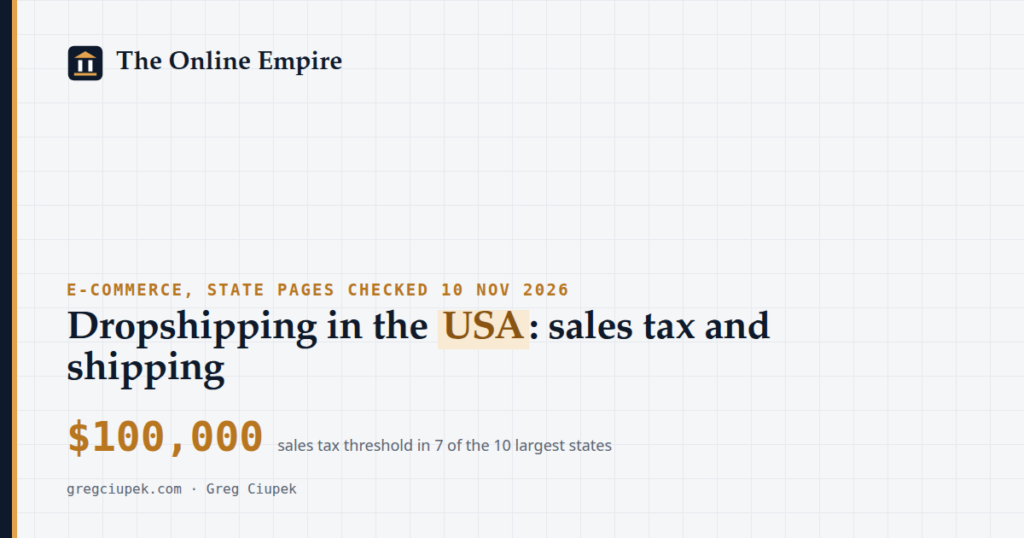
- Sales tax follows the buyer's state. Since South Dakota v. Wayfair (21 Jun 2018) a state can require you to collect without any physical presence once you pass its threshold: $100,000 in most of the big states, $500,000 in California, Texas and New York (state revenue pages checked 10 Nov 2026).
- Only Ohio and Georgia in my table still count transactions (200 sales). New York requires both $500,000 and more than 100 sales. Illinois dropped its 200-transaction test on 1 Jan 2026.
- Shipping: under the FTC Mail Order Rule you must have a reasonable basis to ship within the time you state, or within 30 days if you state none, and offer a cancel-and-refund option when you cannot.
Contents · 8 sections
- 01Dropshipping USA: who is the seller, and who owes sales tax?
- 02Dropshipping USA sales tax: when do you have to collect in each state?
- 03Dropshipping USA: what sales tax issues are specific to dropshipping?
- 04Dropshipping USA shipping: what does the FTC 30-day rule require?
- 05Dropshipping USA suppliers: how do they change your tax and shipping?
- 06Dropshipping USA step by step: how do you set up a compliant store?
- 07Frequently asked questions
- 08Sources
This guide is for you if you plan a dropshipping store for US customers, from inside the US or from abroad with a US LLC. Two rules decide whether it stays out of trouble: state sales tax and the federal rule on shipping times.
My own stores are in Poland, so I have no US sales to show. On 10 Nov 2026 I opened the revenue department pages of the ten largest sales-tax states, plus the FTC rule, and put the thresholds on one grid with the date I checked each one. This is not legal or tax advice; state revenue departments and a US tax professional have the final word.
Dropshipping USA: who is the seller, and who owes sales tax?
In US dropshipping the seller is the store that takes the customer's order and money, not the supplier that ships it. The FTC's Mail Order Rule guide says the person soliciting the order, not the agent fulfilling it, is the seller, and state sales tax laws likewise put collection on the retailer (FTC and state pages read 10 Nov 2026).
A dropshipping order is two sales: the supplier sells to you (a sale for resale), and you sell to the customer (the retail sale, taxed where the goods are delivered). There is no federal sales tax; each state sets its own threshold, period and forms.
Dropshipping USA sales tax: when do you have to collect in each state?
A US dropshipper must collect a state's sales tax once it has economic nexus there: in most large states more than $100,000 of sales into the state in a calendar or rolling year, and $500,000 in California, Texas and New York. These are the thresholds on each state's revenue department page, checked 10 Nov 2026.
Economic nexus is the tax link a seller creates with a state just by selling into it. In South Dakota v. Wayfair (21 Jun 2018) the Supreme Court overruled the physical-presence rule and upheld a law covering sellers with more than $100,000 of sales or 200 or more transactions a year into the state. Most states copied it; many have since dropped the transaction count.
| State | Sales threshold | Transaction rule | Measured over | When collection starts (where the page says) |
|---|---|---|---|---|
| California | More than $500,000 of tangible goods delivered into CA (seller plus related persons) | None | Preceding or current calendar year | Register with CDTFA once over |
| Texas | $500,000 of total Texas revenue, including nontaxable and resale sales | None | Preceding 12 calendar months | No later than the first day of the fourth month after you exceed it |
| New York | More than $500,000 of goods delivered into NY | AND more than 100 sales (both needed) | Immediately preceding four sales tax quarters | Register immediately |
| Florida | More than $100,000 of taxable remote sales | None ("any number of transactions") | Previous calendar year | Rule in force since 1 Jul 2021 |
| Illinois | $100,000 or more in gross receipts | None from 1 Jan 2026 | Preceding 12 months, checked each quarter | Then remit for one year and re-test |
| Pennsylvania | $100,000 in gross sales into PA | None | Prior calendar year | Register, or use a certified service provider |
| Ohio | More than $100,000 of sales to Ohio customers | OR 200 or more separate sales | Current or previous calendar year | Ohio's example: over $100,000 on 15 Oct, first return due 23 Nov |
| Georgia | More than $100,000 of gross revenue from retail sales | OR 200 or more separate retail sales | Previous or current calendar year | Rule in force since 1 Jan 2020 |
| North Carolina | More than $100,000 of gross sales, marketplace sales included | None | Previous or current calendar year | From 2 Jul 2026: first day of the first month at least 60 days after you exceed it |
| Washington | More than $100,000 of combined gross receipts sourced to WA (all WA income, marketplace sales included) | None | Current or prior year | First day of the month at least 30 days after you meet it |
Three details from the pages. Texas counts nontaxable revenue, such as sales for resale. Washington and North Carolina count your marketplace sales toward your threshold. And Illinois contradicts itself: its general sales tax page, checked 10 Nov 2026, still lists "200 or more separate transactions", while its own help guide PIO-125 (revised March 2026) applies only the $100,000 test from 1 Jan 2026. I used the guide, which is the newer document.
Oregon, Montana and Delaware say on their revenue sites (checked 10 Nov 2026) that they have no general sales tax; Delaware instead taxes the seller's gross receipts. Alaska has no statewide sales tax, but many local governments collect through the Alaska Remote Seller Sales Tax Commission, whose threshold is $100,000 of statewide annual gross sales in the previous calendar year. New Hampshire is the fifth state usually on this list; its revenue site refused my request on 10 Nov 2026, so confirm it at revenue.nh.gov.
If you have a physical presence in a state, for example stock in a warehouse there, the thresholds do not protect you: North Carolina and Ohio both say such sellers must collect from the first sale.
Dropshipping USA: what sales tax issues are specific to dropshipping?
US dropshipping adds two tax problems an ordinary store does not have: your supplier may charge you sales tax unless you give it a valid resale certificate, and in some states, California among them, a supplier with nexus can be made to pay tax on your sale if you are not registered there (CDTFA Regulation 1706, read 10 Nov 2026).
Resale certificates
A resale certificate is a form you give your supplier to show you are buying to resell, so the supplier does not charge you sales tax. Illinois, for example, uses Form CRT-61 and puts the duty to verify it on the supplier. Ask suppliers which certificates they accept before the first order.
California's drop shipment rule
California has a regulation written for exactly this setup. If you, the "true retailer", are not engaged in business in California and your supplier is, the supplier is reclassified as the retailer and must pay tax measured by your retail price. It may estimate that price as its own price to you plus a 10% mark-up (Regulation 1706, amended 30 Nov 2021).
Marketplace facilitator rules
If you sell through a marketplace such as Amazon or eBay, the marketplace usually collects and remits the tax on those sales. Texas says a seller using only a marketplace that certifies it collects for them does not need a Texas permit, but must keep records of those sales for at least four years. Your own Shopify or WooCommerce store is not a marketplace for this purpose: there, the tax is yours.
Dropshipping USA shipping: what does the FTC 30-day rule require?
For US online orders, the FTC Mail Order Rule (16 CFR 435.2, read on eCFR 10 Nov 2026) says you must have a reasonable basis to ship within the time you advertise, or within 30 days of a completed order if you state no time. If you cannot, you must offer the buyer a delay or a cancellation with a prompt refund.
- "Ship" means hand to the carrier. The FTC guide defines shipment as placing the goods in the carrier's possession, not delivery. A supplier's "processing time" counts against you.
- 50 days if the buyer applies to you for credit with the order, instead of 30.
- Delay notice. Before the promised time runs out, you must offer the buyer a choice to accept the delay or cancel for a full refund, give a definite revised date (or say you cannot), and give a way to cancel at your expense. For a delay over 30 days, the order is cancelled unless the buyer agrees.
- Prompt refund. Within 7 working days for cash or check payments, or within one billing cycle for card payments.
The FTC's guide (edited Jan 2025) puts civil penalties at up to $53,088 per violation. The rule gives no change-of-mind return right; returns are your policy plus state law.
Shipping settings fail quietly. On GAPLI, the dropshipping platform I own, I found that every extra item in a basket was charged as a full extra parcel, about $3.25 each (converted at the October 2026 rate). No order failed; customers simply saw a higher shipping line. Put a two-item order through your store before launch and read the shipping line as a buyer would.
A note on fit: GAPLI connects stores with Polish wholesalers and couriers. For a store selling to US customers it is probably not the right choice, because its suppliers and carriers are not in your buyers' market.
Dropshipping USA suppliers: how do they change your tax and shipping?
For US dropshipping, where your supplier ships from decides most of your risk: a US warehouse makes the FTC 30-day rule easier to meet and may raise the resale-certificate question, while an overseas supplier makes shipping times harder to promise. Both effects follow from the state and FTC rules checked 10 Nov 2026.
Get in writing each supplier's handling time, carrier, ship-from location and whether it adds sales tax to your invoices. A basket from two suppliers means two parcels and two shipping charges. I go through vetting in how to vet dropshipping suppliers and the margin side in dropshipping profit margin.
Dropshipping USA step by step: how do you set up a compliant store?
Setting up a US dropshipping store takes seven steps: choose a legal entity, pick suppliers with written shipping times, state realistic delivery times, sort out resale certificates, track sales by state against each threshold, register when you pass one, and test an order. The rules come from state revenue pages and the FTC, read 10 Nov 2026.
- Choose the entity. See LLC for an online business or, from abroad, LLC for non-US residents.
- Pick suppliers with written terms. Ship-from location, handling time, carrier, resale certificates.
- State shipping times you can meet. Supplier handling time plus a margin; with none stated, the FTC's 30 days apply.
- Handle resale certificates. Ask which certificate each supplier accepts, and check whether California's Regulation 1706 affects you.
- Track sales by state every month. Dollars and order counts per state, against the table above. New York needs both tests, Ohio and Georgia either one.
- Register when you pass a threshold. Collect from the date the state sets: in Texas the fourth month, in Washington about 30 days later. Ohio's out-of-state seller license has no fee, according to its revenue site.
- Test one order. Check the tax and shipping lines, and draft the FTC delay email in advance.
A UK online buyer can cancel for any reason up to 14 days after delivery, and goods must arrive within 30 days unless agreed otherwise (GOV.UK, checked 10 Nov 2026). The US federal rule has no such cancellation right. The UK side, with VAT, is in dropshipping in the UK; more guides are in the e-commerce topic.
Frequently asked questions
Is dropshipping legal in the USA?
Yes. The general rules for online sellers apply: state sales tax laws, the FTC Mail Order Rule on shipping times and the FTC Act on advertising. The store that takes the payment carries those duties, whatever the supplier's terms say.
Do I need to collect sales tax in every state?
No. You collect in states where you have a physical presence and in states where your sales pass the economic nexus threshold, such as $100,000 in Florida or $500,000 in California (checked 10 Nov 2026). Oregon, Montana and Delaware have no general sales tax.
Does a non-resident's LLC have to collect US sales tax?
The thresholds in my table apply to remote sellers selling into the state, wherever they live. How a foreign-owned business registers is a question for each state's revenue department and a US tax professional.
How long can a US dropshipping order take to ship?
As long as you clearly state, provided you have a reasonable basis to meet it. If you state nothing, the FTC rule gives you 30 days from a completed order. When you cannot ship on time, you must offer the buyer a delay or a full prompt refund.
Sources
- Supreme Court of the United States, South Dakota v. Wayfair, Inc., No. 17-494 (decided 21 Jun 2018, read 10 Nov 2026): law.cornell.edu
- CDTFA, Wayfair implementation, collection of California use tax by remote sellers (checked 10 Nov 2026): cdtfa.ca.gov
- CDTFA, Regulation 1706, Drop Shipments (amended 30 Nov 2021, read 10 Nov 2026): cdtfa.ca.gov
- Texas Comptroller, Remote Sellers (checked 10 Nov 2026): comptroller.texas.gov
- New York State Department of Taxation and Finance, Registration requirement for businesses with no physical presence in New York State (updated 29 Jul 2026, checked 10 Nov 2026): tax.ny.gov
- Florida Department of Revenue, Sales and Use Tax (checked 10 Nov 2026): floridarevenue.com
- Illinois Department of Revenue, PIO-125, Determining Physical Presence or When the Tax Remittance Threshold Has Been Met (R-03/26, read 10 Nov 2026): tax.illinois.gov
- Illinois Department of Revenue, Retailers' Occupation Tax (checked 10 Nov 2026): tax.illinois.gov
- Pennsylvania Department of Revenue, Online Retailers (checked 10 Nov 2026): pa.gov
- Ohio Department of Taxation, Sales and Use Tax: Substantial Nexus and Marketplace Facilitator FAQ (checked 10 Nov 2026): tax.ohio.gov
- Georgia Department of Revenue, Out-of-State Sellers, and Policy Bulletin SUT-2019-02 (7 May 2019, checked 10 Nov 2026): dor.georgia.gov
- North Carolina Department of Revenue, Remote Sales (checked 10 Nov 2026): ncdor.gov
- Washington Department of Revenue, Marketplace sellers (checked 10 Nov 2026): dor.wa.gov
- Oregon Department of Revenue, Sales Tax in Oregon (checked 10 Nov 2026): oregon.gov
- Montana Department of Revenue, Sales Tax Guidance (checked 10 Nov 2026): revenue.mt.gov
- Delaware Division of Revenue, Doing Business in Delaware (checked 10 Nov 2026): revenue.delaware.gov
- Alaska Remote Seller Sales Tax Commission, FAQ (checked 10 Nov 2026): arsstc.org
- eCFR, 16 CFR Part 435, Mail, Internet, or Telephone Order Merchandise (read 10 Nov 2026): ecfr.gov
- FTC, Business Guide to the FTC's Mail, Internet, or Telephone Order Merchandise Rule (Sep 2011, edited Jan 2025, read 10 Nov 2026): ftc.gov
- GOV.UK, Online and distance selling for businesses (checked 10 Nov 2026): gov.uk
As of 10 Nov 2026. That day I read each state revenue page above, the Wayfair opinion, 16 CFR 435 on eCFR, the FTC business guide and the GOV.UK selling page. Thresholds change; the date of each page is in the sources. New Hampshire's revenue site blocked my request, so it is not confirmed here. The $3.25 shipping figure is from my GAPLI platform in Poland, converted at the October 2026 rate. I have no US sales of my own. Not legal or tax advice: check your case with the state revenue department or a US tax professional.