- Dropshipping in the UK is legal, but the store that takes the payment is the seller: delivery within 30 days unless agreed, a 14-day cancellation right after delivery, a refund within 14 days.
- VAT: a UK-based seller registers above £90,000 (about $120,464) of turnover in 12 months; a seller based outside the UK, such as a US LLC, has no threshold (HMRC VAT Notice 700/1, checked 9 Nov 2026).
- Parcels from abroad worth £135 or less (about $181): you charge UK VAT at checkout. The duty relief on them ends by October 2028 at the latest (HMRC, 28 Oct 2026).
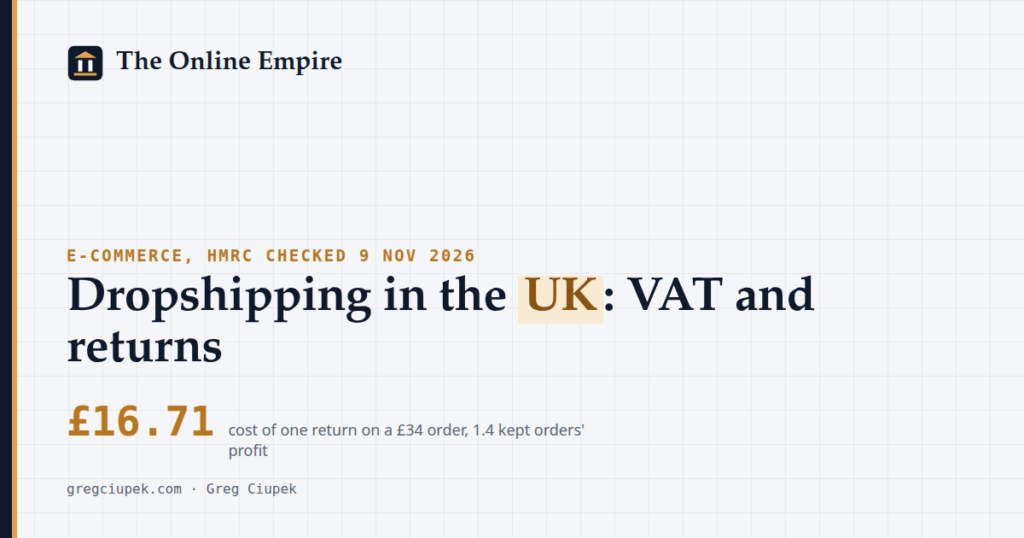
- My worked £34 order: VAT takes £5.67, a third of the profit, and one return costs £16.71, the profit of 1.4 kept orders.
Contents · 8 sections
- 01Dropshipping UK: who is the seller, and who answers for VAT and returns?
- 02Dropshipping UK VAT: which rule applies to your order?
- 03Dropshipping UK: what does VAT do to one order? A worked example
- 04Dropshipping UK returns: what must you refund, and by when?
- 05Dropshipping UK step by step: how do you set up a compliant store?
- 06Dropshipping UK customs: what changes for parcels under £135 by October 2028?
- 07Frequently asked questions
- 08Sources
This guide is for you if you want to dropship to UK customers, from inside the UK or from abroad with, say, a US LLC. VAT and returns decide whether a UK order makes money, and both differ from the US.
My own stores run in Poland, under EU VAT, so I have no UK sales to show. On 9 Nov 2026 I read the HMRC notices and the legislation, built one decision table and worked out one order and one return in pounds. This is not legal or tax advice; HMRC and a UK tax adviser have the final word.
Dropshipping UK: who is the seller, and who answers for VAT and returns?
In UK dropshipping the seller is the business whose store takes the customer's money, not the supplier who ships the parcel. GOV.UK guidance and the Consumer Contracts Regulations 2013 (both read 9 Nov 2026) put pre-order information, delivery within 30 days, the 14-day cancellation right and the refund on that store.
If the supplier refuses returns or ships late, the customer's claim is still against you. A sale through your own Shopify or WooCommerce store is also a direct sale for VAT; only on a marketplace can HMRC make the marketplace liable instead.
Dropshipping UK VAT: which rule applies to your order?
For UK dropshipping, VAT depends on two facts: where your business is established and where the goods are when you sell them. A UK-based seller has a £90,000 registration threshold; a seller based outside the UK has none; and parcels from abroad worth £135 or less carry VAT at checkout, per HMRC guidance read 9 Nov 2026.
HMRC spreads these rules over four pages; here they are on one grid.
| Your setup | VAT registration | Who charges the VAT | Customs duty today |
|---|---|---|---|
| UK-based seller, supplier stock already in the UK | Above £90,000 taxable turnover in a rolling 12 months (or expected in the next 30 days) | You, 20% standard rate, once registered | None (no import) |
| Seller based outside the UK (for example a US LLC), any stock location | From the first taxable UK sale (no threshold since 1 Dec 2012) | You, from the first sale | See rows below |
| Parcel of £135 or less sent from abroad, sold through your own store | The seller registers, per HMRC | You, at the point of sale | None (non-excise); relief ends by Oct 2028 |
| Parcel over £135 sent from abroad | Normal rules for your setup | Import VAT at the border (often the customer pays the courier) | Yes, per the UK Trade Tariff |
| Same goods sold through an online marketplace | Overseas sellers can apply for exemption | The marketplace (parcels up to £135, overseas sellers' UK stock) | As above |
Two details: the £135 limit applies to the whole consignment, not each item, and delivery you charge takes the same VAT rate as the goods (HMRC VAT Notice 700/24).
HMRC's overseas-goods page assumes the seller registers. If you are UK-based, under £90,000 and your supplier ships parcels of £135 or less from abroad, confirm with HMRC or an adviser how the point-of-sale rule applies to you. Northern Ireland has its own rules.
Dropshipping UK: what does VAT do to one order? A worked example
On a £34 UK dropshipping order (£30 item plus £4 delivery), a VAT-registered seller owes HMRC £5.67, one sixth of the price. With a £16 supplier bill and a £0.71 Stripe fee, profit drops from £17.29 to £11.62, a third less, on prices and fees checked 9 Nov 2026.
Prices are examples; the supplier is outside the UK, so there is no UK VAT on its bill to reclaim.
- Customer pays. £30 item + £4 delivery = £34.00 (about $45.51), VAT included, as UK consumer prices must be.
- VAT inside the price. At 20%, VAT is 20/120 of a VAT-inclusive price: £34 ÷ 6 = £5.67 (about $7.59), delivery included.
- Payment fee. Stripe's standard UK card rate (read 9 Nov 2026): 1.5% × £34 + £0.20 = £0.71.
- Supplier. £12 product + £4 shipping = £16.00.
- Profit. Not registered: £34 − £16 − £0.71 = £17.29 (50.9% of the price). Registered: £17.29 − £5.67 = £11.62 (about $15.55, 34.2%).
| Line | Not VAT-registered (UK seller, UK stock) | VAT-registered (or based outside the UK) |
|---|---|---|
| Customer pays | £34.00 | £34.00 |
| VAT to HMRC | £0.00 | −£5.67 |
| Stripe fee | −£0.71 | −£0.71 |
| Supplier (product + shipping) | −£16.00 | −£16.00 |
| Profit per kept order | £17.29 (about $23.14) | £11.62 (about $15.55) |
| One change-of-mind return (next section) | −£16.71 | −£16.71 |
| Kept orders needed to cover one return | about 1 | 1.4 |
This is before advertising, which I break down in dropshipping profit margin. If you are based outside the UK, the right-hand column applies from order one.
Tax settings fail quietly. On GAPLI, the dropshipping platform for Polish stores that I own, a localization bug once set VAT to 0% in about 50 stores (fixed in version 1.9.12). No order failed; only checking the numbers found it. Place one test order and read the VAT line.
Dropshipping UK returns: what must you refund, and by when?
A UK online buyer can cancel for any reason until 14 days after the goods arrive, and you must refund the price plus standard delivery within 14 days of getting the goods back or proof they were sent (Consumer Contracts Regulations 2013, regulations 30 and 34, read 9 Nov 2026). Your supplier's return policy does not change that.
- Tell the customer before the order. Without the cancellation information, the 14 days extend by up to 12 months (regulation 31).
- Return postage. The customer pays the direct cost of sending the goods back only if you told them so beforehand; otherwise it is yours (regulation 35(5) and (6)). They send the goods to the address you specify.
- Delivery charge. Refunded up to your cheapest standard option (regulation 34(2) and (3)).
- Used goods. You may deduct for handling beyond checking the item (regulation 34(9)).
- Faulty goods. Separately, a 30-day right to reject (Consumer Rights Act 2015, section 22).
The return in my example: you refund £34. Stripe keeps its £0.71 fee (its UK pricing page, read 9 Nov 2026). The £5.67 VAT comes back through your VAT return (HMRC guidance on returned goods). If the supplier will not take the item back, the £16 sits in stock. Result: −£16.71, against £11.62 profit on a kept order.
If returns go to a warehouse abroad and you did not say postage is on the customer, you pay that international postage. Agree returns with the supplier in writing before you list, as in how to vet dropshipping suppliers.
Dropshipping UK step by step: how do you set up a compliant store?
Setting up UK dropshipping takes seven steps: decide where your business is established, choose UK or overseas stock, register for VAT when the rules require it, set VAT-inclusive prices, publish the pre-order information, fix returns with the supplier and test one order. The rules are from GOV.UK and HMRC, read 9 Nov 2026.
- Decide where the business is established. Only a UK-established business gets the £90,000 threshold; HMRC says a registered or virtual office alone is not enough. Starting in the UK: see how to become a sole trader.
- Choose where the stock sits. UK warehouse, overseas parcels up to £135, or above: each is a different row in the table.
- Register for VAT when required. UK-based: within 30 days of the end of the month you passed £90,000. Based abroad: when you make, or expect within 30 days, a taxable UK sale.
- Set prices and tax in the store. VAT-inclusive prices, the right rate for your goods (20% standard), delivery taxed the same way, your VAT number on the site.
- Publish the pre-order information. Business name and address, total price with taxes, delivery costs and times, the 14-day right to cancel with a model form, and who pays return postage.
- Fix returns with the supplier. Address, change-of-mind returns, who pays. In writing, before the first listing.
- Test one order and keep records. Check the VAT line and the delivery charge. Keep VAT records for 6 years (HMRC).
Dropshipping UK customs: what changes for parcels under £135 by October 2028?
For UK dropshipping from abroad, the customs duty relief on parcels worth £135 or less will end on a date set by the Treasury, by October 2028 at the latest. HMRC's policy paper of 28 Oct 2026 also announces new declaration rules and UK fiscal representatives for overseas sellers.
Today, non-excise goods worth £135 or less carry no customs duty (GOV.UK). The paper moves the date forward from March 2029 and expects £225 million in 2028/29, rising to £550 million by 2031/32. The detailed regulations are not out, so there is no rate to quote. If your model relies on cheap parcels from abroad, plan for a duty line and check the UK Trade Tariff for your goods.
For US buyers, 16 CFR 435.2 (eCFR version of 5 Nov 2026) requires a reasonable basis to ship within the time you state, or 30 days if you state none (50 if the buyer applies to you for credit). If you cannot, offer a delay or cancellation with a refund within 7 working days, or one billing cycle for a credit card. It creates no change-of-mind return right; that is your policy and state law. More in the e-commerce topic.
For Polish buyers, my platform GAPLI connects stores with Polish wholesalers and couriers. For UK customers it is the wrong tool: its suppliers and carriers are not in your buyers' market.
Frequently asked questions
Is dropshipping legal in the UK?
Yes. The general rules for online sellers apply: the Consumer Rights Act 2015, the Consumer Contracts Regulations 2013 and HMRC's VAT rules. The store that takes the payment carries those duties, whatever the supplier's terms say.
Do I need to register for VAT to dropship in the UK?
A UK-established business registers once taxable turnover passes £90,000 in a rolling 12 months (HMRC, checked 9 Nov 2026). A business established outside the UK has no threshold and registers from the first taxable UK sale, unless it sells only to consumers through a marketplace.
Can a US LLC dropship to UK customers?
Yes, but HMRC treats it as a non-established taxable person: UK VAT registration from the first taxable sale, VAT at checkout on parcels of £135 or less from abroad, and VAT returns. A UK virtual office does not change that.
Who pays for returns in UK dropshipping?
The customer pays the direct cost of sending goods back only if you told them so before the order; otherwise you pay. Either way, you refund the price and standard delivery within 14 days of getting the goods back or proof of sending, even if your supplier refuses the return.
Sources
- HMRC, Who should register for VAT (VAT Notice 700/1) (updated 5 Aug 2026, checked 9 Nov 2026): gov.uk
- HMRC, VAT Notice 700/1: supplement, registration thresholds and deregistration limits (updated 5 Aug 2026, checked 9 Nov 2026): gov.uk
- GOV.UK, Register for VAT (checked 9 Nov 2026): gov.uk
- HMRC, VAT and overseas goods sold directly to customers in the UK (updated 13 May 2022, checked 9 Nov 2026): gov.uk
- HMRC, VAT and overseas goods sold to customers in the UK using online marketplaces (updated 13 May 2022, checked 9 Nov 2026): gov.uk
- HMRC, VAT and overseas goods sent to the UK and returned to the seller (updated 20 Jun 2025, checked 9 Nov 2026): gov.uk
- HMRC, Postage, delivery and direct marketing (VAT Notice 700/24) (updated 30 Sep 2022, checked 9 Nov 2026): gov.uk
- GOV.UK, Tax and customs for goods sent from abroad (checked 9 Nov 2026): gov.uk
- HMRC, Reforming the customs treatment of low value imports into the UK, policy paper (28 Oct 2026, checked 9 Nov 2026): gov.uk
- GOV.UK, Online and distance selling for businesses (checked 9 Nov 2026): gov.uk
- legislation.gov.uk, Consumer Contracts (Information, Cancellation and Additional Charges) Regulations 2013, regulations 29–31, 34 and 35 (read 9 Nov 2026): legislation.gov.uk
- legislation.gov.uk, Consumer Rights Act 2015, sections 22 and 28 (read 9 Nov 2026): legislation.gov.uk
- eCFR, 16 CFR Part 435, Mail, Internet, or Telephone Order Merchandise (version of 5 Nov 2026, read 9 Nov 2026): ecfr.gov
- Stripe, Pricing, United Kingdom (read 9 Nov 2026): stripe.com
- European Central Bank, Euro foreign exchange reference rates (6 Nov 2026): ecb.europa.eu
As of 9 Nov 2026. That day I read the HMRC and GOV.UK pages above (dates are the pages' own last-updated dates), the UK legislation, 16 CFR 435 (eCFR version of 5 Nov 2026) and Stripe's UK pricing. The £34 order and the return are examples: standard-rated goods, a supplier outside the UK, a customer in Great Britain. Pounds at ECB rates of 6 Nov 2026 (about $1.34). I have no UK sales of my own. Not legal or tax advice: check your case with HMRC or a UK tax adviser.