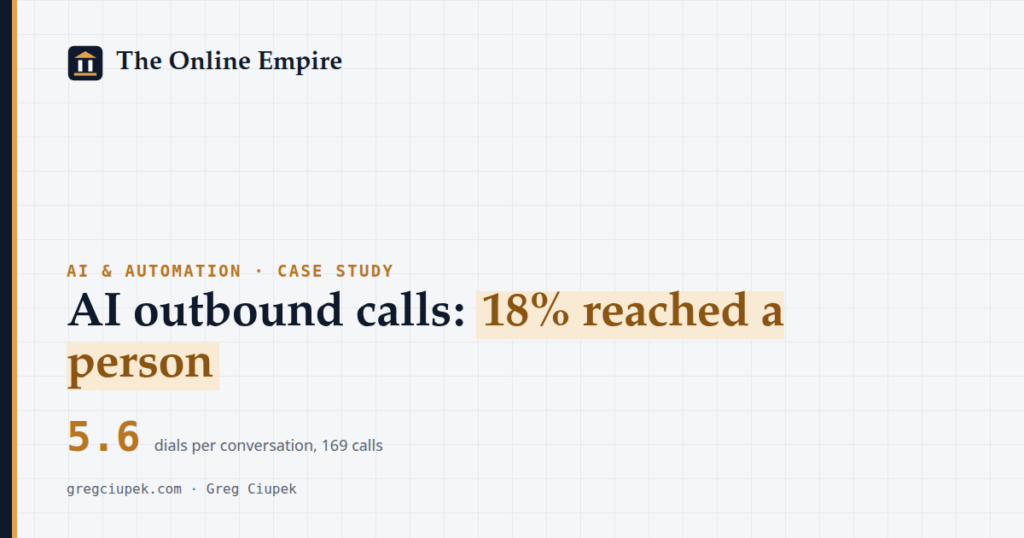
- Between 9 and 27 Oct 2026 our AI assistant Emily made 169 outbound calls. 94 went unanswered, 45 reached voicemail and 30 became a conversation (18%).
- That is 5.6 dials and 1.5 voicemails for every conversation, at about 3.1 calls per number dialed (169 calls to 54 numbers).
- Of 52 onboarding leads, 28 (54%) never had a conversation and 30 were closed by our stop rule after 3 unanswered calls in a row.
- Leads who talked moved forward a step about as often as those who did not (2 of 24 vs 2 of 28), and no sales are attributed to the calls.
- In the US an AI voice is an "artificial" voice under the TCPA (FCC, 8 Feb 2024), so outbound AI calls need prior consent.
Contents · 8 sections
- 01AI outbound calls: how many actually reach a person?
- 02How did our AI outbound call sequence work?
- 03Do AI outbound calls change what leads do?
- 04Are AI outbound calls legal in the US?
- 05Are AI outbound calls legal in the UK?
- 06When should you use AI outbound calls, and when not?
- 07Frequently asked questions
- 08Sources
This is for you if you are about to point an AI voice at a list of phone numbers: new customers to onboard, leads to qualify, carts to chase. Vendor demos show one perfect call. Below is the outbound side of a real assistant, with the dial math and the US and UK rules that apply before the first ring.
Emily works for GAPLI, my dropshipping platform for online stores, and runs on Telofia, my voice-assistant company. Both are mine, so weigh my view of them accordingly. Every number below comes from the GAPLI database, read on 27 Oct 2026, with 13 of my own test calls excluded.
AI outbound calls: how many actually reach a person?
In our data, fewer than one in five. Of 169 AI outbound calls Emily made between 9 and 27 Oct 2026, 30 (18%) became a conversation, 45 (27%) reached voicemail and 94 (56%) were not answered at all. The voice was not the bottleneck: most people simply did not pick up an unfamiliar number.
The ratios are my arithmetic on the database counts. They show what one conversation costs: about four and a half calls that reached nobody or a mailbox.
| Measure | Value | How it is calculated |
|---|---|---|
| Outbound calls | 169 | count from the database |
| Numbers dialed | 54 | 51 store operators + 3 others |
| Calls per number | 3.1 | 169 ÷ 54 |
| Unanswered | 94 (56%) | 94 ÷ 169 |
| Voicemail | 45 (27%) | 45 ÷ 169 |
| Conversation | 30 (18%) | 30 ÷ 169 |
| Calls that reached no person | 139 (82%) | 94 + 45 |
| Dials per conversation | 5.6 | 169 ÷ 30 |
| Voicemails per conversation | 1.5 | 45 ÷ 30 |
The full picture, including the inbound line where the same assistant resolved 63 of 136 calls (46%), is in AI phone assistant: 305 calls. This article stays on the outbound side.
How did our AI outbound call sequence work?
Our AI outbound calls ran on a fixed onboarding sequence from 9 Oct 2026: an announcement text message, then calls on day 0, 3, 7 and 14, built around 4 goal-based conversations that walk a new store operator through a 12-step journey. A lead was closed after 3 unanswered calls in a row, and anyone could ask not to be called.
- Announcement text. A message before the first call, so the number is not a stranger when it rings.
- Calls on day 0, 3, 7 and 14. Four slots, spaced so a missed call is not followed by another the same afternoon.
- One goal per conversation. Each of the 4 conversations moves the operator one step, not through all 12.
- Stop rule. After 3 unanswered calls in a row the lead is closed. 30 of 52 leads hit it.
- "Do not call" honored. 1 of 52 leads asked not to be called again, and the request ends the sequence.
Do AI outbound calls change what leads do?
In our onboarding data from 9 to 27 Oct 2026, no visible change. Of 24 leads who talked to the assistant at least once, 2 moved forward a step before the next call (about 8%); of 28 who never talked, 2 moved forward too (about 7%). No sales are attributed to the calls.
| Lead group | Leads | Share of 52 | Moved a step before next call |
|---|---|---|---|
| At least one conversation | 24 | 46% | 2 (about 8%) |
| No conversation | 28 | 54% | 2 (about 7%) |
| Closed after 3 unanswered calls in a row | 30 | 58% | n/a |
| Asked not to be called | 1 | 2% | n/a |
One detail is easy to miss: 30 leads were closed by the stop rule, but only 28 never talked. So at least 2 leads who had a conversation later stopped answering. A first conversation did not guarantee the next one.
52 onboarding leads: 24 with at least one conversation, 28 (54%) with none, 30 closed after 3 unanswered calls, 1 "do not call". Step progress before the next call: 2 of 24 who talked, 2 of 28 who did not. Sales attributed to calls: 0. Source: GAPLI database, read 27 Oct 2026.
The samples are small, and one operator either way would flip the comparison. I read it as "no effect shown yet", not proof that outbound calling never works. But it is the comparison I would demand from any vendor: people who were called against people who were not.
Are AI outbound calls legal in the US?
Yes, with consent. The FCC ruled on 8 Feb 2024 (FCC 24-17) that AI-generated voices are "artificial" voices under the TCPA, so AI outbound calls to cell phones need the called party's prior express consent, and telemarketing calls need prior express written consent. Calling hours, identification, opt-out and do-not-call rules apply on top.
The details below come from 47 CFR 64.1200 and the FTC's Telemarketing Sales Rule (16 CFR 310.4), both read on eCFR on 9 Nov 2026. Note that 64.1200(a)(1)(iii) covers any call to a cellular number made with an artificial voice, marketing or not, so a business owner's mobile is covered too.
| Rule | What it requires | Source |
|---|---|---|
| AI voice = artificial voice | Calls using AI-generated voices fall under the TCPA's artificial-voice limits | FCC 24-17, 8 Feb 2024 |
| Consent | Prior express consent for artificial-voice calls to cell phones; prior express written consent if the call is telemarketing | 47 CFR 64.1200(a)(1)–(3) |
| Say who is calling | At the beginning of the message, the registered name of the business responsible for the call | 64.1200(b)(1) |
| Opt-out on the call | Telemarketing with an artificial voice: a voice or key-press opt-out within 2 seconds of the identification; a voicemail must also give a toll-free opt-out number | 64.1200(b)(3) |
| Calling hours | No telephone solicitations before 8 a.m. or after 9 p.m., local time of the person called | 64.1200(c)(1); 16 CFR 310.4(c) |
| Do-not-call | Check the national registry (a version no more than 31 days old); keep your own list and honor requests for 5 years | 64.1200(c)(2), (d)(6) |
| Abandoned calls | Telemarketing: abandon no more than 3% of live-answered calls per campaign per 30 days; with written consent, an artificial-voice message that starts within 2 seconds of the greeting is not abandoned | 64.1200(a)(7) |
| Voicemail drops | "Ringless voicemail" to a wireless phone is a call and needs consent | FCC 22-85, 21 Nov 2022 |
| Revoking consent | Honor revocation within 10 business days; from 25 Nov 2026 a caller may name one of three methods (on-call opt-out, reply word such as "stop", a website or phone number) as the exclusive way to revoke, if it discloses it on the call | 64.1200(a)(10); FCC 26-67, 91 FR 67214, 26 Oct 2026 |
The 2-second line matters for AI in particular. Voice models often pause before they speak, and on a telemarketing campaign a slow first word after "hello" counts against the abandonment limit. Test your assistant's first-response delay on a real phone line, not only in the vendor's web demo.
For the US and UK rules side by side, with per-call damages and the new UK fine cap, see my TCPA and PECR guide to AI calls.
Are AI outbound calls legal in the UK?
For marketing, only with consent and a visible number. Regulation 19 of PECR (as amended on 16 May 2016) bans direct-marketing calls with recorded matter from an automated calling system unless the subscriber has consented to such calls from that caller and the caller's line identity is shown or a contact number is presented.
PECR defines an automated calling system as one that can start a sequence of calls automatically and transmit "sounds which are not live speech". On a plain reading, a synthetic voice dialing down a list fits that description, so I would plan for consent rather than argue the point. For live marketing calls, regulation 21 requires the caller's number to be shown and bans calls to numbers that have objected or are on the preference register kept under regulation 26, known as the Telephone Preference Service (with a 28-day grace period for new registrations). Regulation 26 also takes registrations from corporate subscribers, so calling businesses does not escape it.
Repeated dialing has its own risk: under section 128 of the Communications Act 2003, Ofcom can act against persistent misuse, meaning use of a network that unnecessarily causes annoyance, inconvenience or anxiety, repeated often enough to show a pattern. That is why our stop rule exists.
Emily calls store operators in Poland who signed up for the platform, so these US and UK rules do not govern her. If you copy the pattern for US or UK numbers: get consent first, say at the start that it is an AI and who is calling, show a number people can call back, keep a "do not call" list, respect calling hours and stop after a fixed number of tries. This is not legal advice: read the texts in the sources or ask a lawyer.
When should you use AI outbound calls, and when not?
Use AI outbound calls when the people on your list expect the call, agreed to it, and the call has one clear job. Skip them when the list is cold or the message fits in an email: in our data 139 of 169 outbound calls (82%) reached no person, and the 30 conversations did not visibly move onboarding by 27 Oct 2026.
What I would change: measure a control group from day one (email only against calls); treat voicemail as a channel of its own, since there were 1.5 for every conversation; and put the money where the assistant already works, on inbound calls. What an inbound receptionist handles and what five vendors charge is in AI receptionist for small business, and per-minute prices are in How much does an AI agent cost?
If you want a ready assistant, Telofia is here, and the store platform Emily calls for is GAPLI. Both are my companies, and neither is the right choice if your plan depends on cold outbound calling. More tests are in the AI & automation topic.
Frequently asked questions
What answer rate should I expect from AI outbound calls?
Ours was 30 conversations from 169 calls (18%) between 9 and 27 Oct 2026, with 94 unanswered and 45 voicemails. That was to people who had signed up for our platform and got a text before the first call. A cold list would likely do worse, but I have no data for one.
How many times should an AI assistant call the same number?
We used up to four call slots (day 0, 3, 7 and 14) and closed a lead after 3 unanswered calls in a row. On average Emily dialed each number about 3.1 times. Beyond that you add cost and annoyance, and in the UK repeated unwanted calls can count as persistent misuse.
Did the AI calls produce any sales?
No. As of 27 Oct 2026 no sales are attributed to Emily's outbound calls, and leads who talked to her moved forward a step about as often as those who did not (2 of 24 vs 2 of 28). The samples are small, so this shows no effect yet rather than proof of none.
Sources
- GAPLI database, Emily call and onboarding-lead records 9–27 Oct 2026, 13 owner test calls excluded (read 27 Oct 2026).
- Federal Communications Commission, Declaratory Ruling FCC 24-17 on AI technologies and the TCPA (released 8 Feb 2024, checked 9 Nov 2026): docs.fcc.gov
- Federal Communications Commission, Declaratory Ruling and Order FCC 22-85, All About the Message (ringless voicemail) (released 21 Nov 2022, checked 9 Nov 2026): docs.fcc.gov
- eCFR, 47 CFR 64.1200 Delivery restrictions (current text, read 9 Nov 2026): ecfr.gov
- eCFR, 16 CFR 310.4 Abusive telemarketing acts or practices (current text, read 9 Nov 2026): ecfr.gov
- Federal Register, FCC 26-67 Enhancing the Ability of Consumers To Control the Robocalls, 91 FR 67214 (published 26 Oct 2026, effective 25 Nov 2026, checked 9 Nov 2026): federalregister.gov
- UK legislation, Privacy and Electronic Communications (EC Directive) Regulations 2003, regulation 19 (as amended 2016, checked 9 Nov 2026): legislation.gov.uk
- UK legislation, Privacy and Electronic Communications (EC Directive) Regulations 2003, regulation 21 (as amended, checked 9 Nov 2026): legislation.gov.uk
- UK legislation, Communications Act 2003, section 128 (checked 9 Nov 2026): legislation.gov.uk
As of 9 Nov 2026. All of Emily's figures come from the GAPLI database as read on 27 Oct 2026 and cover 9–27 Oct 2026; ratios and percentages are my own arithmetic on those counts. The FCC rulings, 47 CFR 64.1200, 16 CFR 310.4, the Federal Register rule of 26 Oct 2026, PECR regulations 19 and 21 and section 128 of the Communications Act 2003 were checked on 9 Nov 2026.