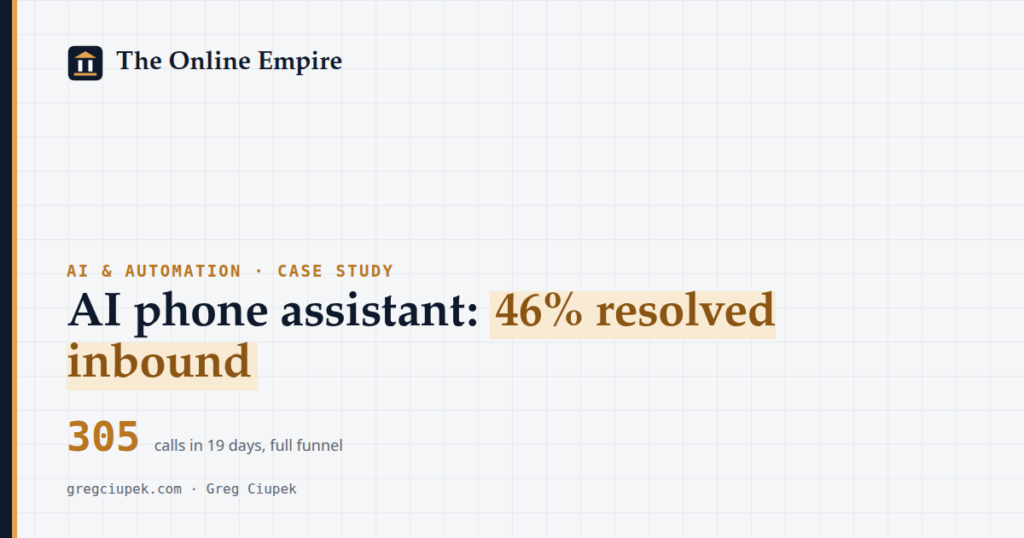
- Emily, the AI phone assistant of my dropshipping platform, went live on 9 Oct 2026. By 27 Oct 2026 she had handled 305 calls (13 of my own test calls excluded): 136 inbound and 169 outbound.
- Inbound worked: 63 of 136 calls resolved (46%), with 9 tickets opened during calls and 1 handover to a human.
- Outbound did not: 94 of 169 calls went unanswered, 45 reached voicemail and only 30 became a conversation (18%).
- Of 52 onboarding leads, 28 (54%) never had a conversation. Operators who talked moved forward a step about as often as those who did not (2 of 24 vs 2 of 28), and no sales are attributed to the calls.
Contents · 8 sections
- 01AI phone assistant results: what did 305 calls actually produce?
- 02How does an AI phone assistant handle inbound calls?
- 03Why did outbound AI phone calls reach only 18%?
- 04How do you set up an AI phone assistant? What I would copy
- 05Is an AI phone assistant legal for calls in the US and UK?
- 06When is an AI phone assistant not the right tool?
- 07Frequently asked questions
- 08Sources
This is for you if you run a store or a small company and you are deciding whether an AI phone assistant should answer your line, call your customers, or both. Vendor pages show the best call. Below is the whole funnel from the first 19 days of a real assistant, including the parts that went badly.
Emily works for GAPLI, my dropshipping platform for online stores, and she is built in Telofia, my voice-assistant company. Both are mine, so read the disclosures and weigh my opinion of them accordingly. The numbers come straight from the GAPLI database, read on 27 Oct 2026.
AI phone assistant results: what did 305 calls actually produce?
Between 9 and 27 Oct 2026, our AI phone assistant Emily handled 305 calls: 136 inbound, of which 63 were resolved (46%), and 169 outbound, of which 30 turned into a conversation (18%). The same period shows 0 sales attributed to the calls and 28 of 52 onboarding leads (54%) never reached in conversation.
Here is the full funnel in one table. The percentages are my arithmetic on the counts from the database; nothing is rounded up.
| Stage | Count | Share | Of what |
|---|---|---|---|
| All calls | 305 | 100% | all calls |
| Inbound calls | 136 | 45% | all calls |
| Inbound: resolved | 63 | 46% | inbound |
| Inbound: completed without "resolved" status | 70 | 51% | inbound |
| Inbound: in neither group | 3 | 2% | inbound |
| Inbound: ticket opened during the call | 9 | 7% | inbound |
| Inbound: handover to a human (with a ticket) | 1 | under 1% | inbound |
| Outbound calls | 169 | 55% | all calls |
| Outbound: unanswered | 94 | 56% | outbound |
| Outbound: voicemail | 45 | 27% | outbound |
| Outbound: conversation | 30 | 18% | outbound |
| Callback requests (all calls) | 15 | 5% | all calls |
| Onboarding leads | 52 | 100% | leads |
| Leads with at least one conversation | 24 | 46% | leads |
| Leads with no conversation | 28 | 54% | leads |
| Leads closed after 3 unanswered calls in a row | 30 | 58% | leads |
| Leads who asked not to be called | 1 | 2% | leads |
| Sales attributed to calls | 0 | 0% | all calls |
Two of my earlier articles use a slice of these numbers: AI agent examples sorts Emily among five automations, and How much does an AI agent cost? prices the same 305 calls. This one is the complete funnel.
How does an AI phone assistant handle inbound calls?
On inbound calls our AI phone assistant resolved 63 of 136 calls (46%) between 9 and 27 Oct 2026, completed another 70 without a "resolved" status, opened 9 tickets during calls and handed 1 caller to a human. Inbound is where an assistant is strongest: the caller wants something, and the answer is usually in the knowledge base.
The knowledge base matters more than the voice. Before launch, on 9 Oct 2026, Telofia's pre-launch test scored Emily 85/100, with 189 FAQs and 239 passages taken from 49 pages. When a question was outside that material, the right move was a ticket, not an improvised answer.
63 of the 136 inbound calls came from people without a GAPLI account. That is the same figure as the resolved count by coincidence; the two numbers measure different things. It means almost half of inbound callers were not customers yet, so the line also works as a sales-question desk, not only support.
70 inbound calls ended normally but were not marked resolved. The database tells me they ended without that status, not why, so I do not guess. I count only the 63 as successes, and the 70 are where I would look first for missing answers in the knowledge base.
Why did outbound AI phone calls reach only 18%?
Of 169 outbound calls Emily made between 9 and 27 Oct 2026, mostly to 51 store operators, 94 (56%) went unanswered, 45 (27%) reached voicemail and 30 (18%) became a conversation. People do not pick up unknown numbers, and an AI voice does not change that. Outbound was the weakest part of the whole funnel. The full dial math and the US and UK calling rules are in AI outbound calls.
The outbound job was onboarding: helping new store operators through a 12-step journey on the platform. The sequence was an announcement SMS, then calls on day 0, 3, 7 and 14, with 4 goal-based conversations, each aimed at moving the operator to the next step.
The result that matters is not the 18%. It is what happened after the calls. Of the 24 leads who talked to Emily at least once, 2 moved forward a step before the next call (about 8%). Of the 28 who never talked, 2 moved forward too (about 7%). On these counts the conversations did not visibly change progress, and no sales are attributed to them.
52 onboarding leads, 24 with at least one conversation, 28 (54%) with none. 30 leads were closed after 3 unanswered calls in a row and 1 asked not to be called again. Step progress before the next call: 2 of 24 who talked, 2 of 28 who did not. Sales attributed to calls: 0. Source: GAPLI database, read 27 Oct 2026.
The samples are small: a difference of one operator would flip the comparison. I read them as "no effect shown yet", not as proof that outbound calls never work.
How do you set up an AI phone assistant? What I would copy
Set up an AI phone assistant inbound-first: build the knowledge base, test it before launch (ours scored 85/100 on 9 Oct 2026 with 189 FAQs), route anything it cannot answer to a ticket, and measure resolved calls rather than total calls. Outbound comes later, with a stop rule and a "do not call" list from the first day.
- Write the knowledge base first. Emily's had 189 FAQs and 239 passages from 49 pages. An assistant can only resolve what is written down.
- Test before you go live. A scored pre-launch test (85/100 for Emily) shows which questions fail before a customer finds them.
- Give it an exit. Tickets and a human handover: 9 tickets and 1 handover inbound in 19 days. A dead end is worse than a ticket.
- Count "resolved", not "answered". Total calls make a pretty chart. Resolved calls (63 of 136) are the number that tells you if it works.
- Put a stop rule on outbound. Ours closes a lead after 3 unanswered calls in a row; 30 of 52 leads hit it. Without it the assistant keeps dialing people who have already said no by silence.
- Measure the result, not the call. Compare people who talked with people who did not (2 of 24 vs 2 of 28). If there is no difference, the calls are cost, not help.
The build itself, from tools to prompts, is covered in How to build an AI agent.
Is an AI phone assistant legal for calls in the US and UK?
Inbound calls are rarely the issue; outbound calls are. In the US, the FCC ruled on 8 Feb 2024 (FCC 24-17) that AI-generated voices are "artificial" voices under the TCPA, so such calls need prior express consent. In the UK, PECR regulation 19 requires prior consent for automated marketing calls with recorded matter.
United States: TCPA and the FCC ruling
The FCC's Declaratory Ruling of 8 Feb 2024 confirms that the TCPA's limits on "artificial or prerecorded voice" cover current AI technologies that generate human voices. Calls using them need the called party's prior express consent unless an emergency purpose or exemption applies. The same ruling points to 47 CFR 64.1200(b): the message must state at the beginning who is responsible for the call, and telemarketing messages must offer a way to opt out.
United Kingdom: PECR and Ofcom
Regulation 19 of PECR (as amended in 2016) bans direct-marketing calls with recorded matter from an automated calling system unless the subscriber has consented to such calls from that caller, and the caller's number is shown or a contact number is presented. Separately, section 128 of the Communications Act 2003 lets Ofcom act against "persistent misuse": repeated use of a network that unnecessarily causes annoyance, inconvenience or anxiety. A dialer that keeps calling people who never answer is the kind of pattern that section describes.
Emily calls store operators in Poland who signed up for the platform, so these US and UK rules do not govern her. If you copy the pattern for US or UK numbers, get consent first, say at the start that it is an AI and who is calling, show your number, keep a "do not call" list and stop after a fixed number of tries. This is not legal advice: read the texts in the sources or ask a lawyer.
When is an AI phone assistant not the right tool?
An AI phone assistant is the wrong tool when your customers prefer writing, when calls are rare, or when your plan depends on outbound calling: in our data only 30 of 169 outbound calls (18%) reached a person, and the conversations did not visibly move onboarding by 27 Oct 2026. In those cases a help page or email sequence costs less.
Questions that a written answer solves are cheaper on a help page, which costs nothing per minute. If you get a handful of calls a week, a person answering is fine. If you have developers, you can wire a voice model and a phone carrier yourself; the per-minute prices are in the cost calculator. What a receptionist handles and what five vendors charge at our call volume is in AI receptionist for small business. Whether you need an agent at all, or a cheaper chatbot would do the same job, is in AI agent vs chatbot.
If you do want a ready assistant for an inbound line, Telofia is here, and the store platform Emily answers for is GAPLI. Both are my companies. For more tools and tests, see the AI & automation topic.
Frequently asked questions
How many calls can an AI phone assistant resolve?
In our case, 63 of 136 inbound calls (46%) between 9 and 27 Oct 2026. Another 70 ended normally without a "resolved" status, and 9 led to a ticket. Your rate depends mostly on how complete your knowledge base is.
Do AI outbound calls work?
In our data, poorly. Of 169 outbound calls, 94 went unanswered, 45 reached voicemail and 30 (18%) became a conversation. Operators who talked moved forward a step about as often as those who did not (2 of 24 vs 2 of 28), and no sales are attributed to the calls.
Is it legal to use an AI voice for phone calls in the US?
The FCC ruled on 8 Feb 2024 that AI-generated voices count as "artificial" voices under the TCPA. Calls using them need the called party's prior express consent unless an exemption applies, and must identify who is calling. This is not legal advice; read the ruling or ask a lawyer.
Can I use an AI phone assistant for marketing calls in the UK?
Only with care. PECR regulation 19 requires prior consent for automated marketing calls with recorded matter and requires the caller's number to be shown, and Ofcom can act on persistent misuse under section 128 of the Communications Act 2003. Check with a lawyer before you start.
Should a small store start with inbound or outbound?
Inbound. It is where our assistant resolved 46% of calls, and callers who dial you already want an answer. Add outbound only with consent, a stop rule and a way to measure whether the calls change anything.
Sources
- GAPLI database, Emily call records 9–27 Oct 2026, 13 owner test calls excluded (read 27 Oct 2026); Telofia pre-launch test report (9 Oct 2026).
- Federal Communications Commission, Declaratory Ruling FCC 24-17, Implications of Artificial Intelligence Technologies on Protecting Consumers from Unwanted Robocalls and Robotexts (released 8 Feb 2024, checked 7 Nov 2026): docs.fcc.gov
- UK legislation, The Privacy and Electronic Communications (EC Directive) Regulations 2003, regulation 19 (as amended 2016, checked 7 Nov 2026): legislation.gov.uk
- UK legislation, Communications Act 2003, section 128, Notification of misuse of networks and services (checked 7 Nov 2026): legislation.gov.uk
As of 7 Nov 2026. All of Emily's figures come from the GAPLI database as read on 27 Oct 2026 and cover 9–27 Oct 2026; percentages are my own arithmetic on those counts. The FCC ruling, PECR regulation 19 and section 128 of the Communications Act 2003 were checked on 7 Nov 2026.